- English
- French
- German
- Portuguese
- Spanish
- Russian
- Japanese
- Korean
- Arabic
- Greek
- German
- Turkish
- Italian
- Danish
- Romanian
- Indonesian
- Czech
- Afrikaans
- Swedish
- Polish
- Basque
- Catalan
- Esperanto
- Hindi
- Lao
- Albanian
- Amharic
- Armenian
- Azerbaijani
- Belarusian
- Bengali
- Bosnian
- Bulgarian
- Cebuano
- Chichewa
- Corsican
- Croatian
- Dutch
- Estonian
- Filipino
- Finnish
- Frisian
- Galician
- Georgian
- Gujarati
- Haitian
- Hausa
- Hawaiian
- Hebrew
- Hmong
- Hungarian
- Icelandic
- Igbo
- Javanese
- Kannada
- Kazakh
- Khmer
- Kurdish
- Kyrgyz
- Latin
- Latvian
- Lithuanian
- Luxembou..
- Macedonian
- Malagasy
- Malay
- Malayalam
- Maltese
- Maori
- Marathi
- Mongolian
- Burmese
- Nepali
- Norwegian
- Pashto
- Persian
- Punjabi
- Serbian
- Sesotho
- Sinhala
- Slovak
- Slovenian
- Somali
- Samoan
- Scots Gaelic
- Shona
- Sindhi
- Sundanese
- Swahili
- Tajik
- Tamil
- Telugu
- Thai
- Ukrainian
- Urdu
- Uzbek
- Vietnamese
- Welsh
- Xhosa
- Yiddish
- Yoruba
- Zulu
How does a satellite antenna maintain precise alignment?
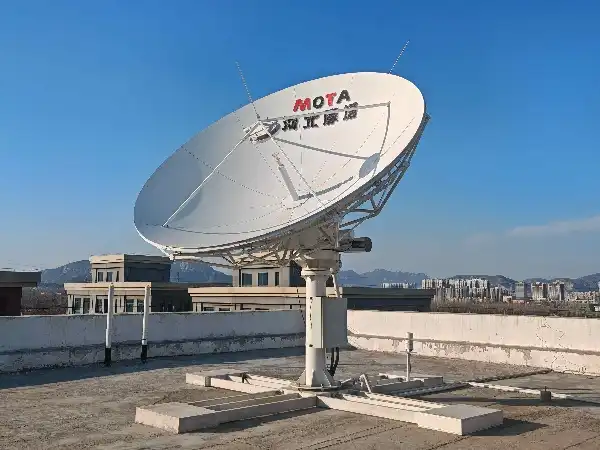
A satellite antenna maintains precise alignment by combining a rigid structure, accurate drive motors, sensor feedback, and software that corrects drift. A high-precision fixed satellite antenna starts with a stiff reflector and mount, acquires the satellite signal, and then holds that position while wind, heat, and vibration push it off target.
A three-axis stabilizer measures the deviation and corrects it in real time. Scheduled checks keep the pointing accurate over years. Below, I explain each step, compare antenna types, and share practical buying advice for research teams and ground-station operators.
Understanding Satellite Antenna Alignment: Fundamentals and Challenges
What Precision Means for a Fixed Antenna
Precision in a fixed antenna means how close the beam stays on the satellite over time, not just how well the installers aim it on the first day. Because its beam is wide and the link has extra room, a standard dish that is used for most things can handle a pointing error of a few tenths of a degree.
A high-precision fixed satellite antenna works with a lot more accuracy. Our model says that the error in satellite alignment is ≤0.1° and the noise level is ≤0.8dB. These two numbers show how accurate the point is and how sensitive the receiver is. Before approving a plan, study teams usually check both of them.
Why Small Angle Errors Matter
When you look at angles from far away, they look very small. Since a geostationary satellite is about 35,786 km above the equator, a mistake of 0.1° means that the satellite has moved about 62 km. As frequency and dish size go up, beamwidth goes down. A common guess is 70 times the wavelength times the diameter.
That gives a beamwidth of about 0.73° for a 2.4-meter dish at 12 GHz. Then there is pointing loss, which is about 12 times (error ÷ beamwidth)² in dB. This means that a 0.1° error costs about 0.2 dB. The beam gets narrower at Ka band or on a 13 m dish, and the same mistake costs more.
What Pushes an Antenna Off Target
A beam moves because of several factors after it is put in place. When wind blows, the mirror and mount get twisted. Changes in temperature make metal grow and shrink. Because steel grows about 12 micrometers per °C and aluminum about 23 micrometers per meter per °C, structures that are mixed will shift in different ways. Foundations settle, and gears and bearings wear out and move out of place.
A fixed offset is added by a bad installation, like a base that isn't level or fasteners that aren't tight enough. Software can't fully hide this offset. Even though each factor is small on its own, they all add up. Because of this, precision work needs more than just one careful setup. It needs a design margin, regular measurements, and active correction.
How High-Precision Fixed Satellite Antennas Achieve Accurate Alignment
Motors, Servo Loops, and Sensor Feedback
In general, the mechanical core is made up of a set of drive axes. Each one has a precise motor, a low-backlash gear train, and an encoder that tells the computer where it is in space. A servo loop changes the motor current many times a second by comparing the angle that was told to move with the angle that was actually moved. Sensors make people more aware of the platform itself.
Inclinometers measure tilt against gravity, and gyroscopes measure spin rate. This lets the controller tell the difference between real drift and shaking. Our high-precision fixed satellite antenna has a three-axis high-precision self-stabilizing platform that automatically fixes any alignment problems that happen. If you keep giving feedback, a one-time pointing result will become stable.
Automated Calibration and Error Correction
Acquiring something is the first step in pointing. Once the system has found where the satellite is thought to be, it reads the strength of the signal it got and moves the axes toward the peak to finetune the angle. Our design uses a self-made high-precision pointing method to align the satellites in just two minutes, and the built-in plug-and-play plan gets rid of the need for complicated debugging steps.
Once lock is done, error correction continues. Usually, software checks the signal against the expected peak and makes small adjustments, while the stabilizer stops the platform from moving. Calibration against a known satellite on a regular basis removes any drift that has built up. This combination keeps the link stable during long runs for data and telemetry reception when no one is around.
How C, Ku, and Ka Bands Change Alignment Demands
The frequency determines how much the beam can bend. The C band, which is between 4 and 6 GHz, makes a wide beam that can handle more pointing error. Ku band, which is between 11 and 14 GHz, makes the wave narrower. At about 20 to 30 GHz, the Ka band makes it even narrower and requires a more precise reflector surface.
Since rain fade gets worse with frequency, Ka links lose more signal when it rains a lot. With manual switching, our antenna works with the Ku, Ka, S, X, C, and Qv bands and has openings of 13, 11, 9, 7.3, 6.2, 5.4, 4.5, 3.3, and 2.4 m. Match the band and aperture to the amount of money you have to spend on pointing, not just on links.
Comparing High-Precision Fixed Satellite Antennas with Other Types
Fixed Versus Mobile Alignment Requirements
Because a fixed antenna is stable and only points to one spot in the sky, every design choice can affect how stiff it is, how well it handles heat, and how well it points. It's important for a mobile or on-the-go terminal to keep tracking even if its platform tilts, rolls, or turns. It gives up some aperture and accuracy for fast motion correction and a small size.
Bigger reflectors, like the 13 m option we offer, can also be used with fixed systems. These have a narrow beam and a high gain. Smaller dishes or flat panels with wider beams are often used for mobile systems. It makes sense to have a stable system if your station stays in one place and data quality is more important than movement.
Evaluating Brands and Models Without Guesswork
There are a lot of buyers who want a list of 2024 leaders. Because the right model depends on band, aperture, site conditions, and pointing budget, and published rankings rarely test those things, I don't rank brands. I think you should compare all of the candidates by making a short list that includes their stated pointing error, noise figure, wind and temperature ratings, ingress protection, first sidelobe level, transceiver isolation, and test methods that are written down.
You can find our high-precision fixed satellite antenna with a range of specs: ≤0.1°, ≤0.8dB, 7-level wind, -30°C to +55°C, IP66, ≥90dB isolation, and ≤-18dB first sidelobe. Get the same information from all of your suppliers and ask them how they got it.
Matching Antenna Type to Budget and Mission
What's the best way to make budget decisions? Connect cost to mission risk. A research station that gets data from remote sensing or sends commands to a satellite can't use a link that drops during a pass. This is why the cost of a larger fixed aperture with tight pointing is worth it.
A temporary field team might like a movable computer and be okay with less accuracy. Our design includes a high-precision LNB/BUC, a high-speed modem, and a signal processing module. This means you don't have to find and test as many separate parts. Pick an aperture that fits the gap between your links, and then make sure that the mount can still point accurately at that size.
Practical Guide to Procuring High-Precision Fixed Satellite Antennas
Specifications to Put in Your Technical Requirements
A clear list of needs keeps disagreements from happening later. Start with goals that can be measured, such as the accuracy of the pointer, the noise figure, the frequency bands, the aperture, and the outdoor area. Add the interfaces you need, like modem protocols and monitoring ports, and make a list of the documents you want, like a technical white paper, test reports, and proof of intellectual property.
Figure out how the acceptance testing will work and who will provide the satellite for checking. When you ask for custom work, say what might be different. When it comes to hardware design, interface protocols, functional modules, and software interfaces, we can do everything from scheme design and prototyping to mass production as an ODM or OEM service.
Installation, Maintenance, and Warranty Planning
The level of accuracy in pointing depends on how well the installation was done. The bases must be stable and level, the wires must be protected from the weather, and grounding must be done according to the rules in your area. Fixed offsets are taken care of during professional commissioning with a calibration pass against the target satellite.
Plan your repair so that you check the seals, bolts, and drive parts, and do a point check after bad weather. We offer online technical help 24 hours a day, seven days a week for system changes, installation, and assistance. International standards say that our goods come with a full-unit guarantee, and we offer flexible payment plans. Cooperative channels are used for localized support, such as on-site service and spare parts.
Checking Supplier Credentials and Lead Times
This is what a supplier's credentials say about how they work. ISO9001, ISO14001, and ISO45001 management system standards show that MOTA has been making things for nine years. In our product description, we also say that the production standards are military-grade and are approved by GJB 9001C. Ask any supplier for proof that is equivalent, and keep an eye on how quickly they respond when you ask for a quote.
Make your plans early. For regular sales, we keep stock on hand, but it takes 45–90 days to make special and large-scale systems. Be clear about when your delivery is due if it needs to happen during a launch or test time. This way, we can plan around it. Our cross-border logistics include tracking from start to finish and packaging that is resistant to shock and moisture.
Case Studies and Real-World Applications of High-Precision Fixed Satellite Antennas
Scientific Research and TT&C Ground Stations
Fixed ground antennas are used for tracking, telemetry, and control by research institutes and satellite operators. They also receive data from assets in orbit. Pointing is very important for a command link to a geostationary satellite; a 0.1° mistake can break a link with very little room for error. The ≤0.1° alignment and ≤0.8dB noise figure of our high-precision fixed satellite antenna make it good for these jobs.
It can also work in temperatures ranging from -30°C to +55°C, which is good for remote observatory sites. The three-axis stabilization makes up for things in the environment that might cause measurement errors. These are application situations, and during technical talks, we go over the details of each project one by one.
Offshore and Remote Infrastructure Links
Fiber isn't always available on offshore bases and other faraway industrial sites, so the data trunk is sent through a fixed satellite link. Salt air, dust, and rain damage hardware that is left out in the open. Our antenna has an IP66 rating, which means it can handle water, dust, and corrosion.
Under 7-level wind, which the Beaufort scale says is 50 to 61 km/h, the design can send stable 4K video and accurate data. Teams can't go to these places very often, so less upkeep work means lower running costs. When you use stable pointing, you also protect the high-capacity data trunk that your daily activities depend on.
Monitoring and Broadcast Backhaul
High-end monitoring stations send 4K video from places with weak terrestrial links. Frames that get stuck and packets that get lost are signs of alignment drift there. In bad weather, our antenna provides stable 4K high-definition backhaul. Transceiver isolation of ≥90dB and a first sidelobe level of ≤-18dB help keep things clean in places with a lot of electromagnetic activity. Sidelobe performance is linked to interference rules that operators follow, like ITU-R S.580 and FCC 25.209, so make sure that each supplier writes down the radiation patterns for your band.
Conclusion
Several layers must work together for accurate alignment of the high-precision fixed satellite antenna. The base is made up of a rigid structure and precise drive axes. Sensors and servo loops provide constant feedback, and drift is fixed by calibration software. A 0.1° mistake is equal to about 62 km at geostationary distance, and it costs more signal at Ka band or on bigger dishes, so noise figure and aiming accuracy should both be taken into account.
Beams can get off target because of wind, changes in temperature, wear, and mistakes in the installation, so buyers should look at environmental ratings, documentation, and the credentials of the supplier along with pointing specifications. Mobile systems are better at handling motion, while fixed receivers like things to stay still and have narrow bands. This article talks about a MOTA system that has ≤0.1° alignment, three-axis stabilization, and a 2-minute lock for study, TT&C, offshore, and tracking uses.
FAQ
How often should I recalibrate a fixed satellite antenna?
Time gaps rely on the goal, band, and site. A lot of teams check the pointing when they do routine maintenance and after storms or building work. Because their beams are smaller, higher bands like Ka need more thorough checks. During the technical review, we made a plan with you.
How does the antenna handle wind and weather?
The three-axis stabilizer instantly fixes any aligning problems that happen. It is said that the antenna will work reliably in 7-level winds and at temperatures ranging from -30°C to +55°C. It is also protected against water, dust, and corrosion with grade IP66.
How long does a custom order take?
Regular orders are met by ready stock. Customized and large-scale systems are made in 45 to 90 days, but the exact time frame relies on the opening, bands, and communication needs. Let us know early on when you plan to start or test, so we can make plans around it.
Talk to MOTA About Precise Alignment for Your Ground Station
Are you looking for a high-precision fixed satellite antenna maker who can meet your delivery, aiming, and noise figure goals? When it comes to custom and large systems, MOTA offers 45–90 day production cycles, 7x24 remote technical support, and ODM/OEM customization. Send your needs for band, aperture, and schedule to hebei_mota@163.com, and our engineers will get back to you with a detailed plan. If you want to know more, go to motasat.com.

References
1. Satellite Communications, 4th Edition, Dennis Roddy, 2006
2. Antenna Theory: Analysis and Design, 4th Edition, Constantine A. Balanis, 2016
3. Satellite Communications Systems: Systems, Techniques and Technology, 6th Edition, Gérard Maral and Michel Bousquet, 2020
4. ITU-R Recommendation S.580-6: Radiation Diagrams for Use as Design Objectives for Antennas of Earth Stations Operating with Geostationary Satellites, 2004
5. Title 47 Code of Federal Regulations §25.209: Earth Station Antenna Performance Standards, Federal Communications Commission, 2023
6. Satellite Communication Engineering, 2nd Edition, Michael Olorunfunmi Kolawole, 2013
Tell us your requirements – get a tailored quote and technical support within 24 hours.