- English
- French
- German
- Portuguese
- Spanish
- Russian
- Japanese
- Korean
- Arabic
- Greek
- German
- Turkish
- Italian
- Danish
- Romanian
- Indonesian
- Czech
- Afrikaans
- Swedish
- Polish
- Basque
- Catalan
- Esperanto
- Hindi
- Lao
- Albanian
- Amharic
- Armenian
- Azerbaijani
- Belarusian
- Bengali
- Bosnian
- Bulgarian
- Cebuano
- Chichewa
- Corsican
- Croatian
- Dutch
- Estonian
- Filipino
- Finnish
- Frisian
- Galician
- Georgian
- Gujarati
- Haitian
- Hausa
- Hawaiian
- Hebrew
- Hmong
- Hungarian
- Icelandic
- Igbo
- Javanese
- Kannada
- Kazakh
- Khmer
- Kurdish
- Kyrgyz
- Latin
- Latvian
- Lithuanian
- Luxembou..
- Macedonian
- Malagasy
- Malay
- Malayalam
- Maltese
- Maori
- Marathi
- Mongolian
- Burmese
- Nepali
- Norwegian
- Pashto
- Persian
- Punjabi
- Serbian
- Sesotho
- Sinhala
- Slovak
- Slovenian
- Somali
- Samoan
- Scots Gaelic
- Shona
- Sindhi
- Sundanese
- Swahili
- Tajik
- Tamil
- Telugu
- Thai
- Ukrainian
- Urdu
- Uzbek
- Vietnamese
- Welsh
- Xhosa
- Yiddish
- Yoruba
- Zulu
How to Choose a Fixed Satellite Antenna for an Existing Video Surveillance System
Choosing a fixed satellite antenna for a working surveillance network is about fit, not horsepower. Installers have lost a month because a dish came with the incorrect feed flange or a noise figure that seemed great on paper failed on a humid afternoon. A high-definition monitoring fixed satellite antenna that slips into your camera, encoder, and NVR chain and stays connected despite wind, rain, and temperature changes is what you need. Before signing a purchase order, I ask technical, practical, and commercial questions.
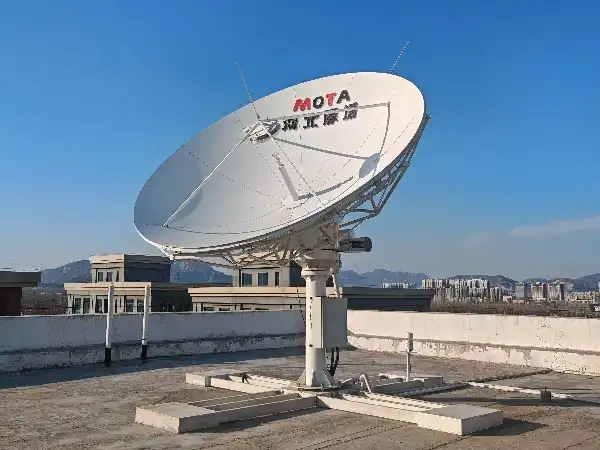
Understanding Fixed Satellite Antennas for HD Video Surveillance
How a Fixed Reflector Carries Camera Video to a Control Room
Pole-mounted cameras don't relay video alone. A block upconverter sends the IP stream from the camera to a transponder 35,786 km above the equator from the dish. A stationary antenna targets one satellite. After commissioning, azimuth, elevation, and polarisation are locked. The camera observes a gate, the dish watches a satellite, and the connection operates unattended for years, making monitoring suitable. Vehicles and boats have tracking mounts, but motors bring only maintenance to fixed sites.
Frequency Bands That Decide How Much Video You Can Push
Throughput, dish size, and rain margin depend on band choice. Ku-band (12–18 GHz) surveillance backhaul is popular because to its small reflectors, extensive transponder availability, and predictable rain fading. Ka-band (26.5–40 GHz) transports more data per hertz but loses signal in a rainstorm, requiring a greater connection buffer based on local rainfall statistics. Storms don't bother C-band (4–8 GHz), although a bigger dish and terrestrial microwave lines may interfere. X, S, and Q/V bands serve government, mobile, and high-capacity. One platform may support many projects with a manual feed switching multi-band antenna.
The Numbers That Decide Whether the Picture Survives
The gain and G/T ratio are indicators of how well a dish can detect weak signals. With a 2.4 m Ku-band reflector, the 3 dB beamwidth is 70 times wavelength divided by diameter which works out to 0.7°. For a 13 m reflector, the beamwidth is 0.13°. The mount must be properly aimed. 90 db isolation transmitters don’t deafen receivers. Operators assessing emissions before allowing access should consider a primary sidelobe below -18 dB to minimise radiation reaching other satellites. The noise figure of less than 0.8 dB protects the weak signal before it is detected by the modem.
Key Criteria for Choosing the Right Fixed Satellite Antenna
Match the Antenna to the Site, Not the Catalog
First Earth. The border checkpoints in Inner Mongolia and maritime seaports encounter several factors, such as −30 °C cold, breeze-driven dust, salt and humidity. Check a satellite view angle for obstructions, confirm enclosure rating. My minimum exterior protection is IP66, dust-tight and strong water jet protection according to IEC 60529. Operating range should include extremes of the location (−30 °C to +55 degrees Celsius for continental and tropical construction, but not alpine winters). Operating wind (where signal must be maintained) and survival wind (where the dish may lose lock but not fail) should be separated for structure ratings.
Integration With the VMS and NVR You Already Run
A trusted recorder chain has a high-definition monitoring fixed satellite antenna. Transparent ethernet bridge? If yes, cameras preserve ip address, NVRs record, satellites have lengthy connections. Use ONVIF Profile S to feed discovery and streaming services, RTSP for direct pulls, and jitter as well as packet loss control since TCP video returns slowly over high-latency lines. Several projects fail because the radio is working, but the recording server can’t see the stream due of VLAN, MTU or codec incompatibility. Test your NVR equipment before you bid.
Maintenance, Warranty, and the Five-Year Bill
It costs a fraction of what the owner spends over time. Ask about the inspection frequency for a fixed dish with a coated reflector. A visual check and signal re-verification every 24 months is typical, with more regular inspections in salt-spray or heavy-snow zones. Reflectors and mounts have longer warranties than modems and upconverters, so check. Who provides spare LNBs, feed windows, and cables quickly? Suppliers that offer spare-part lists and service response times strengthen your application as owners increasingly rate five-year operational cost. Saving 5% on hardware seldom compensates a two-week border site downtime.
Comparing Fixed Satellite Antennas: Key Differences and Market Options
Fixed Versus Tracking Mounts
Fixed mounts are easier. They win. Fewer points of failure, no generators, encoders, control loop. That is the correct engineering option for a single geostationary satellite pointing camera tower. Tracking mounts only cost when the structure or satellite moves – for warships, vehicles, or low-earth-orbit constellations.
The intermediate situation of a stationary reflectors on a three-axis stabilised platform is of interest. The dish is still pointed at a single satellite, but the mount compensates for wind gusts and structural movement to keep a 4K stream from stuttering on a windy mountain. Ask how the asset maintains aiming accuracy in sustained winds over 25 mph.
Reading a Datasheet Without Being Fooled
Most of the figures on the spec sheet are not measured, they are calculated, thus the difference counts at bid time for your high-definition monitoring fixed satellite antenna. Which are now from a test range, and which are from a spreadsheet? Ask for the sidelobe assertion antenna arrangement plot and noise estimation technique.
Antenna gain and aperture size for Ku-band are 40 dBi for an a length of reflector along with 45 dBi for a 4.5 m. Any claims outside that pattern require a test report. Video bit rate ought to match resolution standard and frame rate, not just ‘4K ready.’ Ask for end-to-end latency metrics per encoder and connection.
Cost Structure and Volume Reality
A satellite antenna quote consists of: Reflector Mount Feed and switched mechanism Upconverter and LNB Modem Cabling Commissioning help Level the playing field by separating the hardware and service lines. Some firms hate one to 10 piece project volumes. Enquire about minimum order and price reductions for 10, 25 and 50 items. 5-10% for spares should be budgeted for remote sites: one LNB as well as one modem in country will give you greater uptime than a lower unit pricing.
Installation Practices for Fixed Satellite Antennas in Video Surveillance
Site Survey and Foundation Work
Research before buying. Check the satellite's azimuth and elevation, then look for obstacles: trees grow, buildings develop, and a clean view in January may not last July. Verify foundation soil carrying capability and design for survival wind load, not working load. Prepare a grounding system before the first cable arrives; ridges and border posts constitute a direct mast hit danger. Use conduit with a drip loop and leave service slack. Many locations use solar and battery power, so check actual demand, including heaters, against the power budget.
Alignment, Commissioning, and Acceptance Testing
Project schedules slip during alignment. An expert team with a spectrum analyser may spend an hour each location; a custom pointing process takes minutes. Some high-definition monitoring fixed satellite antennas can align and join in 2.5 minutes, changing the economics of a 20-site deployment. Write an acceptance test into the contract for any tool: carrier-to-noise or Eb/No over a threshold, packet loss below a figure, timestamped delay, and a 72-hour soak with cameras. Commissioning day baseline data allow technicians to compare subsequent faults to reality.
Accessories, Troubleshooting, and Long-Term Care
My link problems were mostly not antenna faults. They included water in a connection, corroded ground, dusty feed windows, and cable runs that exceeded loss budgets. Install waterproof connectors, utilise cable with documented loss at the working frequency, and have a jumper on hand. Start with power, then cable loss, then pointing, then the LNB, then the reflector as signal quality lowers. Radomes blast sand and heavy snow with little expense. Log signal strength weekly for the first year; a steady decline indicates moisture or drift before the image collapses.
Procurement and Supplier Insights for Fixed Satellite Antennas
Vetting a Manufacturer Beyond the Certificate Wall
Certificates open the door; the factory floor decides the outcome. These are the core points I check on a supplier audit, whether in person or by video walkthrough.
• Ask for the calibration records behind the test equipment used for pattern and gain measurements. An uncalibrated range still produces confident numbers, and those numbers become your problem when a client requests a repeat test after installation. Records should be dated and traceable to a metrology standard.
• Ask to see the reflector lay-up and curing process if the dish uses composite material. Process control, not a final inspection step, is what makes the surface accurate and stable over time. Root-mean-square surface error is usually smaller at factories that can show mold maintenance logs and cure schedules.
• Ask which parts are machined in-house and which are subcontracted. The answer predicts how a supplier responds when you need thirty units in six weeks. Shops that control their own machining and finishing can compress a schedule; assemblers of purchased kits can only forward your email and wait.
Samples, Demos, and Evidence That Survives a Bid
Once in a technical variance table, specification numbers are contractual. Get confirmation before you commit. Ask for a demo device and test your own cameras with it: two 4K streams at 60 fps, a 48-hour NVR, and a latency check viewable on the clock. Ask for a vendor signed acceptance procedure with test equipment and thresholds. Radio & TV type clearance and the level certification take time to evaluate so if your client requires domestic manufacturing or specific certifications check the documents early.
Lead Times, Custom Work, and Support Terms
Construction schedules do not include manufacturing delays. Fast shipping on standard stock configurations; 45 to 90 days for bespoke builds and large systems, so order to the acceptance a turning point, not the kick-off meeting. Ask about delivery putting on and find out what happens if the location is not ready. Confirm what may be customised (housing colour, trademark, interface protocol, software branding) as well as which target market qualifications the supplier has for OEM work. “Document response time, remote testing access, spare-part lead time, and partner-supplied technical assistance in country.
Conclusion
When four factors align, a surveillance system's high-definition monitoring fixed satellite antenna works. The band fits the site's rainfall and leased transponder. Your mount's aperture and beamwidth match its aiming precision. Isolation, sidelobe, and noise values are measured, not stated, and supported by tender documentation. Installation and support periods match your personnel and the owner's specified service life. The smallest fraction of a five-year bill, including commissioning, spares, and downtime, is hardware cost.
FAQ
Can one antenna serve several surveillance sites?
One antenna serves one satellite link. Several cameras can share that link if their combined bit rate fits the carrier you lease, so ten cameras at 20 Mbps each need roughly 200 Mbps of uplink capacity. Separate locations kilometres apart need separate reflectors.
Which band works best for outdoor HD monitoring?
Ku-band is the practical default for surveillance backhaul: it balances dish size, transponder availability, and rain margin. Choose Ka-band for higher throughput, C-band where storms are severe and space allows a bigger reflector, and X-band only when a government licence demands it.
How often should the antenna be serviced?
Plan a visual inspection and signal re-verification every 24 months, and every 12 months in coastal or heavy-snow regions. Check connectors, grounding, and the feed window at each visit, and record the measured signal level so drift becomes visible.
How do I verify the quoted latency?
Ask how the figure was measured, then reproduce it with your own encoder and recorder using a clock visible in frame. Compare the timestamp inside the recorded frame with your local clock; the difference is the real delay you will live with.
Talk to MOTA Before Your Next Surveillance Tender Closes
Bring your camera count, look angle, and acceptance criteria to MOTA. As a high-definition monitoring fixed satellite antenna manufacturer, Hebei Mota supplies 2.4 m to 13 m reflectors, multi-band feeds, and integrated modems with documentation you can attach to a bid. Email hebei_mota@163.com or visit motasat.com to request a spec sheet, a test report, and a quote for your project quantity.

References
1. ITU-R S.580-6: Toxicity Diagrams for Earth Station Antenna Design Objectives (2003).
2. ITU-R P.618-13: Diffusion Data and Prediction Methods for Earth-Space Telecommunication System Design (2017).
3. IEC 60529: Enclosure Protection Degrees (IP Code) (2013).
4. ASTM B 117-19: Standard Practice for Managing Salt Spray (Water) Apparatus (2019).
5. 2020 ONVIF Profile S Specification.
6. ITU-T Recommendation H.265: High-Efficiency Video Coding (2019).
Tell us your requirements – get a tailored quote and technical support within 24 hours.