- English
- French
- German
- Portuguese
- Spanish
- Russian
- Japanese
- Korean
- Arabic
- Greek
- German
- Turkish
- Italian
- Danish
- Romanian
- Indonesian
- Czech
- Afrikaans
- Swedish
- Polish
- Basque
- Catalan
- Esperanto
- Hindi
- Lao
- Albanian
- Amharic
- Armenian
- Azerbaijani
- Belarusian
- Bengali
- Bosnian
- Bulgarian
- Cebuano
- Chichewa
- Corsican
- Croatian
- Dutch
- Estonian
- Filipino
- Finnish
- Frisian
- Galician
- Georgian
- Gujarati
- Haitian
- Hausa
- Hawaiian
- Hebrew
- Hmong
- Hungarian
- Icelandic
- Igbo
- Javanese
- Kannada
- Kazakh
- Khmer
- Kurdish
- Kyrgyz
- Latin
- Latvian
- Lithuanian
- Luxembou..
- Macedonian
- Malagasy
- Malay
- Malayalam
- Maltese
- Maori
- Marathi
- Mongolian
- Burmese
- Nepali
- Norwegian
- Pashto
- Persian
- Punjabi
- Serbian
- Sesotho
- Sinhala
- Slovak
- Slovenian
- Somali
- Samoan
- Scots Gaelic
- Shona
- Sindhi
- Sundanese
- Swahili
- Tajik
- Tamil
- Telugu
- Thai
- Ukrainian
- Urdu
- Uzbek
- Vietnamese
- Welsh
- Xhosa
- Yiddish
- Yoruba
- Zulu
How to Choose the Right Mini Satellite Antenna System
The first step in selecting the right micro satellite antenna system is to figure out what your organization really needs. A mini fixed satellite antenna is a compact terrestrial Ku-band terminal for fixed deployment that provides a dependable, high-throughput connection without the bulk or price of traditional large-aperture dish. For small contractors, security integrators and rental fleet operators, the right solution will provide signal reliability, single-person setup, all-weather durability and a price point that makes project-level deployment financially realistic. In this essay we will walk you through all the crucial factors to consider before you purchase.
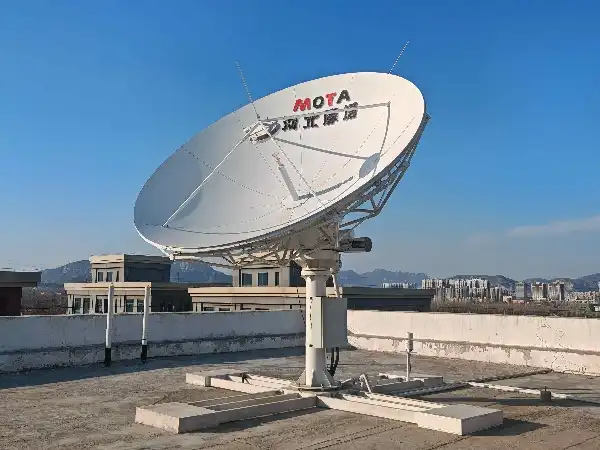
Understanding Mini Fixed Satellite Antenna Systems
How Fixed Ku-Band Terminals Differ from Mobile Alternatives
A fixed satellite terminal is designed for steady, repetitive operation at a defined geographic point. Unlike vehicle-mounted, auto-tracking mobile antennas, a fixed system locks onto a geostationary orbital slot and passively maintains that alignment – intrinsically more stable and far less costly. It also has a lesser rain-fade risk than the higher frequencies but still provides a greater satellite availability than Ka-band. It also has a vast modem ecosystem to choose from.
The size of the aperture directly controls gain. Ku-band transponders provide enough capacity for 1080p video backhaul and data communications using a 1.8m mini fixed satellite antenna dish. A 2.4m aperture provides around 2.5 dB more gain, which is significant in high latency or marginal EIRP areas. Both sizes remain portable by a 2 person crew, or a solo operator with minor equipment assistance, a vital benefit over 3.0m+ infrastructure dishes.
Compact aperture terminals have been more and more used in the enterprise and government verticals to reduce the civil works costs while keeping the sidelobe performance compliant with ITU-R S.580, based on the findings of the ITU Radiocommunication Sector on fixed-satellite service planning.
Key Criteria for Choosing the Right Mini Fixed Satellite Antenna
Procurement decisions at the project manager level rarely hinge on a single specification. The real evaluation covers multiple interdependent factors. Here are the core criteria worth scrutinizing before you sign a purchase order:
- Frequency band and transponder compatibility: Confirm the antenna's feed and BUC/LNB configuration matches your intended satellite plan. Ku-band coverage maps vary by region; always validate EIRP contours against your deployment geography.
- Setup time and operator requirements: For temporary communication points or rapid-response scenarios, a system requiring specialized RF technicians creates scheduling risk. A genuinely field-deployable unit should reach operational status within minutes through a single trained operator, without external calibration tools.
- Wind load and environmental ratings: The Electronics Industries Alliance's EIA-222 structural standard sets wind survival benchmarks for antenna mounts. Verify that the system you're evaluating can sustain operational signal quality—not merely survive—under the wind conditions typical to your project sites.
- Anti-interference performance: Transceiver isolation ≥80 dB and a first sidelobe level ≤-12 dB are the ITU-compliant benchmarks that protect adjacent satellite operators and preserve your own link integrity in spectrally congested environments.
- Logistics footprint: Shipping volume and crate weight directly affect freight cost per unit, which matters acutely when deploying multiple nodes across a distributed project.
These criteria collectively define whether a compact satellite terminal is a practical field asset or an underperforming compromise. Matching all five to your actual use case is what separates a confident purchase from an expensive lesson.
Comparing Mini Fixed Satellite Antennas with Other Satellite Antenna Types
Fixed vs. Large-Aperture Dishes
A 4.5m or 7.3m hub antenna offers superior gain and supports higher symbol-rate carriers, but it demands engineered foundations, crane installation, and dedicated RF staff. For branch-site connectivity or temporary project offices, that infrastructure overhead is disproportionate. A 1.8m or 2.4m fixed terminal achieves workable throughput at a fraction of the total installed cost.
Fixed vs. Mobile Auto-Tracking Antennas
Mobile stabilized antennas—whether maritime VSAT domes or land-mobile flyaway systems—add gyroscopic stabilization hardware that increases cost substantially. When your deployment location is fixed, even temporarily, that stabilization overhead buys nothing. A well-designed mini fixed satellite antenna with a single-axis stabilizing platform and an embedded pointing algorithm handles wind-induced vibration without the mechanical complexity of a full three-axis drive.
Fixed vs. VSAT Micro-Terminals
Modern flat-panel VSAT micro-terminals (under 60 cm) are aesthetically compact but sacrifice aperture efficiency. In Ku-band, smaller aperture means lower G/T ratio and reduced uplink EIRP, which translates to narrower transponder options and higher per-megabit lease costs. A 1.8m parabolic reflector consistently outperforms a 45 cm phased-array panel on raw throughput economics for bandwidth-intensive applications like 1080p video backhaul.
Installation and Deployment Best Practices
Site Assessment and Mounting
Effective deployment starts before you unpack the crate. Verify clear sky visibility to the target orbital arc, accounting for obstructions above the elevation angle. Confirm that the mounting surface—whether ground plate, rooftop parapet, or vehicle flatbed—can absorb the antenna's torque load under rated wind conditions.
A well-engineered compact terminal streamlines this process considerably. The MOTA mini fixed satellite antenna, available in 1.8m and 2.4m apertures, incorporates pre-calibrated mounting hardware and integrated signal quality indicators that guide a single operator from physical positioning to live link in approximately two minutes. The built-in satellite pointing algorithm handles fine azimuth and elevation correction autonomously, eliminating the need for a spectrum analyzer during initial acquisition.
Troubleshooting Signal Degradation
When link quality drops unexpectedly, the most common culprits are feed alignment drift, connector oxidation at the BUC interface, or localized multipath from nearby structures. A system with ≥80 dB transceiver isolation inherently resists the most frequent interference scenarios. If rain fade is a recurring issue in your geography, a 3–5 dB uplink margin buffer in your transponder plan provides meaningful resilience without requiring hardware changes.
Selecting a Trusted Mini Fixed Satellite Antenna Supplier
What to Look for Beyond Price
A competitive unit price means little if lead times are unpredictable or post-sale support is inaccessible. Verified quality certifications—ISO 9001, ISO 14001, ISO 45001, and GJB 9001C military-standard compliance—indicate that a manufacturer operates under audited production discipline, not just claimed performance. According to a 2023 Frost & Sullivan analysis of VSAT equipment procurement trends [3], B2B buyers consistently ranked after-sales responsiveness and parts availability above initial unit cost when evaluating total procurement risk.
MOTA (Hebei Mota Electronics Technology Co., Ltd.) has accumulated nine years of manufacturing experience in satellite communication antenna systems. The company holds ISO 9001, ISO 14001, and ISO 45001 certifications, maintains GJB 9001C compliance, and carries domestic type approval for radio transmission equipment. Each antenna undergoes radiation pattern measurement, far-field range testing, salt spray simulation, vibration testing, and hydrophobic coating integrity verification before shipment.
Ready stock availability supports standard orders immediately, while customized or large-scale systems carry a 45–90 day production cycle. A 7×24 customer response mechanism and established cross-border logistics partnerships—covering international dedicated lines, sea freight, and air freight with professional shockproof and moisture-proof packaging—reduce the delivery risk that often frustrates small B2B buyers. ODM and OEM customization is available, adapting hardware design, interface protocols, and regional certifications to match specific market requirements. Explore the full product portfolio at motasat.com.
Conclusion
Selecting the right compact satellite terminal comes down to aligning technical specifications with real operational requirements. Aperture size, frequency band, anti-interference performance, setup time, and supplier reliability each carry weight in a sound procurement decision. For small contractors and rental operators who need cost-effective, rapidly deployable Ku-band connectivity, a purpose-built 1.8m or 2.4m mini fixed satellite antenna outperforms both undersized micro-terminals and overengineered mobile tracking systems. Vetting your supplier's certifications, stock position, and after-sales infrastructure is as important as evaluating the antenna itself.
FAQ
1. What aperture size should I choose for 1080p video transmission?
A 1.8m aperture handles stable 1080p video backhaul on most Ku-band transponders under typical atmospheric conditions. If your deployment site sits at the edge of a satellite's coverage contour or if you require a higher margin buffer for adverse weather, the 2.4m aperture provides approximately 2.5 dB additional gain—worth the incremental logistics cost for mission-critical links.
2. Can one person realistically install this antenna without RF training?
Yes. The MOTA mini fixed satellite antenna integrates pre-calibrated mounting hardware, a built-in satellite pointing algorithm, and onboard signal indicators that guide the operator through alignment. Full link establishment takes approximately two minutes under normal field conditions.
3. What does transceiver isolation ≥80 dB actually mean for my operation?
It means the transmit signal does not bleed into the receive path at levels that would degrade your incoming data stream—even when transmitting and receiving simultaneously on adjacent polarizations. This specification is critical in congested frequency environments where multiple systems operate in proximity.
4. Is ready stock available for immediate shipment?
MOTA maintains sufficient inventory to fulfill standard orders promptly. Contact the team to confirm current stock levels and lead times for your required quantity.
Get a Quote from MOTA — Mini Fixed Satellite Antenna Supplier
MOTA's compact Ku-band terminals ship from verified stock with full ISO and GJB certifications, 7×24 technical support, and professional cross-border logistics. Whether you need a single unit for project validation or a bulk order for a rental fleet, our team delivers competitive pricing and flexible payment terms. Reach out today at hebei_mota@163.com or visit motasat.com to request specifications and a tailored quotation for our mini fixed satellite antenna solutions.

References
1. International Telecommunication Union – Radiocommunication Sector. (2022). Recommendation ITU-R S.580-6: Radiation diagrams for use as design objectives for antennas of earth stations operating with geostationary satellites. ITU.
2. Telecommunications Industry Association. (2017). ANSI/TIA-222-H: Structural Standard for Antenna Supporting Structures and Antennas. TIA.
3. Frost & Sullivan. (2023). Global VSAT Equipment Market: Growth Opportunities and Procurement Trends. Frost & Sullivan Research.
4. Northern Sky Research (NSR). (2023). VSAT and Broadband Satellite Markets, 16th Edition. NSR.
5. Federal Communications Commission. (2021). Fixed Satellite Service: Technical Rules and Licensing Requirements. FCC.
6. Intelsat. (2022). Ku-Band Satellite Communications: Coverage, Performance, and Application Guide. Intelsat Technical Publications.
Tell us your requirements – get a tailored quote and technical support within 24 hours.