- English
- French
- German
- Portuguese
- Spanish
- Russian
- Japanese
- Korean
- Arabic
- Greek
- German
- Turkish
- Italian
- Danish
- Romanian
- Indonesian
- Czech
- Afrikaans
- Swedish
- Polish
- Basque
- Catalan
- Esperanto
- Hindi
- Lao
- Albanian
- Amharic
- Armenian
- Azerbaijani
- Belarusian
- Bengali
- Bosnian
- Bulgarian
- Cebuano
- Chichewa
- Corsican
- Croatian
- Dutch
- Estonian
- Filipino
- Finnish
- Frisian
- Galician
- Georgian
- Gujarati
- Haitian
- Hausa
- Hawaiian
- Hebrew
- Hmong
- Hungarian
- Icelandic
- Igbo
- Javanese
- Kannada
- Kazakh
- Khmer
- Kurdish
- Kyrgyz
- Latin
- Latvian
- Lithuanian
- Luxembou..
- Macedonian
- Malagasy
- Malay
- Malayalam
- Maltese
- Maori
- Marathi
- Mongolian
- Burmese
- Nepali
- Norwegian
- Pashto
- Persian
- Punjabi
- Serbian
- Sesotho
- Sinhala
- Slovak
- Slovenian
- Somali
- Samoan
- Scots Gaelic
- Shona
- Sindhi
- Sundanese
- Swahili
- Tajik
- Tamil
- Telugu
- Thai
- Ukrainian
- Urdu
- Uzbek
- Vietnamese
- Welsh
- Xhosa
- Yiddish
- Yoruba
- Zulu
Low-Profile Fixed Satellite Antenna vs. High-Profile Antenna: Key Differences
A low-profile fixed satellite antenna differs from a high-profile antenna mainly in height, wind exposure, and visual impact. A high-profile dish, usually a parabolic reflector, stands out from a roof or wall and catches more wind. A slim, flush-mounted unit sits close to the surface. The MOTA design measures 3cm or less, so it blends into rooftops, balconies, and exterior walls. Both types can work in the Ku band, but the thin form often passes property reviews more easily, while a traditional dish builds gain through a larger, deeper reflector. This guide compares the two so you can choose with confidence.
I wrote this for installers, distributors, and building-product buyers in the United States who have heard "no" from a homeowners' association or a city planner. I cover design basics, real differences, uses, installation, and a buyer's checklist.
Understanding Low-Profile Fixed Satellite Antennas and High-Profile Antennas
What a Low-Profile Fixed Satellite Antenna Is
A low-profile fixed satellite antenna is a thin, flat end that stays in one place and doesn't stick out too far from the surface. Our MOTA type is no more than 3 cm thick and can be used on roofs, porches, and outside walls. It works in the Ku band, which is between 10.7GHz and 12.75GHz, and has a noise figure of 1.1dB or less and a receiver separation of 82dB or more. The apertures are 4.5m, 3.3m, and 2.4m in size. "Fixed" means that you set it up by hand only and don't use a motor to follow a moving target. That works well for places like homes and small offices where the satellite doesn't move.
What Counts as a High-Profile Antenna
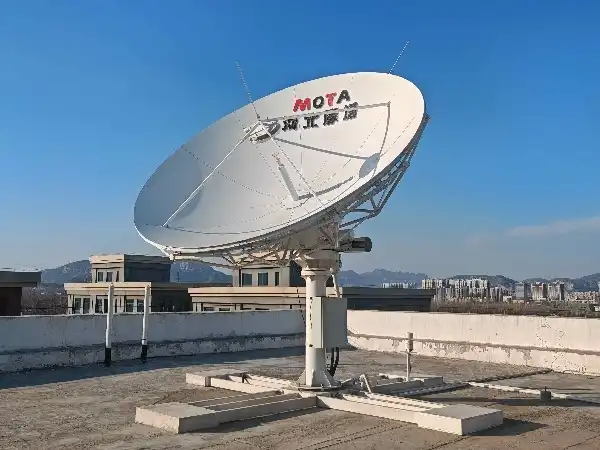
Most people think of a dish with a high-profile antenna. On a mast or bracket, there is a parabolic reflector. An arm with a feed horn and a low-noise block downconverter (LNB) hangs out front. The signal is focused on the feed by the curved surface, which makes the design easy to use and effective. It comes down to depth and height. The dish sticks out from the wall a long way, and its big face makes it look like a sail. Small dishes for homes are easy to move, but dishes made for more gain get bigger quickly, and so do the plates that go with them.
How Each Design Handles Signal Gain
Gain is mostly determined by the opening size. Standard antenna theory says that doubling the diameter of a reflector makes its area four times bigger, which adds about 6dB of gain at the same frequency and efficiency. That's why classic meals get bigger when a link needs more space. Instead, a low-profile design hits its mark with its aperture choices and quiet front end. With a noise level of 1.1dB or less, our unit pairs aperture sizes of 2.4m, 3.3m, and 4.5m. Receivers can pick up weak Ku-band messages better when there is little noise. Both designs still need to be able to see the satellite clearly.
Key Differences Between Low-Profile and High-Profile Satellite Antennas
Size, Weight, and Wind Load
This is the first difference you notice: height for the low-profile fixed satellite antenna. This is also the first difference an inspection will ask about: wind load. ASCE 7 and other building codes say that wind pressure is equal to the square of wind speed. This means that a gust of wind twice as strong pushes four times as hard.
That force is caught at the end of a long lever arm by a deep dish on a tall mast. A thin panel that is 3 cm or less has little depth and sits close to the surface, which makes the screws work less hard. Even so, you should have a qualified engineer look at the mounting loads for your site because the bigger aperture sizes have more surface area.
Performance, Frequency, and Interference
Since both types can work in the Ku band, frequency alone doesn't always make the difference. How each one meets its performance goal is what makes them different. Our low-profile model works with frequencies between 10.7GHz and 12.75GHz and has a noise figure of 1.1dB or less and transceiver isolation of 82dB or more.
Because the send path is close to the receive path and leaks can drown out a weak signal, isolation is important. For traditional dishes, a big reflector and a different feed give them a lot of gain. To get rid of obstacles, dealers often add a mast. Both designs don't get around the fact that Ku-band signals are blocked by things like trees, parapets, and nearby buildings, so check the sky path first.
Durability, Maintenance, and Lifecycle Cost
Gear used outside has to deal with dust, rain, ice, and sun. The grade for our antenna is IP65. In IEC 60529, the "6" means that the door is dust-tight, and the "5" means that it is safe from low-pressure water jets coming from any direction. It can also handle light hits. There is less gear to check on a flush mount dish than on a mast-mounted dish because the arms and frames are not as visible.
The power use is also very low: 5W or less when it's running and 1.0W or less when it's not. The total price includes the unit, the hardware for mounting it, the work, the friction plates, and more trips. A design that gets approved the first time and can be put in quickly saves more than just money.
Benefits and Practical Applications of Low-Profile Fixed Satellite Antennas
Why Approval Boards Prefer a Slim Profile
Many buyers in the US hit its looks limits before it hits its signal problems. A lot of the time, condo boards, historic districts, and homeowner associations care about how a dish looks from the street. The FCC's OTARD rule limits restrictions on some small antennas, but it only applies to certain types and sizes of antennas, and it lets rules related to safety or preserving history apply.
Before you think something applies, check each case. A low-profile fixed satellite antenna of 3cm or less that fits against the wall gives a board less to object to. Bring a mounting plan, real shots, and size drawings to the meeting. Most of the time, clear paperwork does more than just help with debate.
Where the Slim Design Fits Best
Here are the main situations where I think the slim format deserves to be used.
• Residential rooftops, balconies, and exterior walls: Apartment buildings and homes with strict rules about how they look benefit the most. Because it sits flat on the surface, the unit looks like a thin wall instead of a dish on a pole. Also, installers don't have to deal with as many mast parts, which can cut down on visits and callbacks.
• Commercial buildings and small offices: Property managers want to connect buildings without changing the way they look. Sites that have rules about height or looks can use a thin antenna on the edge of a roof or a wall. Running costs for always-on monitoring and transmission lines are low because they use 5W or less of power.
• OEM and modular projects: Roof height and wind drag are important to people who make RVs, mobile buildings, and guard posts. We change the way hardware looks, how it communicates, and what functions it has based on the needs of the project through our ODM/OEM service. It takes 45 to 90 days to make something for a unique order.
All of these uses need the same thing: a quiet look and a safe mount.
Practical Value for Installers and Distributors
The installers can tell a difference in their days off. The visit is shorter with a thin unit that has a bolt-and-sealant mount and a simple alignment guide. A technician who finishes faster can do more jobs in a day. Distributors get a product that is rejected by fewer boards, which is good for both sales and image. Keep track of three numbers during your first sample installations: the time it takes to install, the rate of approvals, and the number of callbacks within 90 days. These numbers help you decide on a bigger order and give you real proof for your own market.
Installation, Maintenance, and Technical Considerations
Mounting Without Damaging the Building
Our mount is fixed in two ways: with bolts and sealer. The bolts hold the weight, and the sealer keeps water out of the holes around them. There are several ways to put it on concrete roofs, brick walls, and patio surfaces, so you can pick the one that doesn't damage the building the least. Find a solid structure, mark the fastener points, and put sealant on every hole before you drill. Before you seal off a point to protect it from water, take a picture of it for your records. If a roof has a warranty, talk to the owner or roofer about it before you go through it.
Aligning in About Two Minutes
Aligning by hand makes the low-profile fixed satellite antenna gear simple. The steps for pointing can be done by anyone in about two minutes with our clear guide. A straight line of sight to the satellite arc should be checked first. Second, use your location data to set the rough direction and tilt.
Third, make small changes while keeping an eye on the reading on the signal, and then lock the screws. It's important to move slowly because a narrow beam quickly goes through the target. Once you've locked it, check the reading again because tightening can move the pointer. Write down the final numbers on the work order so that the next visit can begin with known numbers.
Maintenance and Technical Checks
Set up a quick check every season. Check the sealing lines for cracks, make sure the bolts are tight, clean off any snow or leaves from the face, and make sure the cable entry stays in place. Look at the signal reading next to the record of your installation. A drop means that the alignment has changed, there is a new obstacle, or there is water at a connector. In terms of technology, you should write down the noise figure, isolation, frequency coverage, and ingress rating that you ask any supplier for.
Our low-profile fixed satellite antenna specifications are 82dB or better transceiver isolation, 1.1dB or less noise figure, 10.7–12.75GHz coverage, and IP65. Our factory has been certified by ISO9001, ISO14001, and ISO45001, and it also has a domestic type approval for radio transmission equipment. We change approvals to fit the rules of your target market through ODM/OEM.
How to Choose Between Low-Profile and High-Profile Antennas: A Buyer's Guide
Match the Antenna to the Use Case
Start with the site. A low-profile fixed satellite antenna should be looked at first if the board, city, or landlord has rules about how it looks or how tall it can be, or if it will be exposed to a lot of wind. A normal dish might cost less if the place is open, in the country, and doesn't have any rules.
Next, choose whether the terminal stays put or moves around. Since ours is fixed, it can be used in buildings and other fixed installations. Then look at the weather in your area. The amount of snow, ice, and air from the coast can all affect the choice of gear. Lastly, figure out what size aperture you need (2.4m, 3.3m, or 4.5m) based on how long your link needs to be and how much space you have.
Weigh Price, ROI, and Ordering Terms
Look at the whole price of each job, not just the unit price. Add the hours of the technician, the extra mast hardware, the rejected approvals, and the trips back. After that, you should ask about tiered pricing, minimum order quantities, mixed models, and stock depth, since missing a season can cost more than a small price difference.
For regular orders, we keep stock on hand. Custom or large-system orders take 45–90 days, so I suggest you place your order before your busy months. Start with a small amount, see how it works, and then plan to restock every three months. Small sales can be hurt by freight costs, so ask about consolidated shipping.
Choose a Supplier With Proof and Support
A good seller backs up what they say with facts, not just words. Ask for real photos, installation guides, videos, written specs, certificates, and size drawings. The MOTA brand is owned by Hebei Mota, which has been making products for nine years and has ISO management certifications, a GJB 9001C quality system, and its own antenna and tracking technology.
Changes can be made to hardware, interfaces, and features as well as a guarantee and remote help 24 hours a day, 7 days a week. Our shipping team works with dedicated-line, sea, and air companies. They also help with customs paperwork and pack equipment in materials that are resistant to shock and water.
Conclusion
A low-profile fixed satellite antenna and a high-profile dish can both receive Ku-band signals, but they are different in height, how they look, how much work they require to install, and how much wind they can handle. In both designs, gain is proportional to aperture area. The slim format has a flush mount, less depth, and a quieter look that works well for property reviews.
The MOTA unit is no bigger than 3cm, works from 10.7GHz to 12.75GHz, has an IP65 grade, and has a noise figure of 1.1dB or less and a separation figure of 82dB or higher. Installing them is easy thanks to bolt-and-sealant fixing and hand adjustment, and they stay stable with regular checks. The best choice is not based on unit price alone, but on site rules, wind, climate, aperture needs, and the total cost of the job.
FAQ
Which frequency band does a low-profile fixed satellite antenna support?
At 10.7 to 12.75GHz, our model works in the Ku band. It has at least 82dB of transceiver isolation and a noise figure of 1.1dB. Before you buy, make sure that your satellite service works with this band. A low-profile fixed satellite antenna must be matched to your specific provider's frequency requirements.
How does it perform in harsh weather compared with a high-profile dish?
Our unit has an IP65 rating, which means it can handle light impacts and dust and water jets. Its flat mount means that less of the hardware is out in the wind. It's still possible for heavy snow or ice to block a signal, so clear the face when you need to and check the sealant every season.
What should I weigh when choosing between the two types?
There are rules about approval, wind exposure, opening needs, installation time, temperature, and total cost to think about. If you are limited by your looks or height, a thin unit can help. If the site doesn't have any limits, look at the price and gain of a standard dish.
Send Your Inquiry to MOTA Today
MOTA makes low-profile fixed satellite antennas and has stock ready for regular sales. Custom runs can be made in 45 to 90 days, and they offer ODM and OEM support. Send an email to hebei_mota@163.com with your quantity, target market, and mounting needs. You can also go to motasat.com to get samples and an RFQ.

References
1. Code of Federal Regulations, Title 47, Section 1.4000 (Over-the-Air Reception Devices Rule), 2023
2. ASCE/SEI 7-22, Minimum Design Loads and Associated Criteria for Buildings and Other Structures, 2022
3. IEC 60529, Degrees of Protection Provided by Enclosures (IP Code), 2013
4. Antenna Theory: Analysis and Design (Balanis, Wiley), 2016
5. Antenna Theory and Design (Stutzman and Thiele, Wiley), 2012
6. Satellite Communications Systems (Maral and Bousquet, Wiley), 2009
Tell us your requirements – get a tailored quote and technical support within 24 hours.