- English
- French
- German
- Portuguese
- Spanish
- Russian
- Japanese
- Korean
- Arabic
- Greek
- German
- Turkish
- Italian
- Danish
- Romanian
- Indonesian
- Czech
- Afrikaans
- Swedish
- Polish
- Basque
- Catalan
- Esperanto
- Hindi
- Lao
- Albanian
- Amharic
- Armenian
- Azerbaijani
- Belarusian
- Bengali
- Bosnian
- Bulgarian
- Cebuano
- Chichewa
- Corsican
- Croatian
- Dutch
- Estonian
- Filipino
- Finnish
- Frisian
- Galician
- Georgian
- Gujarati
- Haitian
- Hausa
- Hawaiian
- Hebrew
- Hmong
- Hungarian
- Icelandic
- Igbo
- Javanese
- Kannada
- Kazakh
- Khmer
- Kurdish
- Kyrgyz
- Latin
- Latvian
- Lithuanian
- Luxembou..
- Macedonian
- Malagasy
- Malay
- Malayalam
- Maltese
- Maori
- Marathi
- Mongolian
- Burmese
- Nepali
- Norwegian
- Pashto
- Persian
- Punjabi
- Serbian
- Sesotho
- Sinhala
- Slovak
- Slovenian
- Somali
- Samoan
- Scots Gaelic
- Shona
- Sindhi
- Sundanese
- Swahili
- Tajik
- Tamil
- Telugu
- Thai
- Ukrainian
- Urdu
- Uzbek
- Vietnamese
- Welsh
- Xhosa
- Yiddish
- Yoruba
- Zulu
Can a Portable Satellite Antenna Provide Reliable Connectivity at Remote Sites?
A portable fixed satellite antenna can provide dependable connectivity at remote sites, provided you match it to the job. It sits on the ground during use, so it holds a steady pointing angle, yet one person can carry it in a case. A Ku-band unit can bring 720p video and emergency data to places without cell towers or fiber. Link quality still depends on a clear view of the sky, correct alignment, steady power, and weather. Below, I explain how these terminals work, where they fit, how they compare, and what to check before you buy.
Understanding Portable Fixed Satellite Antennas: What They Are and How They Work
What a Portable Fixed Satellite Antenna Is
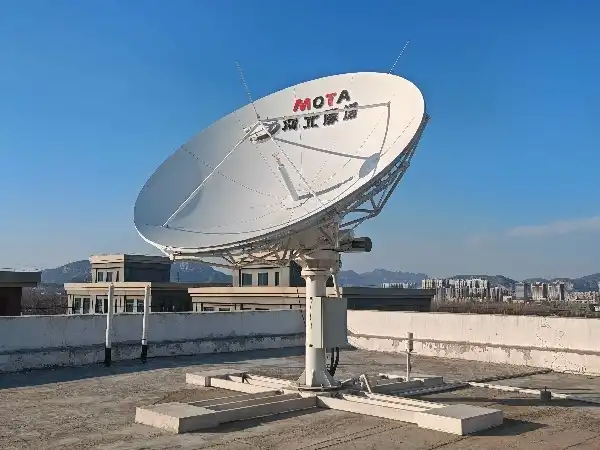
You can take a portable fixed satellite antenna with you, set it down on the ground, and point it at a geostationary satellite. It stays put once it locks. That's not the same as a movable dish, which follows a satellite while a car moves. When you hold still, the dish's gain and pointing angle stay the same, which helps the link stay strong.
We make a small Ku-band model at MOTA that folds up into the size of a suitcase and weighs 2.5 kg or less. It can be carried by one person and can be checked as luggage on an airplane. For ground stations, we also make bigger full-band systems.
How the Link Works: Bands, Orbit, and Latency
It talks to a satellite that is 35,786 km above the equator. It goes up to the satellite and then back down to a portal on Earth. That distance slows things down. Most of the time, the round trip takes at least 30 seconds. This is fine for email, telemetry, and video streaming, but it's obvious during voice talks.
Also, frequency is important. Our small model works in the Ku band, which is between 10.7 and 12.75 GHz and is commonly used for fixed satellite service. Higher frequencies let smaller dishes work, but they lose more signal when it rains, which is something that ITU-R Recommendation P.618 tries to fix. Because of this, a small dish needs a weather buffer in the link plan.
Core Components and Setup Basics
A low-noise block (LNB), transmit and receive electronics, a modem, a feed, and a mount are the basic parts that everything has. Our small unit has a simple modem and a small LNB module built in, so all you have to do is open it and start using it.
It has a noise figure of 1.3 dB or less, radio separation of 80 dB or more, and a first sidelobe of -12 dB or less. It only takes about 15 minutes for the terminal to reach satellite lock without any special tools or tuning. To set up, you need open ground with a clear view of the satellite. After that, you open the unit, turn it on, and let it find the signal.
Advantages and Practical Applications of Portable Fixed Satellite Antennas in Remote Connectivity
Speed, Weight, and Power Advantages
These are the main benefits. I tell buyers about it first for the portable fixed satellite antenna:
- Weight and carry: It's small, weighs no more than 2.5 kg, and folds up into a briefcase-sized package. This means that one person can walk the last mile with it and check it on a plane without any special freight. When a road is washed out or a team arrives by small plane, that's important.
- Time of deployment: It takes about 1.5 minutes for the terminal to reach satellite lock without any special tools or tuning. The quick guide is easy for someone on the crew who has never worked with radios before to follow. A small team can focus on the task at hand instead of the tools because they can set up quickly.
- Power draw: The power draw is less than 10 W when it's in use and even less when it's not. The terminal can be powered by a solar screen or a portable power bank, so a spot that doesn't have a generator can still connect. I suggest getting a panel and battery that are the right size for the longest session you expect.
These pros get rid of the three things that stop people from working from home: big equipment, slow setup, and not having power.
Where Teams Use Them
Portable satellite terminals are used by emergency crews when towers and fibre fail. As soon as they get to a command post after a storm or wildfire, a team can repair the link. They are used by exploration and survey teams in deserts and valleys where no other carrier goes. The same units are used by news crews to send video from the field and by small temporary ground stations or offices outside.
The National Emergency Communications Plan of the Cybersecurity and Infrastructure Security Agency in the United States stresses the need for emergency communications that can work even when regular systems don't. In level-5 wind conditions, our small model can handle 720p video and emergency data return.
Setting Up for a Stable Link
Choose the right site to get good results. If you want to put the dish in the right place, make sure there are no trees, hills, or buildings in the way. Set the unit down on flat, firm ground. If the wind picks up, weigh down or stake the base. Before you point the dish, make sure the power and cables are working.
Move slowly and keep an eye on the signal light while you align. Ku-band signals are more affected by rain than C-band signals, so give yourself extra time if storms are expected. According to IEC 60529. our small unit has an IP64 grade, which means it is dust-tight and safe from dripping water. It works between -10°C and +50 °C. Any way you look at it, keep the connectors dry.
Comparing Portable Fixed Satellite Antennas with Alternative Solutions
Versus Mobile VSAT and Fully Fixed Stations
With mobile VSAT, which is also known as "satellite-on-the-move", you can track a satellite from a moving car or boat. For that feature to work, it costs more and needs motors and sensors. A permanent fixed station can serve for a long time and have a lot of people, but it takes time, planning, and foundations.
In the middle of them is a portable fixed satellite antenna. You put it down, point it once, and then you can work. Moving tracking costs more and doesn't help much if your crew stays in one place for hours or weeks. A mobile system is better if you need to talk on the phone while driving. When I buy something, the first thing I always ask is, "Will the vehicle move while you transmit?"
Ku-Band Compared with C- and Ka-Band
How the food works and the weather depend on the band you choose. C-band works well in heavy rain, but it needs big dishes, which makes it hard to move around. On small dishes, Ka-band can handle high data rates, but rain fade is stronger. Ku-band is in the middle, so it can fit on a small dish and isn't too sensitive to rain. That's why our small model uses it.
This trade-off between frequency, antenna size, and rain absorption is talked about in books on satellite engineering by Maral and Bousquet. Our bigger full-band system automatically switches between Ku, Ka, S, X, C, and Qv for teams that need more than one band.
Lightweight Versus Heavy-Duty Models
Just look at the specs sheet and make your choice. The small Ku-band terminal is good for teams that have to carry gear on foot because it weighs 2.5 kg or less, uses 10 W or less, and locks in 1.5 minutes.
Our heavy-duty full-band system has hole sizes of 1.8 m and 2.4 m. It has a four-axis stabilisation platform that can align itself with an error of 0.05° or less. It has a noise figure of 0.6 dB or less, a first sidelobe of -22 dB or less, and radio separation of 98 dB or more. It can work in temperatures ranging from -45°C to +70°C and is protected by IP68. It can send 10 Gbps data and 8K video at 60 frames per second. They are made for work at ground stations, in space, and in defence, not for carrying around in a backpack.
Procurement Guide: How to Buy and Source Portable Fixed Satellite Antennas
What to Check Beyond Unit Price
A low price per unit doesn't tell you much for a portable fixed satellite antenna. Find out how much the item weighs and how it is packed. Shipping costs for many small, light things add up. Check the power draw and the power sources that can be used. If you live in a desert or on dusty ground, make sure the ingress rating and temperature range are right for your area.
Find out what licences the unit has and who in your market is in charge of paperwork. Get a sample and have your staff try it out. Satellite terminals are sold by well-known companies like Viasat, Gilat, and Cobham. To get the best results, ask all of them the same questions and then compare their answers.
OEM and ODM Options for Brand Owners
A lot of our buyers have their own names of emergency gear, power tools for the outdoors, and satellite devices. Most of the time, they want a terminal that can fit a kit that has power and lights. OEM and ODM work can be done with MOTA. The target country's rules are taken into account when the hardware looks, how it works, and the interface protocols it uses.
Nameplates, color boxes, language instructions, and plug and accessory sets are all options for branding. We create plans, make prototypes, and make a lot of them. You can test demand with a trial batch before making bigger orders, and giving your product a unique look can help it stand out in a crowded market.
Logistics, Warranty, and Support
Lead time is just as important as price. For regular orders, we keep stock on hand, but it takes 45–90 days to make custom and large systems. We move things with foreign dedicated lines, by sea freight, and by air freight. Electronics that need to be precise are packed in a way that keeps them safe from shock and moisture. They are tracked from start to finish and help with customs clearing is provided.
There are flexible payment plans and a full-unit guarantee that meets foreign standards for each unit. Our team is available 24 hours a day, seven days a week to help with installation, troubleshooting, and system upgrades. We also offer on-site service and quick delivery of new parts through partner outlets.
Keeping the Link Stable: Troubleshooting and Maintenance
Fixing Signal Loss and Alignment Errors
Do a series of easy checks in order when the link goes down for your portable fixed satellite antenna. Check the power and cable connections first. Second, check the path to the satellite for new things that could get in the way, like branches, cars, or tents. Third, make sure the terminal is level and hasn't moved because of wind or soft ground.
Then slowly adjust while keeping an eye on the signal light. Heavy rain can also temporarily cut off Ku-band signals, but they normally come back after the storm is over. Send us pictures and readings from the indicators if the problem keeps happening. Our team can help your operator every step of the way.
Routine Inspection and Cleaning
Most field mistakes can be avoided with a short practice. Clean the reflector of dust and mud every time you use it, because dirt and water can weaken the signal. Check the pins and connectors for corrosion and damage. Also, look for play or damage in the hinges and folding joints.
After sandstorms or use near the coast, check the gaskets and seals. Make sure the unit is dry before you pack it, and keep it in its case away from heat. When new versions of modem software come out, install them and keep a log of each inspection. This way, patterns can be seen early.
Remote Monitoring and Support
Watching cuts down on site trips. Our full-band technology allows for real-time tracking, fault self-diagnosis, and remote parameter change. This means that a technician can see a problem and fix the settings without being there.
Our 7x24 online technical help covers setting up and fixing problems with the small unit. Most problems on the job site can be fixed by teaching operators a few simple steps, like how to read the signal indicator and re-point. For repairs that need to be done quickly by a crew that is far away, keeping an extra parts kit with each batch is a good idea.
Conclusion
The terminal, band, power source, and location must all be right for a portable fixed satellite antenna to work reliably at rural locations. To connect to a geostationary satellite 35,786 km away, it stays still after the first adjustment. This means that a delay of about half a second is common. Ku-band finds a good balance between dish size and how sensitive it is to rain.
Heavy full-band systems serve ground stations, while lighter units are better for walking. In an emergency or while working in the field, it's most important to have something that is light, locks quickly, and uses little power. To protect the link over time, it's helpful to compare options to mobile VSAT, look at ratings, approvals, lead time, and warranties, and do regular simple checks.
FAQ
How long does setup take?
It takes our small Ku-band model about 1.5 minutes to lock on to a satellite. It's not tuned or needs any special tools.
Can one person carry it?
Yes. It's less than 2.5 kg and folds up into a briefcase, so it's easy for one person to carry and check on a plane.
What powers the compact terminal?
Power needs are 10 W or less to work. The battery can be charged by the sun or a portable power bank.
Does rain affect Ku-band signals?
Heavy rain does affect Ku-band more than C-band. Plan a link margin and keep water and other things from getting in the dish.
Can MOTA customize the product?
Yes. We do OEM and ODM work, and our services include appearance, interface protocols, color boxes, and manuals in more than one language.
CTA
MOTA makes portable fixed satellite antennas and has stock ready for regular orders as well as OEM or ODM builds for your brand. We will respond to your email at hebei_mota@163.com as soon as possible, no matter what time it is. Our goods are certified by ISO9001, ISO14001, and ISO45001, and they come with a guarantee that covers the whole unit. For more information, go to motasat.com.
References
1. Satellite Communications Systems (Maral and Bousquet), 2009
2. Satellite Communications Systems Engineering (Ippolito), 2017
3. ITU-R Recommendation P.618-13, Propagation Data and Prediction Methods for Earth-Space Telecommunication Systems, 2017
4. IEC 60529, Degrees of Protection Provided by Enclosures (IP Code), 2013
5. National Emergency Communications Plan, Cybersecurity and Infrastructure Security Agency, 2019
6. ITU Radio Regulations, 2020
Tell us your requirements – get a tailored quote and technical support within 24 hours.