- English
- French
- German
- Portuguese
- Spanish
- Russian
- Japanese
- Korean
- Arabic
- Greek
- German
- Turkish
- Italian
- Danish
- Romanian
- Indonesian
- Czech
- Afrikaans
- Swedish
- Polish
- Basque
- Catalan
- Esperanto
- Hindi
- Lao
- Albanian
- Amharic
- Armenian
- Azerbaijani
- Belarusian
- Bengali
- Bosnian
- Bulgarian
- Cebuano
- Chichewa
- Corsican
- Croatian
- Dutch
- Estonian
- Filipino
- Finnish
- Frisian
- Galician
- Georgian
- Gujarati
- Haitian
- Hausa
- Hawaiian
- Hebrew
- Hmong
- Hungarian
- Icelandic
- Igbo
- Javanese
- Kannada
- Kazakh
- Khmer
- Kurdish
- Kyrgyz
- Latin
- Latvian
- Lithuanian
- Luxembou..
- Macedonian
- Malagasy
- Malay
- Malayalam
- Maltese
- Maori
- Marathi
- Mongolian
- Burmese
- Nepali
- Norwegian
- Pashto
- Persian
- Punjabi
- Serbian
- Sesotho
- Sinhala
- Slovak
- Slovenian
- Somali
- Samoan
- Scots Gaelic
- Shona
- Sindhi
- Sundanese
- Swahili
- Tajik
- Tamil
- Telugu
- Thai
- Ukrainian
- Urdu
- Uzbek
- Vietnamese
- Welsh
- Xhosa
- Yiddish
- Yoruba
- Zulu
Vehicle-mounted Fixed Satellite Antenna for Military and Defense Vehicles
Where cellular and fiber networks don't reach, a vehicle-mounted fixed satellite antenna provides a reliable satellite link for military and defense vehicles. Mounts with bolts, magnets, or both, and stays on the car. After the car parks, it points at a satellite. Then, crews can send voice, data, and video from command posts, patrol units, and field labs without having to take out a portable dish. This guide was written to show you how these terminals work, what specs are important, how to set them up and keep them in good shape, and how to buy them from a factory like MOTA with confidence.
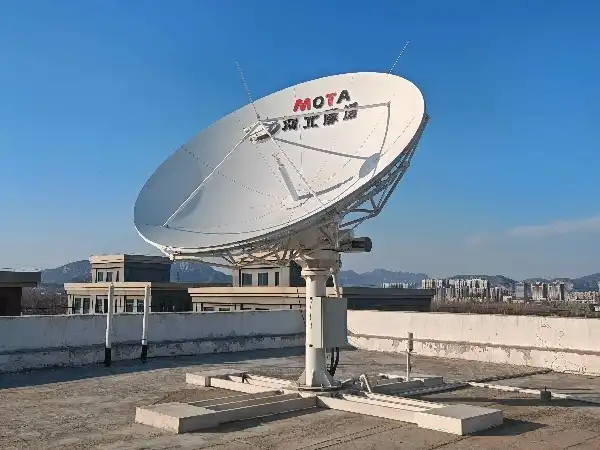
Understanding the Vehicle-Mounted Fixed Satellite Antenna
What Is a Vehicle-Mounted Fixed Satellite Antenna?
When you put a vehicle-mounted fixed satellite antenna on a command vehicle, mobile lab, border patrol unit, or disaster-response truck, it stays there permanently or mostly permanently. It sends voice, data, video, and command traffic in places that don't have a lot of land-based infrastructure. A fixed mount always gives the same position, cable routes, and startup routine. This cuts down on time needed to get ready and operator error. Also, buyers should know the difference between buying an antenna only and buying a full solution with RF equipment, a modem, power distribution, tracking control, and network compatibility. The choice of solution changes both the price and the amount of work that needs to be done to integrate it.
How the Terminal Works
Laptops, phones, and cameras send data to a modem and transceiver, which then send it to the feed and antenna and up to a satellite. Geostationary satellites are in a circle 35,786 kilometers above the equator. This means that the dish can only point at one spot in the sky. GPS/GNSS position, compass readings, and signal-strength feedback can all be used to get pointing information. A vehicle-specific alignment algorithm on the MOTA unit completes satellite lock within 3 minutes of the vehicle stopping. A manual mode is also kept as a backup. The on-the-move tracking method holds the beam while the vehicle drives with gyro stabilization, which is different from this stop-and-connect method.
Fixed Mount, Portable, and Tracking Designs Compared
Parabolic dishes are a well-known and effective way to receive signals, and their high gain makes them ideal for command vehicles with roofs. Flat-panel arrays may cost more or use more power, but they sit lower and have fewer moving parts. Portable terminals give you options, while fixed mounts make things consistent, tough, and ready for a fleet. Automatic tracking systems are also different from mechanically fixed antennas because the first one only lines up once when the car is parked, while the second one stays pointed while it's moving. The MOTA unit uses the stop-and-connect method and has an aperture of 0.45 m. It works for crews that park first and talk to each other later, and it doesn't cost as much or be as hard to use as gyro-stabilized platforms.
Key Specifications and Selection Criteria
Technical Specifications That Matter on Defense Vehicles
Size of the antenna and the gain claimed are only parts of the story. Make sure that your satellite service has the right band, G/T, EIRP, polarization, beamwidth, throughput, and network availability. The industry uses the 10.7–12.75 GHz Ku band, but IEEE Std 521 officially lists Ku as 12–18 GHz, so make sure you know which frequencies your network uses. Then look at how well it works in different environments, including how well it protects against dust and water, humidity, salt fog, shock, vibration, and electromagnetic compatibility. MIL-STD-810H outlines how to test for shock and vibration in a lab, so ask any supplier what methods they used and ask for the reports. A datasheet and radiation pattern should be sent with every quote.
MOTA Antenna Specifications at a Glance
The MOTA vehicle-mounted fixed satellite antenna has an aperture of 0.45 m and works in the Ku band between 10.7 and 12.75 GHz. It has a noise level of 1.0 dB or less, which is about 75 K of noise temperature. Engines, alternators, and other onboard electronics can't mess with transceivers if the isolation level is 85 dB or higher. The unit only needs 8 W of power to work and 1.5 W of power to be idle, so it doesn't use much of the car's battery. It can be directly hooked up to 12V or 24V power. A lot of commercial trucks and RVs use 12V systems, but a lot of tactical vehicles use 24V systems. The IP66 rating means that the case is dust-tight and can handle strong water jets.
How to Choose for Your Vehicle Platform
First, say whether the vehicle works while it is parked, moving, or in transit. Write down the name of the satellite network, its coverage area, the type of traffic, its speed, its polarization, its power limit, and the modem interface. Make sure the service works with Ku band and that the terminal's frequencies work with your network. Then check the vehicle itself to see how strong the roof is, how much weight it can hold, where the center of gravity is, how high the antenna is mounted, how the cables are routed, how it is grounded, and how much space there is around hatches, sensors, and other antennas. RF equipment, brackets, commissioning, training, and maintenance are all part of the total cost, so compare quotes that cover the same ground.
Installation, Mounting, and Maintenance
Installation Steps From Survey to Commissioning
We recommend that you start by taking a look at the roof structure, line of sight, satellite look angle, power source, grounding point, and equipment compartment. Next, mount the bracket so that it can spread the weight and stand up to wind, vibration, and corrosion. A project-specific wiring diagram should show how to connect the antenna, modem, power unit, and user network. The diagram should also show how to deal with cable loss and waterproof connectors. The next part of commissioning is setting up the system, choosing a satellite, polarization, pointing calibration, receive checks, throughput tests, and failover checks. Before sending a test message, make sure you have permission to do so, and leave service access around the unit so that it can be inspected later.
Dual Fixing for Vibration and Sharp Maneuvers
The MOTA design uses both strong magnets and bolts to attach the parts. The magnet and bolts help hold the unit in place on two levels, so it can handle bumps, sharp turns, and climbs. Core parts are also reinforced to be shock-proof. Different cars have different roof stiffness, bracket shapes, and road conditions, so we suggest you do a road test on your own platform before releasing the fleet. They should be kept in your acceptance file. When you customize MOTA, you can change the suction base and bracket to fit a roof curve or rail that needs a different interface.
Maintenance and Troubleshooting
In harsh field conditions, regular checks make sure that the link is always available. Follow a written schedule that works for your operating conditions to check the housing, seals, connectors, cables, brackets, grounding points, and areas that are likely to rust. If a link breaks, work backward. Check the power, the GPS status and satellite coordinates, the signal strength, the polarization, the continuity of the cable, and the modem alarms. Slow acquisition, broken links, and low signal are all common faults. Make sure you have extra connectors and cables on hand. MOTA offers remote support 24 hours a day, seven days a week for installation, troubleshooting, and system upgrades. Cooperative channels provide on-site service and quick spare-part delivery.
Applications and Customization
Where These Terminals Work
Fixed satellite terminals are used on command vehicles, mobile labs, border patrol units, and disaster response trucks for both the defense and public safety sectors for vehicle-mounted fixed satellite antenna. If a storm or earthquake damages local networks, a command vehicle that is parked can hold high-definition video conferences, help different agencies work together, and send information to headquarters about what is happening. In places where cellular and fiber links don't exist, energy and mining teams that work in remote areas send seismic and survey data sets. News crews use the same method to upload live 4K video, and field researchers can use cloud resources and video calls without having to go back to an office.
OEM and ODM Customization for Vehicle Builders
Builders of special vehicles almost never want to have to fix a standard part. MOTA lets OEMs and ODMs change the look of the housing, the suction base, the bracket, the length of the harness, the type of connector, the interface protocol, and the function modules. We change certifications to fit the rules of the target country. The service includes everything from designing the scheme and making a prototype to mass production. Before placing large orders, we also help with pilot installations on a representative vehicle. Regular orders can be filled from ready stock, while custom and large-system production takes 45 to 90 days. It's not possible for your engineers to make brackets and harnesses on their own with this path.
Quality Systems, Delivery, and Warranty
MOTA has been making things for nine years and has ISO 9001, ISO 14001, and ISO 45001 management system certifications. They also have a GJB 9001C military quality system and domestic type approval for radio transmission equipment. Our antennas, tracking algorithms, and satellite-terrestrial technologies are protected by a number of intellectual property rights. We are a national high-tech and military-civil integration business. Precision electronics are shipped in packaging that is resistant to shock and moisture via international dedicated lines, sea freight, or air freight. They can be tracked, and they can be stored overseas. International standards say that products come with a full-unit warranty, and you can get copies of the certificate from any supplier.
Procurement Guide and Risk Control
Preparing a Clear RFQ
Include the type of vehicle, its operating environment, frequency band, polarization, coverage, tracking mode, throughput, size, weight, power consumption, interfaces, and when it will be delivered. You should say if you want just the antenna or a package that includes the modem, RF chain, controller, bracket, cables, installation, and going live. When you buy from a factory, you can get better pricing and customization options. Distributors and integrators, on the other hand, offer local support. For U.S. projects, let the supplier know right away if the terminal is subject to FCC Part 25 rules for non-federal use or to federal spectrum coordination through NTIA. This way, the radio approval plan can be set in stone.
Common Risks and How to Avoid Them
A lot of projects fail because choosing the product is not linked to integrating the vehicle. Before you buy, make sure you know the frequency, polarization, modem, and satellite service. Keep an eye out for roofs that aren't strong, too much weight, bad vibration isolation, cable loss, a blocked view of the sky, and low power. Ku band is more affected by heavy rain than C band, so plan link margin for places that get wet. Automatic pointing while parked is not the same as stabilized operation while moving, and keep in mind that gain alone does not describe performance. In the contract, include software updates, spare parts, repair times, documentation, training, and a warranty. This is because end users often complain about not being able to understand how to use the product.
Evaluation Model for Global B2B Buyers
Here is the three-part scoring model we suggest for B2B buyers around the world.
- Technical score: Rate RF performance, band compatibility, coverage, pointing accuracy, power draw, interfaces, environmental durability, and fit with the vehicle's modem, power system, and satellite network. Weight each item by mission need, and ask suppliers to back every figure with a datasheet, radiation pattern, or test report.
- Commercial score: Compare total delivered cost, production capacity, lead time, customization options, warranty terms, export support, and spare-part availability. A low unit price loses value if brackets, harnesses, and commissioning arrive as separate charges, so price every quote against the same scope. Also confirm the supplier will keep offering the same model after vehicle updates.
- Pilot test: Install one unit on a representative vehicle before fleet release. Test acquisition time, throughput, vibration behavior, power draw, weather performance, and modem interoperability, then record the results. A pilot catches bracket, wiring, and sky-view problems while changes still cost little. Repeat the 3-minute alignment check at several parking sites.
When put together, these checks make sure that a purchase decision is based on real results, not just claims on a data sheet.
Conclusion
A vehicle-mounted fixed satellite antenna lets military and defense vehicles connect and disconnect from the satellite network. The best choice depends on the vehicle's band, power, mounting, and network. Portable dishes can't be used over and over again, but fixed mounts can. Stop-and-connect designs save money on gyro-stabilized tracking when a mission lets them park first. Datasheets and road tests are needed to prove things like noise figure, isolation, power draw, ingress protection, and shock resistance. Most problems in the field can be avoided with careful installation, regular inspections, and a clear RFQ. The 0.45 m Ku-band unit from MOTA, which has dual fixing, a 12V/24V supply, an IP66 housing, and 3-minute alignment, is an example of how these criteria work in a real product. The safest way to make sure a ship is fit for the fleet is still to test it with a pilot.
FAQ
Does fixed-mounted mean the antenna works while driving?
No, "fixed-mounted" refers to the way the installation is done. While the car is moving, the MOTA unit doesn't track; it only lines up with the satellite after the car is parked.
What power supply does the MOTA antenna need?
It connects straight to 12V or 24V power in a car. Power used is 8 W or less, and power in standby mode is 1.5 W or less.
Can I customize the mounting and cables?
Yes. MOTA lets ODM and OEM make changes to the way it looks, the suction base, the bracket, the length of the harness, the connectors, and the interface protocol.
How long does production take?
Regular orders are met by ready stock. It takes 45 to 90 days to make a customized or large system.
What should I include in an RFQ?
Write down the type of vehicle, its operating environment, the satellite network, its coverage area, its throughput, its tracking needs, its interfaces, and how many there are. Tell us if you only want an antenna or the whole package.
Request a Vehicle-mounted Fixed Satellite Antenna Quote from MOTA
MOTA has been making vehicle-mounted fixed satellite antennas for nine years and works with defense contractors, integrators, fleet operators, and original equipment manufacturers (OEMs). Email hebei_mota@163.com with the type of vehicle, mission profile, satellite network, and quantity you need. Our team will then suggest a Ku-band configuration that has a 7x24 response time, ISO-certified quality, and ODM/OEM options.

References
1. IEC 60529, Degrees of Protection Provided by Enclosures (IP Code), 2013
2. MIL-STD-810H, Environmental Engineering Considerations and Laboratory Tests, U.S. Department of Defense, 2019
3. IEEE Std 521, IEEE Standard Letter Designations for Radar-Frequency Bands, 2019
4. Radio Regulations, International Telecommunication Union, 2020
5. Satellite Communications Systems: Systems, Techniques and Technology, Maral and Bousquet, Wiley, 2020
6. Code of Federal Regulations Title 47, Part 25, Satellite Communications, Federal Communications Commission, 2023
Tell us your requirements – get a tailored quote and technical support within 24 hours.