- English
- French
- German
- Portuguese
- Spanish
- Russian
- Japanese
- Korean
- Arabic
- Greek
- German
- Turkish
- Italian
- Danish
- Romanian
- Indonesian
- Czech
- Afrikaans
- Swedish
- Polish
- Basque
- Catalan
- Esperanto
- Hindi
- Lao
- Albanian
- Amharic
- Armenian
- Azerbaijani
- Belarusian
- Bengali
- Bosnian
- Bulgarian
- Cebuano
- Chichewa
- Corsican
- Croatian
- Dutch
- Estonian
- Filipino
- Finnish
- Frisian
- Galician
- Georgian
- Gujarati
- Haitian
- Hausa
- Hawaiian
- Hebrew
- Hmong
- Hungarian
- Icelandic
- Igbo
- Javanese
- Kannada
- Kazakh
- Khmer
- Kurdish
- Kyrgyz
- Latin
- Latvian
- Lithuanian
- Luxembou..
- Macedonian
- Malagasy
- Malay
- Malayalam
- Maltese
- Maori
- Marathi
- Mongolian
- Burmese
- Nepali
- Norwegian
- Pashto
- Persian
- Punjabi
- Serbian
- Sesotho
- Sinhala
- Slovak
- Slovenian
- Somali
- Samoan
- Scots Gaelic
- Shona
- Sindhi
- Sundanese
- Swahili
- Tajik
- Tamil
- Telugu
- Thai
- Ukrainian
- Urdu
- Uzbek
- Vietnamese
- Welsh
- Xhosa
- Yiddish
- Yoruba
- Zulu
What specifications should you check when choosing a high-precision satellite antenna?
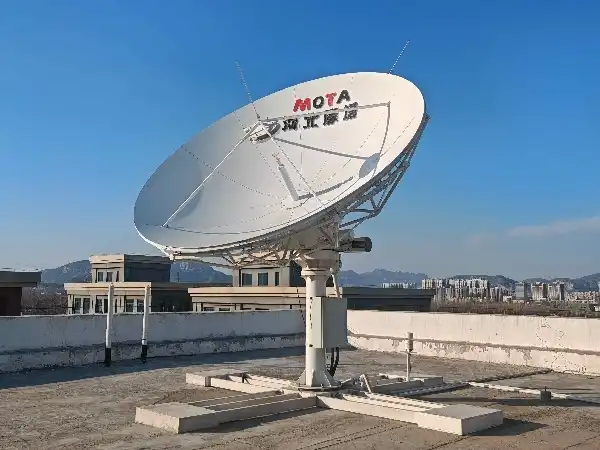
There are seven things I look at when I review a high-precision fixed satellite antenna. Along with frequency band and RF compatibility, they look at noise figure, pointing accuracy, reflector surface accuracy, environmental and structural ratings, and support over the course of the product's life. Link quality is determined by the noise figure and the pointing error. The quality of the link will last as long as the wind rating, ingress protection, and documentation are in place. It's important to make sure that each value fits your satellite orbit, link budget, and site. Also, don't just take the supplier's word for it; ask for test results as well. The sections that follow spell out each test in simple terms and show how well MOTA's antenna does.
Introduction: Why Antenna Specifications Matter in Satellite Communication
Specifications Decide Link Performance
For many years, a fixed antenna stays in the same place. This means that a weak link stays weak for the whole service life. Link availability, throughput, interference rejection, regulatory compliance, installation effort, and operating cost are all controlled by specifications. Price and dish size don't show these things on their own. For instance, doubling the diameter of a reflector at the same frequency adds about 6 dB of gain, but it also makes the foundation and wind load requirements go up. A datasheet is not a list of numbers to me; it's a list of trade-offs. Each value is linked to a real risk or cost on your site.
Five Areas to Evaluate
I divide the checks into five groups: RF performance, mechanical accuracy, durability in harsh environments, installation and maintenance, and supplier ability. Frequency, gain, noise figure, and sidelobes are all parts of RF performance. Pointing and reflector surface accuracy are both covered by mechanical precision. Wind, temperature, and corrosion are all part of environmental durability. Commissioning and service access are part of installation and maintenance. Quality systems, documentation, and customization are all examples of what a supplier can do. Going over the areas in this order helps keep conversations with vendors on track. Also, it finds holes early on, before a purchase order locks in the design.
Where MOTA's Antenna Fits?
MOTA makes a high-precision fixed satellite antenna that is used for high-level monitoring, scientific research, and precise measurements. It has apertures of 13 m, 11 m, 9 m, 7.3 m, 6.2 m, 5.4 m, 4.5 m, 3.3 m, and 2.4 m and can switch between Ku, Ka, S, X, C, and Qv bands (by hand). The error in alignment is 0.1° or less, the noise level is 0.8 dB or less, and it takes 2 minutes to set up the link. An automatic three-axis stabilizer fixes any alignment problems that happen. A high-precision LNB/BUC, a high-speed modem, and a signal processing module are all built into the unit. Under GJB 9001C, manufacturing must meet standards for military-grade accuracy. Throughout this article, I use these numbers as guides.
RF Performance: Frequency, Gain, and Noise
Frequency Band and RF Compatibility
Compatibility with frequencies comes first. Make sure you know the full operating range, uplink and downlink frequencies, polarization, and that it works with your satellite provider, modem, BUC, LNB, and feed. C-band can handle rain the best. Ku-band is widely available and strikes a good balance between dish size and capacity. Ka-band can handle high-throughput service, but it needs more link margin and tighter pointing. You should also ask about the performance of the cross-polarization, feed horns, OMTs, polarizers, waveguides, and polarization. These parts determine how well the antenna fits into your system. With manual band switching, MOTA's antenna covers Ku, Ka, S, X, C, and Qv. This means that one platform can do more than one job without needing separate systems for each one.
Gain, Aperture Size, and Beamwidth
Ask for measured or guarantyd values across the whole operating range because gain is affected by frequency, aperture, reflector efficiency, surface accuracy, and feed design. Half-power beamwidth is about 70 times the wavelength divided by the diameter. This is a good rule of thumb. At 12 GHz, a 2.4-meter dish gives off about 0.73° of signal. At 30 GHz, it drops to about 0.29°. Narrow beams make interference between nearby satellites less likely, and the FCC based its geostationary rules on orbital spacing of 2°. Gain and link margin go up with bigger dishes, but cost, wind load, and foundation size go up too. Choose the smallest aperture that lets you reach your G/T goal.
Noise Figure, Isolation, and Sidelobes
The noise figure tells the receive chain how much noise to add. A noise level of 0.8 dB is the same as a noise temperature of about 59 K. This keeps weak signals from faraway or low-power satellites safe. Next, check the transceiver isolation to make sure that the transmitter doesn't make the receiver too busy. The antenna from MOTA has at least 90 dB of isolation and a first sidelobe level of -18 dB or less. Off-axis radiation is limited by regulators, so sidelobes are important. For your site, look over the envelopes in ITU-R S.580-6 and FCC 47 CFR 25.209, and ask for measured patterns for the exact configuration that was quoted.
Mechanical Precision: Pointing, Reflector, and Stabilization
Pointing Accuracy and Tracking
Directly pointing out error costs signal. Most people think that pointing loss is about 12 times the square of the error divided by the beamwidth, expressed in decibels. Any mistake of 0.1° causes a 2.4 m dish to lose about 0.2 dB at 12 GHz, but it costs about 1.4 dB at 30 GHz. That gap is what makes Ka-band links need tighter pointing. Check the accuracy of both static pointing and tracking, as well as the encoder's resolution, backlash, repeatability, and performance. After being set up, a GEO terminal usually stays in place. On the other hand, LEO and MEO links need to be tracked automatically. The antenna on MOTA keeps the alignment error at or below 0.1° and locks the link after 2 minutes.
Reflector Design and Surface Accuracy
The shapes of the reflectors improve the beam pattern, stability, and high-frequency performance. Because surface flaws scatter energy, and the loss goes up quickly as the wavelength goes down, Ka-band needs tighter tolerances than C-band. Most of the time, solid reflectors keep surface accuracy better and work well with Ku-band, Ka-band, and narrow-beam links. At frequencies below C-band, mesh reflectors cut down on weight and wind load. Ask about the reflector's material, the tolerances between panels, the quality of the coating, and how it expands and contracts when heated. Then ask for measurements of the exact configuration you want to buy to make sure it fits correctly and is the right size. This question is quickly answered by a supplier with a well-organized process for high-precision fixed satellite antenna.
Three-Axis Stabilization and Drive Quality
I check how the system fixes drift because wind and temperature can move an antenna out of place over time. The three-axis high-precision self-stabilizing platform from MOTA automatically fixes any alignment problems. This keeps the link on target and the data flowing during long operations. Check the drive torque, the accuracy of the gears, the brakes, the limit switches, the remote control, and the emergency override. In this way, we can see if the mechanism will still work correctly in five years and on delivery day. Ask the vendor how it checks for backlash and what steps are in the maintenance manual for recalibration.
Environmental, Installation, and Lifecycle Checks
Environmental and Structural Ratings
It's important for a fixed antenna to stay stable for its whole life, so pay close attention to the environmental values. Check the operating wind speed and the survival wind speed separately. Also look at the temperature range, the amount of snow and ice, the salt spray, the humidity, the dust, and the heavy rain. The antenna on MOTA works from -30°C to +55°C, can send and receive 4K video and data even in 7-level wind (about 32–38 mph on the Beaufort scale), and has an IP66 rating. IEC 60529 says that IP66 means that something is dust-tight and can handle strong water jets. For sites near the coast, ask for results on salt spray that meet ASTM B117 or ISO 9227. Ask for information on grounding, lightning protection, foundation loads, and overturning moments so that local engineers can look it over.
Installation, Alignment, and Commissioning
A bad installation can erase the RF performance that was published. A site survey, foundation work, feed installation, grounding, cable routing, satellite acquisition, polarization adjustment, and acceptance testing are all things that you can expect. Make sure the supplier gives you instructions, assembly drawings, torque specs, and help with installation. It should be in the commissioning plan to use alignment tools like GPS, inclinometers, spectrum analyzers, and beacon tracking. MOTA's antenna comes fully assembled and ready to use. Its own pointing algorithm aligns satellites in just two minutes, which cuts down on the time needed for debugging on-site. Note down the final azimuth, elevation, polarization, and signal metrics so you can use them when you need to troubleshoot in the future.
Maintenance and Lifecycle Support
Maintenance access and support are important for a long service life. Review how often to inspect, how to lubricate, how to get to the gearbox and motor, how to apply protective coatings, and how to recalibrate. Ask the supplier about field references, warranty terms, factory acceptance testing, and the availability of spare parts. MOTA provides remote technical support 24 hours a day, seven days a week for system upgrades, installation, and troubleshooting. We also offer a flexible full-unit warranty that meets international standards. We also offer localized support through cooperative channels, such as on-site service and quick delivery of spare parts. This coverage is best for sites that are far away, since each service call costs time and money for travel and downtime. Look at these terms line by line from different sellers.
Comparing Options, Cost, and Supplier Capability
Comparing Antenna Architectures
Not price, but operating priority should be used to compare designs. When compared to standard dishes, high-precision fixed antennas tend to have better gain stability, tighter beam control, better pointing repeatability, and more rigid structures. Moving systems work best for short-term tasks, while fixed installations work best for long-term locations and continuous service. Electronically steered antennas can change their beams more quickly and work in more than one orbit, but they can be more expensive to buy, use more power, and be harder to set up. When it comes to research, a ground station that tracks the same GEO satellite for years doesn't need to be very flexible. A site that changes orbits might be able to. You can compare solid and mesh reflectors based on their frequency, surface accuracy, wind load, weight, and how easy they are to maintain.
Cost, Quotation, and Supplier Evaluation
Not just the price of the reflector, but also the total cost of ownership. Included in a full quote are the reflector, mount, feed, motors, controller, BUC, LNB, shipping, foundation work, installation, training, warranty, support, and spare parts. In your RFQ, you should list the location of the satellite, its frequency, polarization, gain (G/T), accuracy of pointing, site conditions, certifications, quantity, and date of delivery. Then, look at the supplier's ability to make the product, their quality control systems, their experience exporting, project references, and the ways they let you inspect their factory. MOTA has been making things for nine years and has ISO 9001, ISO 14001, and ISO 45001 certifications. They also have domestic type approval for radio transmission equipment. We keep stock on hand for regular orders, and it takes 45 to 90 days for custom or large-scale systems to be made.
A Practical Checklist and Application Fit
When you compare proposals, use the same list. RF items include frequency range, gain, G/T, beamwidth, sidelobes, isolation, and the ability for BUC and LNB to work together. Some mechanical factors are aperture, surface accuracy, repeatability of pointing, and wind rating. Things that are sold for money include supply scope, documentation, warranty, training, and lead time. Then, compare the result to what you want to do. High gain, stable pointing, and structural strength are the most important things for GEO installations. Coastal sites need to be protected from corrosion, and windy sites need a strong foundation design. Custom engineering might be worth the money for scientific research, telemetry and control, or 4K monitoring links. When it comes to hardware design, interface protocols, and software interfaces, MOTA can do everything from scheme design and prototyping to mass production.
Conclusion
To pick a high-precision fixed satellite antenna, you need to read the specs as a set of linked trade-offs instead of separate numbers. RF performance is determined by the frequency band, gain, aperture, noise figure, isolation, and sidelobes. It depends on how well the pointing is done, how well the reflector surface is done, and how well the system is stabilized. The beamwidth examples showed that a 0.1° error costs a lot more at Ka-band than at Ku-band. Wind, temperature, water ingress, and corrosion ratings, along with the quality of the installation and support throughout the lifecycle, determine how long something will be available. Quotes should include the whole project and all of its costs, and suppliers should be able to back up what they say with test records and other paperwork. Checked antenna values that match your orbit, band, site, and mission are the best ones to choose.
FAQ
What is the most important specification?
Not just one value determines suitability. Rates of interference, gain, beamwidth, accuracy of pointing, environmental ratings, and site conditions should all be compared to your link budget.
How do I choose a reflector diameter?
Begin by figuring out the link's budget and need for G/T. Gain goes up with a bigger dish, but so do wind load, foundation cost, and the ability to point more accurately. MOTA has apertures that range from 2.4 m to 13 m.
When is tracking necessary?
Once they are turned on, geostationary stations usually stay put. Make sure you know that LEO and MEO links need to be tracked automatically and quickly repositioned before you buy them.
How do C-band, Ku-band, and Ka-band differ?
C-band can handle rain the best. With Ku-band, dish size and capacity are equal. Ka-band has a lot of data to send, but it needs more link margin and tighter pointing.
Should I choose a solid or mesh reflector?
With solid reflectors, the surface is more accurately matched for Ku and Ka bands. At C-band, mesh reflectors can cut down on weight and wind load.
Request a High-Precision Fixed Satellite Antenna Recommendation from MOTA
Talk to MOTA about your desired satellite, frequency band, aperture, site conditions, and delivery date. They are a high-precision fixed satellite antenna manufacturer with nine years of experience, ISO 9001, ISO 14001, and ISO 45001 certifications, and they can make antennas that are ODM or OEM. Our engineers look over your instructions and get back to you at any time. To get a technical quote for your high-precision fixed satellite antenna project, email hebei_mota@163.com.

References
1. Satellite Communications (3rd ed.), Pratt and Allnutt, Wiley, 2019
2. Antenna Theory and Design (3rd ed.), Stutzman and Thiele, Wiley, 2012
3. ITU-R Recommendation S.580-6: Radiation Diagrams for Use as Design Objectives for Antennas of Earth Stations Operating with Geostationary Satellites, International Telecommunication Union, 2004
4. Code of Federal Regulations, Title 47, Section 25.209: Earth Station Antenna Performance Standards, U.S. Federal Communications Commission, 2023
5. IEC 60529: Degrees of Protection Provided by Enclosures (IP Code), International Electrotechnical Commission, 2013
6. ASTM B117: Standard Practice for Operating Salt Spray (Fog) Apparatus, ASTM International, 2019
Tell us your requirements – get a tailored quote and technical support within 24 hours.