- English
- French
- German
- Portuguese
- Spanish
- Russian
- Japanese
- Korean
- Arabic
- Greek
- German
- Turkish
- Italian
- Danish
- Romanian
- Indonesian
- Czech
- Afrikaans
- Swedish
- Polish
- Basque
- Catalan
- Esperanto
- Hindi
- Lao
- Albanian
- Amharic
- Armenian
- Azerbaijani
- Belarusian
- Bengali
- Bosnian
- Bulgarian
- Cebuano
- Chichewa
- Corsican
- Croatian
- Dutch
- Estonian
- Filipino
- Finnish
- Frisian
- Galician
- Georgian
- Gujarati
- Haitian
- Hausa
- Hawaiian
- Hebrew
- Hmong
- Hungarian
- Icelandic
- Igbo
- Javanese
- Kannada
- Kazakh
- Khmer
- Kurdish
- Kyrgyz
- Latin
- Latvian
- Lithuanian
- Luxembou..
- Macedonian
- Malagasy
- Malay
- Malayalam
- Maltese
- Maori
- Marathi
- Mongolian
- Burmese
- Nepali
- Norwegian
- Pashto
- Persian
- Punjabi
- Serbian
- Sesotho
- Sinhala
- Slovak
- Slovenian
- Somali
- Samoan
- Scots Gaelic
- Shona
- Sindhi
- Sundanese
- Swahili
- Tajik
- Tamil
- Telugu
- Thai
- Ukrainian
- Urdu
- Uzbek
- Vietnamese
- Welsh
- Xhosa
- Yiddish
- Yoruba
- Zulu
What determines the pointing accuracy of a satellite antenna?
Pointing accuracy in satellite antennas is determined by a combination of mechanical structural integrity, servo control system responsiveness, reflector surface tolerance, environmental compensation capability, and signal processing algorithms. In a high-precision fixed satellite antenna, all these variables must work in concert to maintain alignment error at ≤0.1° — a threshold that separates professional-grade ground station equipment from standard commercial dishes. For TT&C operations, remote sensing data reception, and large scientific ground stations, this level of precision is not a preference — it is a hard requirement.
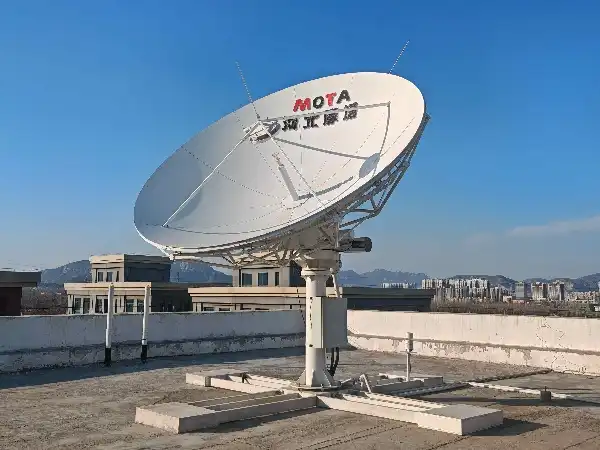
Understanding Pointing Accuracy in Satellite Antennas
Pointing accuracy is how well the beam axis of an antenna lines up with the orbital position of the target satellite. At Ka-band frequencies, even a small change of 0.2° can cause several decibels of gain loss, which directly hurts link margin and data flow. ITU-R S.580-6 says that ground station antennas working in coordinated frequency bands need to follow strict sidelobe envelopes. Antennas that are structurally rigid and carefully controlled can constantly meet this standard.
What Causes Pointing Error?
Ground station antennas get pointing errors from three main places. When wind force or temperature growth changes the reflector's focal shape, it deforms mechanically. There is control delay when the servo system can't fix location drift quickly enough. When gyroscopes or encoders give inaccurate angle data, it makes both problems worse. A high-precision fixed satellite antenna is different from a regular dish installation because it can deal with all three at the same time.
Core Technologies Behind High-Precision Satellite Antenna Systems
Getting alignments of less than 0.1° is a difficult engineering problem that can't be solved by a single part. Instead, it requires an architecture that tightly integrates mechanics, electronics, and software.
Here are the core technical layers that define precision performance in a professional fixed satellite antenna:
- Three-axis stabilization platform: The three-axis stabilization platform has a servo drive with real-time encoder input that fixes deviations in azimuth, elevation, and orientation all the time. MOTA's design instantly fixes any alignment drift caused by gusts of wind or ground movement, so the lock stays in place without any help from the user.
- Closed-loop control algorithms: Proprietary tracking algorithms take in data from onboard gyroscopes and inclinometers and use it to make adjustment orders every millisecond. This gets rid of the mistake that builds up over time and that open-loop systems can't fix during long passes.
- Sub-millimeter reflector surface accuracy: At Ka-band, the wavelength is about 8 mm. Surface RMS mistakes bigger than 0.3mm cause phase shift and loss of gain that can be measured. Precision-formed aluminum or CFRP reflection plates keep their shape over a wide range of temperatures.
- GPS-assisted ephemeris tracking: Using high-accuracy GPS timing and satellite orbital position data together helps the control system guess and place the antenna ahead of each tracking window. This cuts down on acquisition time and improves the reliability of handoff.
These features allow for the 2-minute satellite lock time and ≤0.1° alignment error that TT&C teams and scientific research facilities need. High-precision LNB/BUC modules and a high-speed signal processing unit are built in to make sure that the signal chain stays clean all the way from the dish surface to the data output.
Comparing High-Precision vs. Traditional Fixed Satellite Antennas
The basic design of traditional fixed satellite antennas is to work reliably in narrow bands when conditions are good. For radio reception or low-data-rate telemetry, where alignment errors of 0.5° to 1° are okay, they work well enough. When operational needs change to high-throughput data backhaul, precise measurement, or multi-band scientific observation, these antennas show structural and control flaws that can't be fixed with software alone.
A high-precision ground station antenna built to military standards is in a different performance level. The MOTA high-precision fixed satellite antenna can switch between Ku/Ka/S/X/C/Qv bands and has an aperture size range of 2.4m to 13m, which means it can be used for small research terminals as well as large observatory-grade systems. It can send 4K data reliably in 7 different wind speeds, stay functional from -30°C to +55°C, and has an IP66 rating for security against dust, water, and places that are corrosive. Transceiver isolation of ≥90dB and a first sidelobe level of ≤-18dB provide the clean electromagnetic spectrum that scientific operations need.
When you look at mission continuity, link availability, and data integrity along with the purchase price, the total cost of ownership figure clearly favors high-precision models.
Best Practices for Installation and Maintenance to Maximize Accuracy
To get rated pointing accuracy in the field, you need to do more than just choose the right antenna. You also need to place it correctly and keep up with its upkeep.
When choosing a site, structural safety should come first. Foundation settlement is the main reason why permanent ground stations lose their pointing over time. Precision servo systems need a stable reference plane, which can be provided by a reinforced concrete pier that is deep enough to handle frost and the soil in the area. When the telescope is first set up, the bore-sight is aligned with a known satellite ephemeris position. This sets the baseline for all future calibration cycles.
The maintenance schedule is just as important. Every six months for normal use and every three months in coastal or high-humidity areas, mechanical parts like elevation and azimuth drive gearboxes, limit switches, and encoder mounts should be inspected. Firmware updates for tracking methods should be applied as soon as they come out. As part of its normal after-sales service, MOTA offers online technical help and software upgrades 24 hours a day, seven days a week. Systems that guarantee alignment to within 0.1° must be recalibrated on a regular basis after any earthquake, strong storm, or base work.
Purchasing and Partnering: How to Choose Reliable Ground Station Antenna Suppliers
Buying scientific and TT&C ground station tools takes a long time and has a lot at stake for the operation. As important as the hardware specs are, the supplier's technical paperwork package, which includes full system white papers, third-party test results, and intellectual property credentials, is just as important.
Reliable makers set themselves apart by having certificates that can be checked, technical help that is quick to respond, and track records of meeting project deadlines for delivery. MOTA is certified to use the ISO9001, ISO14001, and ISO45001 management systems, and their products are made to meet GJB 9001C military-grade quality standards. With nine years of production experience, multiple patents on their own work in the areas of high-precision tracking algorithms and satellite communication antenna design, and a stable production system that can support 45–90 day customized build cycles, MOTA is a reliable long-term partner for important ground station projects.
For procurement teams looking at high-precision fixed satellite antenna suppliers, being able to change interface protocols, aperture configurations, and band combinations to fit the needs of a specific project is a key factor. MOTA's ODM/OEM capability and joint verification engagement model clearly give them an edge in this area.
Conclusion
For a satellite antenna to point accurately, its structure, servo control architecture, surface manufacturing tolerance, and real-time environmental compensation must all work together as a single system. A deviation of less than 0.1° in alignment is the cutoff for scientific research facilities, TT&C operations, and precise measurement ground stations. This mistake determines whether a link is functional or not. The most important procurement choice that determines mission success is choosing a high-precision fixed satellite antenna system that really meets this standard. This system must come with test data that can be checked, full technical paperwork, and a supplier with enough engineers to support the whole project lifecycle.
FAQ
1. What pointing accuracy level is required for TT&C and scientific ground stations?
Pointing accuracy of ≤0.1° is usually needed for professional TT&C and scientific tasks. At Ka-band frequencies, a loss of 0.1° in alignment can be measured in terms of effective isotropic radiated power. This level is not a soft goal; it is a hard minimum for systems that maintain command links with geostationary satellites.
2. Can a high-precision fixed satellite antenna maintain alignment in adverse weather?
Yes, as long as the system has active stabilization and wind load engineering for the structure. With its three-axis self-stabilizing platform, MOTA's antenna stays stable even when there is seven levels of wind. This is because it fixes alignment problems right away, instead of waiting for the wind to die down.
3. How often should ground station antennas be recalibrated?
A full recalibration should be done every six to twelve months under normal operating conditions. Installations near the coast, in places with a lot of humidity, or in areas with a lot of earthquakes benefit from being checked every three months. Any major technical event, like a storm, a problem with the base, or the replacement of a drive component, should immediately cause a recalibration against a known ephemeris reference.
4. What documentation should a buyer request from the manufacturer?
Buyers should ask for a full technical white paper, RF measurement test results from a third party, data to confirm the accuracy of the surface, documents for wind load analysis, and proof of intellectual property like patents and software copyrights. These materials directly help expert review groups and making sure that contract milestones are met.
Partner with MOTA for Your Next Ground Station Project
MOTA makes high-precision fixed satellite antennas that meet military standards. Their opening sizes range from 2.4m to 13m, and they can work with all Ku/Ka/S/X/C/Qv bands. We are a reliable high-precision fixed satellite antenna manufacturer with nine years of experience and dual ISO/GJB certification. We allow full customization, from interface protocols to structural configuration. To get a detailed plan that fits the needs of your project, email our engineering team at hebei_mota@163.com or visit motasat.com to request a technical proposal tailored to your project requirements.

References
1. ITU-R Recommendation S.580-6. (2004). Radiation diagrams for use as design objectives for antennas of earth stations operating with geostationary satellites. International Telecommunication Union.
2. Imbriale, W. A. (2003). Large Antennas of the Deep Space Network. JPL Publication 02-011, California Institute of Technology / NASA.
3. Roddy, D. (2006). Satellite Communications (4th ed.). McGraw-Hill.
4. Stutzman, W. L., & Thiele, G. A. (2012). Antenna Theory and Design (3rd ed.). Wiley.
5. Maral, G., Bousquet, M., & Sun, Z. (2020). Satellite Communications Systems: Systems, Techniques and Technology (6th ed.). Wiley.
6. Evans, B. G. (Ed.). (1999). Satellite Communication Systems (3rd ed.). IET.
Tell us your requirements – get a tailored quote and technical support within 24 hours.