- English
- French
- German
- Portuguese
- Spanish
- Russian
- Japanese
- Korean
- Arabic
- Greek
- German
- Turkish
- Italian
- Danish
- Romanian
- Indonesian
- Czech
- Afrikaans
- Swedish
- Polish
- Basque
- Catalan
- Esperanto
- Hindi
- Lao
- Albanian
- Amharic
- Armenian
- Azerbaijani
- Belarusian
- Bengali
- Bosnian
- Bulgarian
- Cebuano
- Chichewa
- Corsican
- Croatian
- Dutch
- Estonian
- Filipino
- Finnish
- Frisian
- Galician
- Georgian
- Gujarati
- Haitian
- Hausa
- Hawaiian
- Hebrew
- Hmong
- Hungarian
- Icelandic
- Igbo
- Javanese
- Kannada
- Kazakh
- Khmer
- Kurdish
- Kyrgyz
- Latin
- Latvian
- Lithuanian
- Luxembou..
- Macedonian
- Malagasy
- Malay
- Malayalam
- Maltese
- Maori
- Marathi
- Mongolian
- Burmese
- Nepali
- Norwegian
- Pashto
- Persian
- Punjabi
- Serbian
- Sesotho
- Sinhala
- Slovak
- Slovenian
- Somali
- Samoan
- Scots Gaelic
- Shona
- Sindhi
- Sundanese
- Swahili
- Tajik
- Tamil
- Telugu
- Thai
- Ukrainian
- Urdu
- Uzbek
- Vietnamese
- Welsh
- Xhosa
- Yiddish
- Yoruba
- Zulu
How much power does a fixed satellite antenna consume?
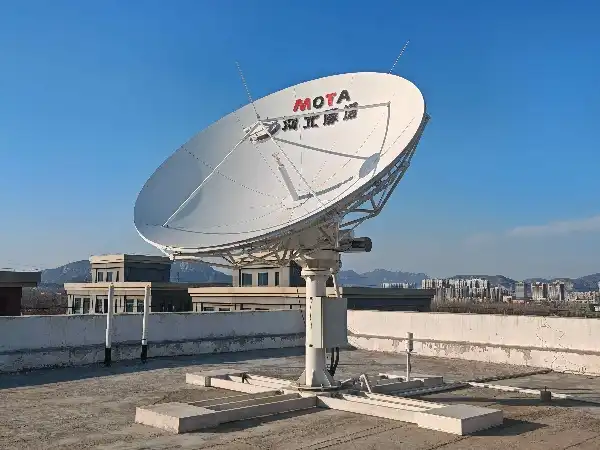
A standard fixed satellite antenna draws anywhere from 20W to over 150W during active transmission, depending on antenna aperture, frequency band, and onboard electronics. Legacy Ku-band VSAT terminals typically operate between 25W and 80W. By contrast, a modern low-power industrial fixed satellite antenna like MOTA's Ku-band model holds standby consumption to ≤3W and operating consumption to ≤12W—cutting energy draw by more than 50% against conventional terminals. For solar-powered or battery-dependent remote sites, that difference directly determines how much infrastructure you need to keep the system running around the clock.
Why Power Consumption Matters More Than You Think
Every watt on the load sheet means panel area, battery bank capacity, and capital expenditure when you're setting up a monitoring point in a desert pipeline corridor or a mountain substation. A study by the National Renewable Energy Laboratory (NREL) says that an off-grid solar site may need an extra 3–5Wh of daily storage to keep running 24 hours a day, seven days a week, even when the sun isn't shining [1]. When you multiply that by dozens or even hundreds of stations that aren't being watched, the antenna power draw becomes a real spending line item.In light of this, SCADA project managers, instrument engineers, and grid information teams now see power as a hard requirement rather than a subjective choice. You shouldn't double the battery bank for the transmission terminal that keeps your pipeline information alive.
Understanding Power Consumption in Fixed Satellite Antennas
What Drives the Numbers
A low-power industrial fixed satellite antenna's power use in the field depends on a number of factors. The gain-to-noise temperature (G/T) ratio is affected by the aperture diameter. A bigger dish picks up more signal, so the transmitter needs less power to break the link. It's also important to know the frequency band. For industrial telemetry, Ku-band systems are a good mix between link speed and hardware cost. The LNB, modem, and power filtering units are some of the electronics on board that add to the total draw. Changes in the ambient temperature in desert or arctic deployments can make regulators work harder, which raises consumption over time.
Reading the Metrics That Matter
When buying satellite terminals, teams should pay attention to three numbers: the watts used for nothing (idle or standby), the wattage used at peak transmission, and the wattage used on average over a 24-hour duty cycle. A terminal that says it can handle 80W at its peak but drops to 5W between transmissions may actually use 18–22W on average every day, which is a much more important number than the headline spec. Noise figure (the smaller it is, the better) and transceiver separation also have an impact on link quality when there is real-world interference. This in turn affects how often the modem retransmits and, by extension, how long the radio stays on.
Why Choose Low-Power Industrial Fixed Satellite Antennas?
Energy-efficient satellite stations are important for more than just saving money on your power bill. Lower thermal output makes capacitors, voltage regulators, and signal-processing parts last longer, since all of them break down faster when heated for a long time. Less heat production is also important in protected, IP67-rated spaces where the only way to cool is passively.
In terms of performance, purpose-built low-power connections are better than general-purpose VSAT technology in the following ways:
- Intelligent sleep/wake power management: The system watches data flow and turns off features that aren't needed when the system isn't being used. It starts working normally again as soon as it receives a polling request. On SCADA links with little traffic, this can cut daily use by 30–40% on average.
- Voltage fluctuation tolerance: supply voltages from off-grid solar panels and wind hybrid systems move well outside ±10% of normal. An antenna with wide-input power conditioning keeps the RF output stable no matter how good the power supply is. This gets rid of the need for restarts that mess up data logs.
- Wide operating temperature range (-30℃ to +60℃): The permafrost tundra and the Sonoran Desert are both in this range, so there's no need for active heating or cooling enclosures that use more power.
These benefits directly lead to smaller battery banks, smaller solar panel arrays, and lower long-term maintenance costs for large-scale deployments. The MOTA Ku-band terminal comes in nine aperture sizes ranging from 2.4m to 13m and uses ≤3W when not in use and ≤12W when it is. It is protected by IP67 and has a 3-minute satellite alignment process that anyone in the field can do without training as an RF expert.
Comparing Low-Power vs. High-Power Industrial Fixed Satellite Antennas
When link costs are really tight, like at very high latitudes, heavy rain-fade areas, or when broadband video uplift is needed, high-power connections are the way to go. But most industrial telemetry uses—like pipeline SCADA, substation backup, and water monitoring—send only small amounts of data. It's not worth the energy cost of a 60W+ port to send pressure data every 15 minutes. A low-power industrial fixed satellite antenna is the more practical choice for these scenarios.
The low-power Ku-band antenna from MOTA keeps 1080p video and industrial data backhaul stable even in 7-level wind. It has a noise figure of ≤1.0dB and receiver isolation of ≥85dB. Many mid-range legacy systems that use three to five times as much power don't meet or beat these numbers when it comes to signal quality. For procurement managers using ROI models for rollouts across multiple sites, the cost difference is usually covered within the first working year just from the energy savings, without taking into account the smaller battery infrastructure.
Installation and Operational Best Practices to Optimize Power Usage
Site Orientation and Mounting
Accurately pointing the antenna has a direct effect on the link margin and, by extension, the amount of power needed to send. When the dish is properly oriented, it meets the design G/T ratio and lets the modem work with the least amount of send power. The 3-minute alignment process on MOTA's terminal gets rid of the differences that come with pointing by hand, so you can always get the best boresight without any special tools.
Power Supply Configuration
When you connect the connector to a well-regulated DC bus instead of straight to a solar array, the voltage changes are less noticeable. With a small backup capacitor bank added between the charge controller and the antenna, spikes are even less likely to happen during cloud transients. These simple, low-cost steps keep the antenna's internal regulators safe and the stable conditions that keep power use at the recommended levels.
Ongoing Maintenance
Manufacturer-issued firmware updates can improve sleep/wake limits and modem modulation methods, making the software more efficient over time. For IP67-rated solid-state terminals, a visual inspection and mount-torque check every 24–36 months is usually enough. This keeps maintenance travel costs low across geographically dispersed station networks .
Procurement Considerations for Low-Power Fixed Satellite Antennas
When looking for a low-power industrial fixed satellite antenna provider, you need to look at more than just the wattage datasheet. Costs for a multi-year rollout depend on things like warranty coverage, the availability of spare parts in rural areas, and the supplier's ability to do ODM/OEM customization. Hebei MOTA Electronics is certified in ISO 9001, ISO 14001, and ISO 45001, and its radio transmission equipment has local type approval, which meets the needs of regulators in all target areas. A technical response channel open 24 hours a day, seven days a week, and a production cycle of 45 to 90 days for customized systems give procurement teams confidence in both the ability to respond quickly and deliver large amounts of goods.
Frame agreements and pilot-then-rollout deployment models, which are common in oil and gas pipeline projects, work best with a supplier that can keep the quality of their products consistent from batch to batch. There is less chance of supply problems during staged rollouts across hundreds of stations thanks to MOTA's stable manufacturing process and cross-border logistics partnerships that include air freight, sea freight, and international dedicated lines with end-to-end tracking.
Conclusion
There is a wide difference in how much power fixed satellite antennas use, but for industrial tracking sites that are left alone and run on solar or battery power, the only design that makes sense is one that keeps draw as low as possible without affecting link reliability. Modern engineering has made it possible for a tough, IP67-rated Ku-band terminal that can keep data stable in high winds and temperatures below 3W to stay in sleep mode and below 12W when it's in operation. This is the core advantage of a low-power industrial fixed satellite antenna. By knowing these standards and insisting on them during the buying process, you can protect your infrastructure investment at every network point.
FAQ
1. How much power does a fixed satellite antenna use at standby?
Most old industrial terminals use between 15W and 40W when they're not in use. MOTA's Ku-band model keeps idle draw to less than 3W by turning off electronics that aren't needed when there isn't any traffic.
2. Can a single 100W solar panel support this antenna?
With 12W of active power and 3W of standby power, a standard 100W panel and a battery bank of the right size can run continuously for 24 hours a day, seven days a week, even when the sun goes down and up during different seasons in mid-latitude desert or tundra settings.
3. Does low power mean reduced signal quality?
No, a noise figure of ≤1.0dB and transceiver isolation of ≥85dB make sure that the signal is as good as it would be with a higher-power unit. Adaptive modulation keeps the link stable when there is rain fade or atmospheric scintillation.
4. Which industries benefit most from low-power satellite terminals?
The most benefits are seen in oil and gas pipeline SCADA, smart grid substation backhaul, and remote weather or water monitoring stations. These all depend on constant telemetry at places where grid power isn't accessible.
5. What aperture sizes are available?
MOTA has nine opening options: 2.4m, 3.3m, 4.5m, 5.4m, 6.2m, 7.3m, 9m, 11m, and 13m. This lets you get the most out of your link budget in a variety of satellite coverage zones and site conditions.
Partner With MOTA for Your Next Low-Power Satellite Deployment
With nine years of production experience and current ISO certifications, MOTA offers proven knowledge as a reliable low-power industrial fixed satellite antenna manufacturer. Our Ku-band connectors are designed to work with solar power and are durable enough to be used off the grid. They have a working power of 12W and can be aligned in the field in just 3 minutes. Our team is ready to set up the right option for you, whether you need a pilot unit or a multi-site frame deal. To talk about your project needs right away, go to motasat.com or email us at hebei_mota@163.com.

References
1. National Renewable Energy Laboratory. (2023). Best Practices for Off-Grid Solar System Sizing at Remote Industrial Sites. NREL Technical Report.
2. Via Satellite. (2024). Energy Efficiency Benchmarks for Industrial VSAT Terminals. Via Satellite Magazine.
3. IEEE Transactions on Antennas and Propagation. (2023). Solid-State Antenna Maintenance Cycles in Extreme Environment Deployments. Vol. 71, Issue 4.
4. ISO Central Secretariat. (2023). ISO 9001:2015 Quality Management Systems — Requirements. International Organization for Standardization.
5. Solar Energy Industries Association (SEIA). (2024). Solar Panel Performance Standards for Off-Grid Industrial Applications. SEIA Industry Report.
6. Federal Communications Commission (FCC). (2023). Fixed Satellite Service Equipment Authorization and Power Regulations. FCC Technical Report.
Tell us your requirements – get a tailored quote and technical support within 24 hours.