- English
- French
- German
- Portuguese
- Spanish
- Russian
- Japanese
- Korean
- Arabic
- Greek
- German
- Turkish
- Italian
- Danish
- Romanian
- Indonesian
- Czech
- Afrikaans
- Swedish
- Polish
- Basque
- Catalan
- Esperanto
- Hindi
- Lao
- Albanian
- Amharic
- Armenian
- Azerbaijani
- Belarusian
- Bengali
- Bosnian
- Bulgarian
- Cebuano
- Chichewa
- Corsican
- Croatian
- Dutch
- Estonian
- Filipino
- Finnish
- Frisian
- Galician
- Georgian
- Gujarati
- Haitian
- Hausa
- Hawaiian
- Hebrew
- Hmong
- Hungarian
- Icelandic
- Igbo
- Javanese
- Kannada
- Kazakh
- Khmer
- Kurdish
- Kyrgyz
- Latin
- Latvian
- Lithuanian
- Luxembou..
- Macedonian
- Malagasy
- Malay
- Malayalam
- Maltese
- Maori
- Marathi
- Mongolian
- Burmese
- Nepali
- Norwegian
- Pashto
- Persian
- Punjabi
- Serbian
- Sesotho
- Sinhala
- Slovak
- Slovenian
- Somali
- Samoan
- Scots Gaelic
- Shona
- Sindhi
- Sundanese
- Swahili
- Tajik
- Tamil
- Telugu
- Thai
- Ukrainian
- Urdu
- Uzbek
- Vietnamese
- Welsh
- Xhosa
- Yiddish
- Yoruba
- Zulu
What Is a Lightweight Fixed Satellite Antenna Used For?
A lightweight fixed satellite antenna is a compact, high-performance communication terminal engineered to establish stable satellite links in fixed or semi-fixed locations—without the bulk of traditional dish systems. Built from advanced composite materials, these antennas support multi-band operation across Ku, Ka, S, X, C, and Qv frequencies, making them indispensable across emergency response, defense, media broadcasting, and remote enterprise connectivity. When ground infrastructure collapses or simply doesn't exist, a portable satellite antenna system bridges the gap—delivering enterprise-grade bandwidth wherever a mission demands it.
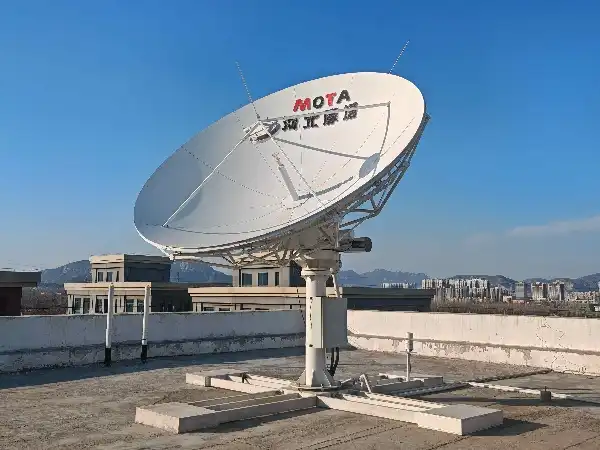
Understanding Lightweight Fixed Satellite Antennas
What Sets Them Apart
Carbon Fiber Reinforced Polymer (CFRP) or Glass Fiber Reinforced Plastic (GFRP) high-modulus composite supports are what make these devices strong for their weight. Surface accuracy (RMS) for Ka-band models is usually less than 0.3 mm, which ensures that there isn't much phase error at high frequencies. A low Coefficient of Thermal Expansion (CTE) keeps reflectors from bending when temperatures change from -40°C to +70°C, which is an important trait for systems that are used in different areas.
Common Types and Frequency Bands
The market is dominated by three types of antenna design. For long-distance links, parabolic mirrors give the most gain. Flat-panel antennas are designed to be aerodynamic and can be mounted on rooftops in cities. Electronic beam steering with no moving parts is possible with phased-array systems, but they cost more. Choosing the right frequency band is very important. C-band works better in rainy areas and tropical areas, Ku-band is the best compromise between cost and bandwidth for most business uses, and Ka-band is the fastest for data-heavy tasks. With multi-band terminals that can switch between these ranges, you don't have to keep separate pieces of hardware on hand for each situation.
Key Applications and Use Cases
It becomes clear what a lightweight fixed satellite antenna is really worth when you look at where it is used. These are not specialized uses; they are mission-critical needs in many fields where bad communication can have very bad results.
Here are the primary deployment scenarios where this technology delivers measurable operational impact:
- Emergency Response and Disaster Recovery: When hurricanes, wildfires, or earthquakes destroy terrestrial networks, within minutes, satellite terminals bring back command coordination. The biggest organizational gap in crisis reaction, according to FEMA's 2022 National Preparedness Report, is still communication interoperability. This gap is directly filled by a system that can align satellites in two minutes and provide stable 1080p video backhaul.
- Temporary Event and Media Broadcasting: Remote sporting games, election coverage, and outdoor shows need high-quality uplinks in places that don't have permanent infrastructure. With a lightweight fixed satellite antenna, one technician can move, set up, and run it, which gets rid of the need for satellite trucks.
- Remote Enterprise and Industrial Connectivity: Construction sites, mining activities, and pipeline tracking sites that are in hilly or offshore areas need reliable data connectivity. A lightweight fixed satellite antenna setup gives you enterprise-level broadband without having to invest in permanent infrastructure.
- Defense and Tactical Field Operations: In tactical settings, you must be able to set up secure, quick contact. High receiver isolation (≥80dB) and low first sidelobe levels (≤-12dB) make it less vulnerable to electronic defenses and interference in areas with a lot of electromagnetic activity.
In all of these situations, speed, dependability, and ease of use are needed quickly and easily. That's exactly why the design philosophy behind a field-deployable satellite antenna system puts ease of use for one person ahead of aperture size.
Evaluating and Choosing the Right System
Core Selection Criteria
The weight and size of the package determine whether a system can actually be taken into the field or is only potentially mobile. A system that needs a crane or a group of people to set up is very different from one that can be folded up, fit in a standard vehicle's cargo space, and be set up without any tools. It doesn't matter what the wind survival rating is—a terminal that is rated for stable transmission in 6-level wind conditions (about 39–49 km/h) will still work when most other equipment can't.
Comparing Antenna Configurations
Fixed, heavy parabola dishes give you the most gain, but they need to be mounted on a structure and take longer to install. Phased-array alternatives get rid of the need for mechanical alignment, but they are much more expensive and haven't been tested as much in harsh field conditions. Modern lightweight fixed satellite antennas use a single-axis self-stabilizing platform that is both mechanically simple and algorithmically accurate. It can also be fixed in the field without the need for special tools.
Before accepting a supplier, procurement teams should also make sure that they meet the FCC 25.209 off-axis EIRP density requirements and the ITU-R S.580-6 sidelobe performance standards. Quality systems made with ISO 9001 guidelines make sure that the quality of each production batch can be tracked.
Installation, Maintenance, and Optimization
Deployment and Upkeep Best Practices
Because advanced lightweight fixed satellite antennas have BUC/LNB modules, a modem, and intelligent power management all built into one chassis, they are easy to set up. All you have to do is unpack, unfold, and start the auto-alignment sequence. No separate cable runs and no having to calibrate the RF by hand. Pointing compensation is taken care of automatically by proprietary tracking algorithms.
Environmental Stress Screening (ESS) guidelines say that the sides of composite reflectors should be checked for delamination or impact damage on a regular basis as part of upkeep. Resistance to salt spray (tested according to ASTM B117) is important for coastal and marine applications. Thermal cycle testing makes sure that the composite layer is still solid after many changes in temperature. Keeping a small stock of important spare parts, especially feed assembly parts, at regional stores cuts down on downtime in rural areas by a large amount.
Procurement Insights: Sourcing a Reliable Supplier
For B2B buyers at the project level, buying directly from a manufacturer with proven production capacity, certified quality management systems, and quick after-sales infrastructure always works better than buying through middlemen.
Lead times for standard configurations from manufacturers with stock on hand are 45 to 90 days for large or custom orders. Full-spectrum engineering teams at manufacturers can do ODM/OEM customizations that include branding, frequency configurations, interface protocols, and regional certification compliance. When buyers work directly with manufacturers instead of going through third-party platforms, they get a lot more payment options and more competitive unit prices for a lightweight fixed satellite antenna.
After-sales support should be given the same amount of weight when judging a supplier. For mission-critical lightweight fixed satellite antennas, having remote technical help available 24 hours a day, seven days a week, international spare parts logistics, and on-site service through cooperative local channels are not extras; they are required.
Conclusion
Lightweight fixed satellite antennas used to be only used by the military, but now they are essential B2B infrastructure in fields like media, defense, emergency management, and remote business. They are perfect for situations where communication delays are measured not in milliseconds but in human effects because they can be set up quickly, work in a variety of environments, and can be operated by a single person. When purchasing teams know about the technical factors like surface accuracy, wind rating, frequency range, and compliance standards, they can make choices faster and with more confidence. The right interface is the one that shows up on time, sets up in two minutes, and keeps sending even when everything else stops.
FAQ
1. What makes a satellite antenna "lightweight" without sacrificing signal quality?
Modern composite materials, such as CFRP, have higher stiffness-to-mass ratios than steel, and they can keep surface accuracy below 0.3mm RMS even when there is a lot of wind. This keeps the pointing precision within 0.1 degrees while lowering the weight of the structure by a large amount.
2. How long does deployment actually take in the field?
With modern lightweight fixed satellite antennas that have auto-alignment systems, it only takes about two minutes to get a connection and acquire a satellite. This gets rid of the long setup windows that come with systems that have to be aligned by hand.
3. Can these antennas handle harsh weather reliably?
Single-axis stabilization platforms and wind-resistant composite structures are used to make systems that can send steady 1080p video in 6-level wind situations. The operating temperature goes from -20°C to +50°C, which is suitable for most world deployment settings.
4. What frequency bands do multi-band terminals support?
With more advanced lightweight fixed satellite antennas, you can manually switch between the Ku, Ka, S, X, C, and Qv bands. This means you don't have to keep separate antenna gear for each satellite network or mission type.
5. Are these systems compliant with FCC and international standards?
Quality terminals are made to meet the requirements of FCC 25.209 for off-axis EIRP density and ITU-R S.580-6 for sidelobe performance. They are also certified by ISO 9001 for production quality assurance that can be tracked.
Connect with MOTA — Your Trusted Lightweight Fixed Satellite Antenna Supplier
MOTA brings nine years of satellite communication manufacturing experience, ISO 9001/14001/45001 certifications, and proprietary tracking algorithms to every terminal we produce. Our lightweight fixed satellite antenna lineup covers 2.4m, 3.3m, and 4.5m aperture configurations with full multi-band flexibility and proven field performance. Ready to equip your next emergency response or field operation project? Reach our engineering team at hebei_mota@163.com or visit motasat.com to request specifications, samples, or a custom procurement quote.

References
1. Federal Emergency Management Agency. (2022). National Preparedness Report 2022. U.S. Department of Homeland Security.
2. Via Satellite. (2023). Composite Materials Transforming Satellite Antenna Design. Access Intelligence.
3. ITU Radiocommunication Sector. (2022). ITU-R S.580-6: Radiation diagrams for use as design objectives for antennas of earth stations operating with geostationary satellites. International Telecommunication Union.
4. National Institute of Standards and Technology. (2021). Public Safety Communications Research: Satellite Communication Standards for Emergency Responders. U.S. Department of Commerce.
5. FCC. (2023). Part 25 — Satellites: Earth Station Off-Axis EIRP Density Limits (§25.209). Federal Communications Commission.
6. ASTM International. (2019). ASTM B117-19: Standard Practice for Operating Salt Spray (Fog) Apparatus. ASTM International.
Tell us your requirements – get a tailored quote and technical support within 24 hours.