- English
- French
- German
- Portuguese
- Spanish
- Russian
- Japanese
- Korean
- Arabic
- Greek
- German
- Turkish
- Italian
- Danish
- Romanian
- Indonesian
- Czech
- Afrikaans
- Swedish
- Polish
- Basque
- Catalan
- Esperanto
- Hindi
- Lao
- Albanian
- Amharic
- Armenian
- Azerbaijani
- Belarusian
- Bengali
- Bosnian
- Bulgarian
- Cebuano
- Chichewa
- Corsican
- Croatian
- Dutch
- Estonian
- Filipino
- Finnish
- Frisian
- Galician
- Georgian
- Gujarati
- Haitian
- Hausa
- Hawaiian
- Hebrew
- Hmong
- Hungarian
- Icelandic
- Igbo
- Javanese
- Kannada
- Kazakh
- Khmer
- Kurdish
- Kyrgyz
- Latin
- Latvian
- Lithuanian
- Luxembou..
- Macedonian
- Malagasy
- Malay
- Malayalam
- Maltese
- Maori
- Marathi
- Mongolian
- Burmese
- Nepali
- Norwegian
- Pashto
- Persian
- Punjabi
- Serbian
- Sesotho
- Sinhala
- Slovak
- Slovenian
- Somali
- Samoan
- Scots Gaelic
- Shona
- Sindhi
- Sundanese
- Swahili
- Tajik
- Tamil
- Telugu
- Thai
- Ukrainian
- Urdu
- Uzbek
- Vietnamese
- Welsh
- Xhosa
- Yiddish
- Yoruba
- Zulu
How Does Transmit Power Affect Fixed Satellite Antenna Performance?
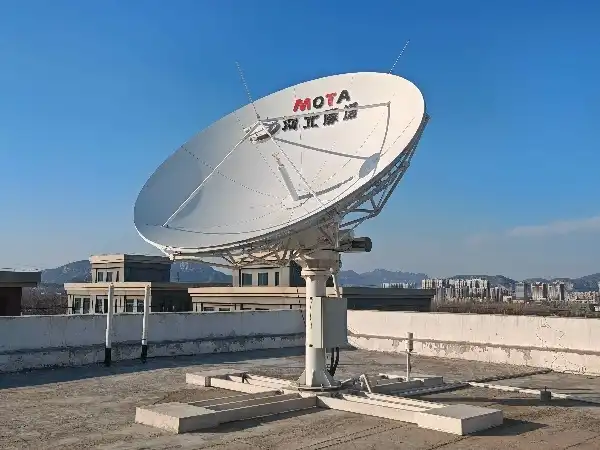
Transmit power sets how strongly a fixed satellite antenna reaches the satellite, and that shapes link margin, throughput and interference. A dual-band high-power fixed satellite antenna turns watts into usable capacity only when gain, pointing, isolation and heat control work together. Doubling output adds just 3 dB, and a small pointing error can erase that gain. In this guide, I explain how transmit power works, which datasheet numbers deserve a second look, and how MOTA builds antennas rated at 50 W or higher for backbone, broadcast and data center links. I keep the math light and the examples practical.
Understanding Transmit Power in Fixed Satellite Antennas
It's helpful to agree on what the numbers mean before you compare models. These three points are the most important ones.
What Transmit Power Means in Practice
The radio frequency energy that the amplifier sends to the receiver feed is called transmit power. Engineers use watts or dBW, which is a decibel scale based on watts, to measure it. It takes about 17 dBW, or 47 dBm, to make 50 W of sound. EIRP is what the satellite sees. It is equal to broadcast power at the feed plus antenna gain minus feed losses. So, a 50 W amplifier on a big dish can work better than a 100 W amplifier on a small one. The first thing a buyer needs to know is whether the wattage given refers to output at the antenna port or just at the amplifier. Find out how much your link budget is at that point.
How Power Shapes Signal Strength, SNR and Throughput
The signal-to-noise ratio (SNR) at the satellite sensor goes up when the uplink is greater. In 1948, Claude Shannon came up with the idea that capacity grows as SNR goes up by a factor of ten. So power does help, but only up to a point. Doubling the power adds about 3 dB, and as the link gets better, the percentage gain goes down. The modem can choose a better modulation and coding method when the SNR is higher.
This lets it send more bits through the same transponder. That's important for 8K video backhaul and connecting data centers, where steady rates are more important than peak rates. Power has a limit too. When an amplifier gets too much juice, it reaches saturation, and then distortion spreads to nearby carriers. To avoid going over, good planners leave room for error.
Why Band Choice Changes the Power You Need
Each band acts in a unique way. C-band uplinks work well in rain and are close to 6 GHz. Ku-band uplinks are close to 14 GHz, and Ka-band uplinks are close to 30 GHz, which is faster than rain. ITU-R Recommendation P.618 describes the ways that planners use to guess how long it will take for rain to stop falling in each place.
At Ka-band, a strong storm can need a lot of extra margin, which the amplifier has to provide. When you use the same dish size for higher bands, the beams are narrower, so pointing is more important. Since FCC rules in 47 CFR Part 25 govern earth station licensing in the US, regulators add another limit. You can pick the band that works best for the weather and the satellite with a multi-band antenna instead of putting too much into one band.
Dual-Band vs Single-Band Satellite Antennas: Transmit Power Considerations
Band count changes how a power receiver works. The trade-offs are shown in the next three sections.
How Dual-Band Designs Handle Power
Multi-band and dual-band antennas use a single structure to cover more than one frequency band. This saves space on the spot and on extra parts. For this reason, the feed, filters, and amplifier chain need to be able to handle all of the frequencies without interfering with any of them. Because path loss, regulatory limits, and amplifier efficiency are all different, each band needs its own power allocation.
Since a single-band antenna can only focus on one frequency, it may be easier for it to reach its peak performance. However, a multi-band hub needs more units. The MOTA dual-band high-power fixed satellite antenna works with Ku/Ka/S/X/C/Qv signals and has a clever band identification function and automatic swapping. People who want to buy often ask if moving breaks the link, so I suggest that you write down the accepted switch time in your RFQ and test it before accepting it.
Isolation and Noise Figure at High Power
One big problem with high send power is that it can leak into the receive line. A 50 W signal is about +47 dBm, while the satellite signal that is being received is very weak. The wall between them is transmit-receive isolation. MOTA says that the separation must be at least 95 dB and the noise level must be at least 0.7 dB. A noise level of 0.7 dB is the same as a noise temperature of about 51 K, which makes the receive side responsive.
The first sidelobe level is –20 dB or less, which stops energy from spreading to nearby satellites. This is a problem that ITU-R S.580 and FCC rules try to fix. Ask any vendor if their noise and isolation numbers were taken at full output power or low drive when you look at their numbers. A claim on a datasheet is different from a result that was tested by that one question.
Reading Vendor Datasheets Fairly
In their datasheets, companies like Cobham SATCOM, Intellian, and Hughes Network Systems list broadcast power, EIRP, and gain. However, the meaning of these terms can be different from one sheet to the next. Some list the output of the amplifier, some list the EIRP at the flange, and some list the numbers at a certain band edge. Before you compare prices, make sure you're looking at the same amount in the same way.
Maritime antennas also keep them stable when the ship moves, which adds design requirements that buyers who want to use them at a set spot don't need. For a fixed hub antenna, the design work can be focused on how to handle power, how to isolate signals, and how to point accurately. Make a simple table with the output at the port, the gain, the EIRP, the noise figure, the isolation, the temperature range, and the switch time once you have a short list. Then have each provider fill out the same table.
Improving Fixed Satellite Antenna Performance Through Transmit Power Management
The raw wattage is just the beginning. Taking good care of that power keeps lines stable and tools in good shape.
Pointing Accuracy and Calibration
Power doesn't mean much if the beam doesn't hit its mark. If you split the pointing mistake by the 3 dB beamwidth, you get the pointing loss in decibels, which is about 12 times that number. A mistake that is equal to a quarter of the beamwidth costs about 0.75 dB. This is closer than at C-band because the beams are narrower at Ka-band. The antenna on MOTA can point with an error of 0.1° or less, and it has both human and automatic aiming modes.
Automatic mode is useful for places that are far away, and manual mode gives engineers a backup option while starting for our dual-band high-power fixed satellite antenna. When setting up the send chain, make sure it is calibrated. Use a power meter to check the output and write down the numbers. With a baseline log, your NOC can see drift months later instead of having to guess.
Adaptive Power Control for Rain Fade
It can rain at any time, and a constant high output wastes power on clear days. When the link gets weaker, uplink power control raises the output. When the sky clears, it lowers the output. The antenna from MOTA has smart power control that only sends output when it is needed. This way, the amplifier doesn't have to work hard when the link doesn't need it. Less average output means less heat and stress on the parts, which helps them last longer.
It also keeps carrier levels in the range that the satellite operator wants them to be, which is important because operators set power limits to protect transponders that are shared. Power control and band swapping should be used together. If Ka-band goes out during a storm, traffic may be able to stay on a lower band, as long as your satellite service allows it.
Heat, Weather and Remote Monitoring
High-power amplifiers turn some of the power they receive into heat, and as the temperature rises, gain and efficiency generally go down. The case has to keep the gadgets safe and let that heat escape. The antenna for MOTA has a high-strength aluminum alloy shell that is protected by IP67. It can work in temperatures ranging from -30 °C to +60 °C. Those ratings work for both coastal salt air and desert heat, but you should still plan for shade, drainage, and regular checks.
The smart control module and integrated high-power transceiver report status, and the system sends alerts automatically when it finds problems. Remote status data saves time for a NOC that keeps an eye on many sites in different time zones. We can talk about interface protocols through ODM/OEM customization if you ask how alerts can connect to your network management system.
Practical Applications and Decision-Making for High-Power Dual-Band Antennas
The most important thing about specs is that they match up with a real job. These parts talk about site fit, approvals, and checks on the source.
Matching Power to Your Site
Don't start with the leaflet, but with the link fund. For interconnecting and replicating, big data centers need links that are stable and fast. In order to send 8K feeds, broadcasters need clean uplinks. Backbone paths that are reliable over long distances are needed for government and business hubs. For each case, the EIRP, availability, and margin goals are different. The antenna from MOTA can handle 8K video and large amounts of cluster data backhaul, and it works well for networked deployment. First, count your sites.
Then, count your models. If you replace several single-band units with a multi-band unit, you'll save time and money on extra parts and training. To your calculations, you should add the amount of power used, the site's power source, and the position of the antenna. Then, you should set a rain margin goal for your busiest band. If you need stable antennas for marine or mobile use, I handle them differently than set hubs.
Licensing, Shipping and Support Concerns
Three concerns buyers bring up over and over for the dual-band high-power fixed satellite antenna. The first one is time for approval. For high-power transmitters, you need spectrum licenses and equipment approvals, so get the paperwork done as soon as possible. In the US, 47 CFR Part 25 covers earth station licenses. Each country has its own rules. Our ODM/OEM service changes hardware, interface protocols, and functional modules to fit the rules of the target country.
MOTA has a local radio transmission equipment type approval. The second fear is getting around. We use shockproof and moisture-proof packaging to send sensitive electronics overseas. We also work with international dedicated lines for air and sea freight, and we help with customs clearance and tracking. The third worry is service in places where there isn't a local office. Our team is available 24 hours a day, seven days a week to help with installation, troubleshooting, and upgrades remotely. Cooperative channels can also provide on-site support and spare parts.
Why Buyers Trust MOTA's Factory
Hebei MOTA started out in 2017 as a company that both made and sold things. We have nine years of experience making things now. Along with ISO 9001, ISO 14001, and ISO 45001, we also have the GJB 9001C military quality management system. We are a national high-tech company and a company that helps the military and civilians work together. Our engineers create satellite transmission antennas and high-precision tracking methods in-house.
These are protected by a number of intellectual property laws. We have a lot of stock ready for normal sales. Customized and big systems take 45 to 90 days, so set early on that time frame as one of your project's goals. Checks or videos of the plant are welcome, and I suggest testing a sample before placing a large order. Send us the bands you want to use, the power level, and the conditions at the site, and we'll map them to a configuration. It's possible to pay for big projects over time with flexible terms.
Conclusion
A fixed satellite antenna's EIRP, signal-to-noise ratio, and throughput are all controlled by its transmit power. However, the gains are logarithmic, since doubling output only adds 3 dB. Antenna gain, pointing accuracy, transmit-receive isolation, noise figure, and thermal control all affect how much power is useful. The amount of margin a link needs depends on the band it is in, especially when it comes to Ka-band rain fade.
With multi-band designs for our dual-band high-power fixed satellite antenna, there are fewer models needed at a spot, as long as the figures in the document show the same measuring conditions. Power management that adapts to the situation, precise calibration, and remote tracking help keep output high and help workers notice shift early. In practice, this means that buyers need to start with a link budget, check the specifications at full output, and make plans for licensing, shipping, and support before they place an order.
FAQ
Does higher transmit power always improve link quality?
No, adding more power only raises SNR if the amplifier stays straight and the beam points in the right direction. After that point, distortion and disturbance from nearby satellites get worse, and operators may limit your output. It only takes 3 dB to double the power, so check the gain, pointing, and isolation first.
What happens if I exceed the recommended power level?
Going over the rated or licensed output can distort the signal, cause it to get too hot, interfere with nearby satellites, and could lead to action from the government. Follow the limits set by your satellite provider and keep the headroom below the amplifier's saturation point. MOTA's smart power adjustment means that the output only goes up when it's needed, instead of always being at full power.
Can I adjust power remotely on a dual-band high-power fixed satellite antenna?
MOTA's dual-band high-power fixed satellite antenna lets you check on its state from afar and sends you automatic messages when something goes wrong. Its smart power adjustment changes the output based on demand. Talk to us to make sure that the network management interfaces and remote functions we offer are right for your project.
Request a Quote for Your Dual-Band High-Power Fixed Satellite Antenna from MOTA
MOTA makes dual-band high-power fixed satellite antennas and is certified by ISO 9001, ISO 14001, and ISO 45001; they have stock ready for regular orders and can make custom systems in 45 to 90 days. Send your link budget, target bands, and delivery date to hebei_mota@163.com. Our team will get back to you with a setup suggestion as soon as possible. Find out more at motasat.com and get your price right away.

References
1. Satellite Communications Systems: Systems, Techniques and Technology, 6th Edition (Wiley), 2020
2. Satellite Communications, 3rd Edition (Wiley), 2019
3. Satellite Communications Systems Engineering, 2nd Edition (Wiley), 2017
4. ITU-R Recommendation P.618-13: Propagation Data and Prediction Methods Required for the Design of Earth-Space Telecommunication Systems (International Telecommunication Union), 2017
5. A Mathematical Theory of Communication (Bell System Technical Journal), 1948
6. Electronic Code of Federal Regulations, Title 47, Part 25: Satellite Communications (U.S. Federal Communications Commission), 2024
Tell us your requirements – get a tailored quote and technical support within 24 hours.