- English
- French
- German
- Portuguese
- Spanish
- Russian
- Japanese
- Korean
- Arabic
- Greek
- German
- Turkish
- Italian
- Danish
- Romanian
- Indonesian
- Czech
- Afrikaans
- Swedish
- Polish
- Basque
- Catalan
- Esperanto
- Hindi
- Lao
- Albanian
- Amharic
- Armenian
- Azerbaijani
- Belarusian
- Bengali
- Bosnian
- Bulgarian
- Cebuano
- Chichewa
- Corsican
- Croatian
- Dutch
- Estonian
- Filipino
- Finnish
- Frisian
- Galician
- Georgian
- Gujarati
- Haitian
- Hausa
- Hawaiian
- Hebrew
- Hmong
- Hungarian
- Icelandic
- Igbo
- Javanese
- Kannada
- Kazakh
- Khmer
- Kurdish
- Kyrgyz
- Latin
- Latvian
- Lithuanian
- Luxembou..
- Macedonian
- Malagasy
- Malay
- Malayalam
- Maltese
- Maori
- Marathi
- Mongolian
- Burmese
- Nepali
- Norwegian
- Pashto
- Persian
- Punjabi
- Serbian
- Sesotho
- Sinhala
- Slovak
- Slovenian
- Somali
- Samoan
- Scots Gaelic
- Shona
- Sindhi
- Sundanese
- Swahili
- Tajik
- Tamil
- Telugu
- Thai
- Ukrainian
- Urdu
- Uzbek
- Vietnamese
- Welsh
- Xhosa
- Yiddish
- Yoruba
- Zulu
What is an energy-saving fixed satellite antenna?
An energy-saving fixed satellite antenna is a stationary Ku-band ground terminal built to keep power draw low while holding a stable satellite link. It stays aimed at one satellite and pairs a low-noise receive chain with auto sleep and wake control and an integrated modem. MOTA's model draws 5W or less in standby and 15W or less in operation, which reduces energy use by over 40% compared with conventional satellite antennas. That matters most at off-grid and weak-grid sites, where solar panels and batteries drive the project budget. In this guide, I explain how the technology works, where it fits, and how to buy it.
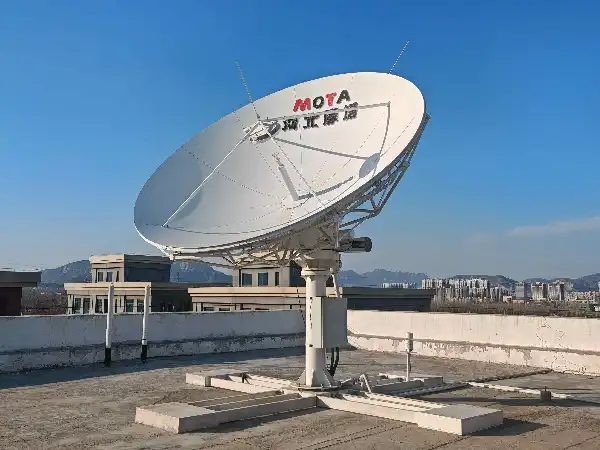
Understanding Energy-Saving Fixed Satellite Antennas
How Power Draw Stays Low
Because it is fixed and only points at one geostationary satellite, the electronics behind the dish use most of the power. A simple modem and an energy-saving LNB module are built into one unit in MOTA's design, which cuts down on that load. Power consumption is less than 5W when not in use and less than 15W when it is.
The smart power management feature turns off the terminal when there is no traffic and turns it back on when data demand comes back. Imagine a laptop that turns off when you leave it alone. Your batteries and solar panels carry less weight during the day because the terminal idles at a low draw.
Signal Specifications That Hold Up at Low Power
It is only helpful to save energy if the link stays clean. It says that this antenna has transceiver isolation of 85dB or higher, which means that there isn't much loss between the send and receive routes. Its first sidelobe level is -14dB or less, which makes it less likely to pick up signals from nearby satellites.
The noise level is 1.1dB or less, and the usual conversion puts that noise level close to 84 K, which means that weak messages can still be read. Some books on satellite engineering, like Pratt, Bostian, and Allnutt's Satellite Communications, say that less receiver noise makes the link margin better without sending more power. The terminal can do its job with less power thanks to its clean RF design.
Ku-Band Operation and Aperture Options
It works in Ku-band, which is a popular choice for VSAT backhaul for internet, video, and data. There are nine different opening sizes: 13m, 11m, 9m, 7.3m, 6.2m, 5.4m, 4.5m, 3.3m, and 2.4m. A bigger dish picks up more information and works better for places that need more link space. An easier dish to ship and set up is one that is smaller.
The energy-saving fixed satellite antenna terminal works between -20°C and +50°C and has an IP64 rating, which according to IEC 60529 means it is dust-tight and can handle water splashes. It can still send stable 720p video in level 6 wind, which is a strong breeze of about 39 to 49 km/h on the Beaufort scale.
Benefits and Applications for B2B Users
Lower Total Cost of Ownership at Off-Grid Sites
What makes a contractor win or lose a rural project is not just the unit price, but also the total cost of ownership. Power decides how big the battery bank, solar array, and backup engine are, and these things are used at hundreds of places. The rated numbers make it easy to do the math: 15W on all day adds up to 360 Wh, and 5W in standby mode adds up to 120 Wh. In sleep mode, real consumption drops even more.
Figure out how big your system needs to be by adding up the losses from the panels and batteries. As a load goes down, repair visits may go down as well, since batteries and engines will cycle less deeply and run less often. You keep the money you saved as an operating margin for a long time after the tender ends.
Rural Broadband and Small Base Station Backhaul
The ITU's "Measuring Digital Development: Facts and Figures 2023" report said that about 2.6 billion people were still not online, and it also said that people in rural places used the internet less than people in cities. Backhaul via satellite can reach places where fiber and radio towers can't.
Small cell towers, rural communication hubs, and distributed network nodes can all be linked by this terminal. At each site, the power load is kept low. The LNB and modem are already built into the plug-and-play design, so you don't have to worry about matching parts from different companies. That cuts down on the time it takes to start up and keeps the site teams moving to the next town.
Monitoring Posts, Border Sites, and Emergency Stations
Many security checkpoints, weather stations, and monitoring posts that are outside run on small solar systems. This receiver can handle 720p video in level 6 wind, so you can still use a camera feed or video call when the weather is bad. Setting up emergency response stations is quick because aligning the satellites only takes three minutes, and anyone can use it without needing special skills.
There is low draw, so backup batteries last longer when the power from the grid goes out. One thing these situations have in common is that no one wants to send a worker on a long trip for a small link issue. Those trips happen less often when the terminal sets up quickly and doesn't use much power.
Comparing Energy-Saving vs Traditional Fixed Satellite Antennas
Power Consumption: What the 40% Figure Means
MOTA says that its energy-saving fixed satellite antenna uses no more than 5W when it's not in use and no more than 15W when it is. When compared to regular satellite dishes, it says that it uses more than 40% less energy. Different models have different power draws, so make sure you get written proof from each provider of the rated standby and operating watts, tested under the same conditions.
Then multiply by the number of sites and the number of hours spent on each site. In a project with 200 sites, for example, saving a few watts at each site can make a difference in how much solar and battery power is bought. Also, ask for the test conditions, such as weather and traffic load, behind any number that is given.
Trade-Offs to Weigh Before You Buy
Designs that save energy want you to think about a few things. It may cost more to buy a low-power unit than a basic terminal, but over the life of the project, the lower costs of energy and maintenance can make up for that. Integration also needs care: before placing an order, make sure you know what the satellite provider wants, how to set up the modem, and what their Ku-band capacity plan is.
Up to 13m apertures need stronger foundations and more work to set up than 2.4m dishes. Lastly, don't just go with the cheapest price. Having to pay more for extra panels, batteries, or site visits because the unit is too cheap can add up over the course of the project.
Standards and Documents to Check in Market Comparisons
If you want to compare names, ask for papers instead of words. If you want to know how a provider measured its sidelobe figure, you can look at ITU-R S.580, which sets design goals for radiation patterns for earth station antennas that work with geostationary satellites. IP ratings are set by IEC 60529. For example, IP64 means that the device is dust- and splash-proof.
It is certified to use the ISO 9001, ISO 14001, and ISO 45001 management systems. Another thing it does is make things under GJB 9001C standards and has local type approval for radio communication equipment. For sites in the United States, FCC earth station license rules apply. Make sure you know what paperwork your project needs.
Procurement Guide: How to Choose the Right Energy-Saving Fixed Satellite Antenna
Match Aperture and Link Needs to the Site
Set aside budget for links first. Gather the satellite orbit path, your site location, required data rate, and local weather conditions. One of the nine energy-saving fixed satellite antenna dish sizes, ranging from 2.4m to 13m, may suit a site that only needs basic data, while a hub handling heavy video traffic might need a larger one. Next, calculate the power budget.
For solar design, use the 15W operating maximum and then add the losses in the system. Last, take a look at the surroundings. If you live in a place with extreme temperatures, make sure that the -20°C to +50°C operating range and IP64 security are enough for your spot. Give these details to the MOTA engineers early on so that they can help you choose an aperture.
Evaluate Suppliers on Support, Training, and Spares
For every supplier, I look at three support points:
- Quality systems: Get ISO 9001, ISO 14001, and ISO 45001 certificates, as well as type approval for radio transmission gear. GJB 9001C is also used by MOTA to make things. Before you send in your bid, make sure that the model on the documents match the one on your bid and that the certificate's scope and validity dates are correct. So, there won't be any arguments during the acceptance process.
- Training and remote help: Local teams need to be taught by doing. MOTA offers technical help by phone 24 hours a day, seven days a week for installation, troubleshooting, and system updates. Cooperative channels also offer technical services on-site. Ask for a training plan in your quote so that operator leaders and field teams know what to expect before the first batch comes.
- Spares and warranty: Turnover of spare parts ties up cash. MOTA provides an international standard guarantee on the whole unit, as well as customizable payment plans and quick access to spare parts through working together. In the contract, agree on a spares list for each batch, delivery times, and the start date of the warranty. This way, your stock levels will match your actual site count.
Plan Bulk Orders, Payment Terms, and Lead Times
After the site count, bulk buying happens, and shipments usually happen in groups after the bid is won. MOTA has stock ready for normal sales, but it takes 45 to 90 days to make custom and large-scale systems. Plan your batch calendar around those times, then make sure it works with your acceptance and installation schedules.
In addition to reasonable prices and easy payment terms, MOTA also lets OEMs and ODMs change the design of hardware, input protocols, and software interfaces. Support across borders includes air freight, sea freight, international dedicated lines, shockproof and moisture-proof packaging, tracking from start to finish, clearing customs, and storing goods overseas. In your quote, ask for a written schedule and the terms of the deal that were agreed upon.
Future Trends and Innovations in Energy-Saving Satellite Technology
Closer Pairing With Solar and Battery Systems
Power costs will continue to affect how terminals are made. A satellite site that is driven by solar must carry the electronics for the dish as well as a router, camera, or base station. This means that for every watt saved at the port, the panels and batteries you need are cut down.
I think that more bids for country projects will include maximum wattage limits in the technical specs. For example, 5W standby and 15W running are examples of these limits. Suppliers who give clear ratings and test conditions will get through the technical review process faster than those who just make broad claims.
Smarter Power Control and Remote Monitoring
Auto sleep and wake is already built into this antenna, and I see it as a place to start. Many workers like being able to check on a site from afar because it lets them plan maintenance ahead of time instead of having to fix problems as they happen. Putting IoT sensors and monitoring tools on linking terminals can show how much power is being used and how healthy the links are at many sites. Talk about interface protocols and software interfaces early on if remote monitoring is important to your project. Both ODM and OEM versions are available from MOTA, so you can talk about your needs before production starts.
Regulation and Demand Shape Adoption
Policy and funds drive this market. In its 2016 "World Development Report: Digital Dividends," the World Bank looked at how unequal internet access limits the benefits of digital technology. The GSMA's "State of Mobile Internet Connectivity" reports keep an eye on the usage gap. Low-power terminals are getting more attention as lenders and operators look at how much it will cost to run a project over its ten-year life. Each country has its own rules, so type approval and license papers are important. MOTA changes certifications to fit the rules of different countries, which helps contractors who bid in more than one market.
Conclusion
A stationary Ku-band terminal that maintains a clean signal through high isolation, controlled sidelobes, and a low noise figure is known as an energy-saving fixed satellite antenna. It keeps idle power at 5W or less and working power at 15W or less. It uses over 40% less energy, so off-grid sites don't need as much solar, battery, or maintenance.
This lowers the total cost of ownership for rural broadband, monitoring posts, and small base station backhaul. The main cons are that it might cost more, there are checks to make sure it works with everything else, and installing bigger openings takes more work. All of these points show that rated power numbers, proven quality, and clear terms for support should all be used to help people decide what to buy.
FAQ
How much energy does this antenna save?
MOTA says that its standby power is 5W or less and its working power is 15W or less. Compared to regular satellite dishes, this means that MOTA uses over 40% less energy. Auto-sleep and wake can cut down on daily use even more.
Is it compatible with existing infrastructure?
It has a basic modem and an energy-saving LNB module that work in Ku-band. Check the settings with your satellite provider, then send us your link information so our engineers can make sure it works before you place your order.
Which certifications support its quality?
MOTA is certified by ISO 9001, ISO 14001, and ISO 45001, and their products are made in line with GJB 9001C. They also have local type approval for radio transmission equipment. Please ask us for the papers that go with your bid.
What are the lead times and payment options?
Regular orders are met by ready stock. It takes 45 to 90 days for large and customized systems to be built. Terms of payment are open, and we can talk about them when you get your price.
Get an Energy-Saving Fixed Satellite Antenna Quote From MOTA
MOTA is an energy-saving fixed satellite antenna manufacturer with nine years of experience, ready stock, ODM/OEM options, a 7-day response time, and flexible payment options. Our team will get back to you with a quote and technical advice after you send your site count, aperture needs, and delivery schedule to hebei_mota@163.com. Find out more about our products at motasat.com, and get in touch with us right away to get a quote on your next country or off-grid job.

References
1. International Telecommunication Union, Measuring Digital Development: Facts and Figures 2023, 2023
2. International Telecommunication Union, Recommendation ITU-R S.580-6: Radiation Diagrams for Use as Design Objectives for Antennas of Earth Stations Operating with Geostationary Satellites, 2004
3. International Electrotechnical Commission, IEC 60529: Degrees of Protection Provided by Enclosures (IP Code), 2013
4. GSMA, The State of Mobile Internet Connectivity 2023, 2023
5. Pratt, Bostian, and Allnutt, Satellite Communications, 3rd Edition (Wiley), 2019
6. World Bank, World Development Report 2016: Digital Dividends, 2016
Tell us your requirements – get a tailored quote and technical support within 24 hours.