- English
- French
- German
- Portuguese
- Spanish
- Russian
- Japanese
- Korean
- Arabic
- Greek
- German
- Turkish
- Italian
- Danish
- Romanian
- Indonesian
- Czech
- Afrikaans
- Swedish
- Polish
- Basque
- Catalan
- Esperanto
- Hindi
- Lao
- Albanian
- Amharic
- Armenian
- Azerbaijani
- Belarusian
- Bengali
- Bosnian
- Bulgarian
- Cebuano
- Chichewa
- Corsican
- Croatian
- Dutch
- Estonian
- Filipino
- Finnish
- Frisian
- Galician
- Georgian
- Gujarati
- Haitian
- Hausa
- Hawaiian
- Hebrew
- Hmong
- Hungarian
- Icelandic
- Igbo
- Javanese
- Kannada
- Kazakh
- Khmer
- Kurdish
- Kyrgyz
- Latin
- Latvian
- Lithuanian
- Luxembou..
- Macedonian
- Malagasy
- Malay
- Malayalam
- Maltese
- Maori
- Marathi
- Mongolian
- Burmese
- Nepali
- Norwegian
- Pashto
- Persian
- Punjabi
- Serbian
- Sesotho
- Sinhala
- Slovak
- Slovenian
- Somali
- Samoan
- Scots Gaelic
- Shona
- Sindhi
- Sundanese
- Swahili
- Tajik
- Tamil
- Telugu
- Thai
- Ukrainian
- Urdu
- Uzbek
- Vietnamese
- Welsh
- Xhosa
- Yiddish
- Yoruba
- Zulu
What Are the Benefits of a Low-Profile Fixed Satellite Antenna?
A low-profile fixed satellite antenna offers four main benefits. Its slim body blends into rooftops, balconies, and exterior walls. It gives property managers less to reject. It installs faster and with less stress on the building. It delivers steady Ku-band performance. Our MOTA model is 3 cm thick or less, mounts with bolts and sealant, and draws 5 W or less in operation. I wrote this guide for installers, distributors, and building teams who lose jobs to appearance rules or wind concerns. Below, I explain how the design works, how it compares with a standard dish, and what to check before you buy.
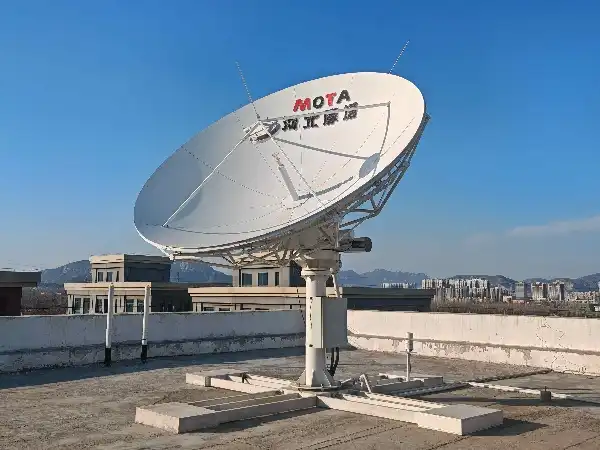
Understanding the Low-Profile Fixed Satellite Antenna
What a Low-Profile Design Means
Instead of standing on a tall mast, a low-profile fixed satellite antenna sits close to the surface it connects to. "Fixed" means that it stays where you point it and doesn't move. But a mobile station can keep track of a car or ship as it moves. Our MOTA unit is no more than 3 cm thick, so it can be placed next to a roof deck, porch rail, or outside wall. You can choose an aperture of 2.4 m, 3.3 m, or 4.5 m. The signal is picked up by the aperture, and a bigger aperture usually means more gain. You choose the size that works best for your link and the space you have.
Ku-Band Performance and Specifications
The antenna works in the Ku band, which is 10.7 to 12.75 GHz. A lot of satellite TV and broadband services use this band. If the noise number is 1.1 dB or less, it means that the receiver chain doesn't add much noise to a weak signal. Transceiver separation of 82 dB or more keeps the strong signal going out of the way of the weak signal coming in. The book "Satellite Communications" by Roddy also says that Ku band tends to have less rain fade than Ka band. The main things buyers want to know first are these:
| Item | Specification |
|---|---|
| Frequency band | Ku band, 10.7–12.75 GHz |
| Aperture | 4.5 m, 3.3 m, 2.4 m |
| Noise figure | ≤1.1 dB |
| Transceiver isolation | ≥82 dB |
| Thickness | ≤3 cm |
| Protection rating | IP65 |
| Working / standby power | ≤5 W / ≒1.0 W |
| Installation | Bolts and sealant |
| Alignment | By hand, with a clear guide |
| Mounting locations | Roofs, walls, balconies |
People who work for property managers and technicians often ask about thickness, power, and mounting. These numbers answer those questions.
Where Installers Use It
I see three main places. Rooftops and balconies of residential buildings are used because association rules don't allow equipment to be seen. When it comes to placement height, exterior walls and roof parts are used in commercial buildings and small offices. Thin profiles are wanted by people who make RVs and mobile buildings to save room inside and reduce roof drag.
Our engineers take care of ODM and OEM work for those buyers, which includes making sure the hardware looks good, follows the right protocols, and has the right function modules based on the rules of the destination country. At the start of each project, the type of surface, the maximum mounting height, and the satellite that is being used are all chosen.
Core Benefits of a Low-Profile Fixed Satellite Antenna
Easier Approval from Property Managers and Associations
For many jobs, getting approval is the first step. As long as the flat shape is 3 cm or less, a low-profile fixed satellite antenna doesn't stick out like a dish, so a board doesn't have much to complain about. In the US, the FCC's OTARD rule puts many limits on antennas that are one meter or less in areas that are only controlled by one person.
Most of the time, you need written permission for bigger openings and shared roof areas. You should bring pictures, plans with measurements, and a sketch of how the thing will be mounted to the meeting. When you have a clear package, a discussion about looks turns into a review of facts.
Lower Wind Exposure and Lighter Mount Stress
The square of the wind speed makes the wind pressure go up. This is why engineers use standards like ASCE 7 to figure out the right size mounts. A dish on a tall arm works as a lever, and each gust twists the fasteners. That lever is shorter when the unit is close to the wall or roof. Ask a structural engineer to confirm big installations because the real load still varies on the size of the panels, the height of the building, and the wind zones in the area. When it comes to small buildings, a thin body usually means easier hardware and less worry about space.
Faster, Gentler Installation
Our mounting system has bolts and sealant, and there are several ways to install it that don't damage the main structure. The sealant covers the holes that the nuts make, which stops the leaks that are the cause of many lawsuit claims. It's easy to do manual adjustment, and it only takes about two minutes for someone who isn't an expert to finish. Each visit for a crew is cut short, so they can do more jobs each day. Also, clear instructions can help stop two common reasons for callbacks: bad pointing and bad sealing.
Weather Resistance and Low Power Use
IEC 60529 says that an IP65 enclosure can't let dust in and can't be damaged by water jets coming from any direction. Our enclosure can also handle hits from light. Only 5 W or less is used, and only 1 W or less is used when not in use. This means that leaving the unit on all year won't really add to your electric bill. IP65 doesn't promise that it will work in all weather conditions. If you live in an area with a lot of snow or ice, I suggest you test it out in the field before placing a big order.
Low-Profile vs. Traditional Satellite Antennas: A Side-by-Side Comparison
Size, Weight, and Appearance
In its most basic form, a parabolic dish is an arm with a deep, bent mirror on it. It sticks out, makes a shade, and takes attention away from the street. One type of low-profile fixed satellite antenna stays about 3 cm from the surface, making it look like a flat screen. It also needs less space around it, which is good for balconies and roof edges that aren't very wide. Because aperture changes weight, ask for the picture and weight sheet for the size you want to buy. Those numbers affect how you plan to mount.
Performance and Frequency Considerations
Performance must be part of a fair comparison. For the same size, a well-made parabolic reflector works well, so gain alone is not enough to choose one over the other. Low-profile designs are better because they offer Ku-band performance with a noise figure of 1.1 dB or less and isolation of 82 dB or higher in a way that approval boards can accept. Your link budget, which takes into account the satellite's signal strength, where you are, and the data rate you need, will help you choose the right aperture. Let us know what you need, and we'll help you find the right aperture.
Cost Over the Product Life
Price per unit doesn't tell the whole story. Costs also come from not getting permits, having to come back, buying extra tools for reinforcement, and using power. You won't lose a day's work on a slim unit that passes review. Leak claims are limited by sealed placement. A power draw of 5 W when working and 1.0 W when not in use keeps the costs of running sites that stay online low. I can't promise a certain amount of savings because it depends on where you live and who you hire. Keep track of the number of hours spent on each build and response during a test batch. Then, compare those numbers to the ones you have now.
Procurement Guide: How to Select and Source the Right Antenna
Define Your Requirements First
Start with the building. Make a list of the surface type (concrete, brick, or balcony), the highest point that can be reached, the target satellite, and the aperture size that you need. Check the rules in your area, like the OTARD limits we talked about earlier, as well as the association covenants and municipal codes.
Then write down what your crew needs, like tools, time to hang the things, and training. A clear requirement sheet keeps us from placing the wrong orders and speeds up the quote process by letting us confirm the model, any accessories, and any custom changes to the look or feel of the interface all at once.
Check Supplier Credentials
Hebei Mota (MOTA) was founded in 2017 and does both business and manufacturing. We have nine years of experience making things. The ISO 9001, ISO 14001, and ISO 45001 standards have been met by our management systems. You can also find us with a Chinese type approval for radio transmission equipment and the GJB 9001C military quality management certification.
We are a national high-tech business. Because every market has its own rules, when we get orders from ODM or OEM, we change the hardware, the interface protocols, and the verification papers to fit the country where the goods are going. You can ask any supplier, including us, what approvals your market needs.
Documents and Samples to Request
Before you commit, I suggest you get this package of evidence:
- Appearance package: Real installation photos, dimensioned drawings, and mounting sketches for use on rooftops, balconies, and walls are all included in the appearance package. These things show the property board exactly what the unit looks like and how it connects. In most clearance meetings, they answer the first complaint and cut down on the review time.
- Installation materials: An English installation guide, installation manual, and movie that your workers can use on the job site. On a test unit, use a new technician to check them out. Write down the time, the questions, and any steps that were hard to understand.
- Sample trial: Some units of the low-profile fixed satellite antenna put in based on your own weather and building types. For two to four weeks, keep an eye on the signal, closing, and fastener state. After that, compare the results before placing a batch order. Write down things and keep pictures so you can answer buyers.
When you have this whole package, you can answer boards and technicians with facts instead of promises.
Ordering, Lead Times, and Support
We have a lot of stock ready for normal sales. Customized and large-scale systems take 45 to 90 days to make, so plan your seasonal stock early, especially before winter or rainy months when there aren't many times to install. Our team answers 7 days a week. Precision electronics come in packaging that keeps them safe from shock and water.
We offer international dedicated line, sea, and air freight services, as well as tracking, help with customs clearance, and storage overseas. International standards back up the full-unit guarantee that comes with each unit, and the plans are customizable. Installation, troubleshooting, and changes are all part of remote technical help. Find out about tiered pricing and minimum order quantities based on how much you buy each year.
Future Trends in Low-Profile Satellite Antenna Technology
Flat-Panel and Electronically Steered Designs
Flatter terminals are becoming more popular in the business world. Phased-array technology is used in many new low-height antennas. Instead of moving a dish, this technology automatically directs the beam. This method works well for stations that keep an eye on satellites in low Earth orbit, which move quickly across the sky. This is what fixed Ku-band units like ours are used for: a stable link to one satellite from a building where rules about how to look and mount things are very important. You can't compare goods that are made for different jobs if you know that difference.
Multi-Orbit Networks and Interface Needs
Now that operators offer services in both geostationary and low-Earth orbits, buyers are asking more and more if the hardware can adapt. Make sure you know what satellite, band, and protocol your service uses before you place your order. A low-profile fixed satellite antenna needs to be able to connect to the right satellite. MOTA lets you make changes to interface protocols and function modules as an ODM or OEM. That helps operators who have their own brand of terminals or who need a certain way to connect to their modem.
Building Rules and Energy Use
Both rules and building design are trying to make buildings look better and use less energy. Limits on what technicians can do are set by local laws, association rules, and the FCC's OTARD rules. These limits vary from address to address. Low power use is also good for places that don't need to be fixed for years. Forms and paperwork for approval will likely be just as important as the gear itself. That's why I think every project should start with a standard evidence file.
Conclusion
When looks, mounting restrictions, and wind exposure decide whether a job goes ahead or not, a low-profile fixed satellite antenna is the most important thing. A thickness of 3 cm or less helps with property approvals. A close-mounted body makes the lever on fasteners shorter, and installation is faster with bolt-and-sealant mounting and a clear alignment guide.
With a noise figure of 1.1 dB or less and an isolation level of 82 dB or higher, Ku-band specifications support steady links. IP65 protection and low power use keep maintenance and running costs low. The flat form looks better and is easier to place than a regular dish. The aperture should match the link budget. Before placing a large order, buyers who write down their needs, check certifications, and do a test run on a sample item lower their risk.
FAQ
What frequency band does this antenna use?
The Ku band, which goes from 10.7 GHz to 12.75 GHz, is used by a lot of satellite TV and broadband services. The noise figure must be 1.1 dB or less, and the transceiver isolation must be 82 dB or more. Before you order, make sure that your satellite service works with this band.
Will mounting damage my building?
The unit is put together with nuts, sealant, and a few different ways that don't damage the main structure. The sealant keeps water out of the holes in the fasteners. For roofs, I recommend a trained worker who follows the rules for building in your area.
How long does alignment take?
Alignment is done by hand, and a clear guide makes it possible for someone who isn't an expert to finish pointing in two minutes. Techs still need to get the right satellite information for the spot.
Can MOTA customize the antenna?
Yes. We can help ODM and OEM work on making hardware look good, making sure it works with other devices, and adding function parts that follow the rules of the place where it will be sent. It takes 45 to 90 days to make something custom.
Contact MOTA for Your Low-Profile Fixed Satellite Antenna Order
Looking for a company that makes low-profile fixed satellite antennas and can give you photos, drawings, and samples? Everyday types are kept in stock by MOTA, and special orders take 45 to 90 days to make. Send an email to hebei_mota@163.com with your building type, number, and target market. Our team will reply as soon as possible. Specifications and more information can be found at motasat.com.

References
1. Roddy, D. Satellite Communications, 2006.
2. Maral, G. and Bousquet, M. Satellite Communications Systems, 2020.
3. International Electrotechnical Commission. IEC 60529: Degrees of Protection Provided by Enclosures (IP Code), 2013.
4. American Society of Civil Engineers. ASCE/SEI 7: Minimum Design Loads and Associated Criteria for Buildings and Other Structures, 2022.
5. Federal Communications Commission. Over-the-Air Reception Devices Rule, 2000.
6. International Telecommunication Union. Radio Regulations, 2020.
Tell us your requirements – get a tailored quote and technical support within 24 hours.