- English
- French
- German
- Portuguese
- Spanish
- Russian
- Japanese
- Korean
- Arabic
- Greek
- German
- Turkish
- Italian
- Danish
- Romanian
- Indonesian
- Czech
- Afrikaans
- Swedish
- Polish
- Basque
- Catalan
- Esperanto
- Hindi
- Lao
- Albanian
- Amharic
- Armenian
- Azerbaijani
- Belarusian
- Bengali
- Bosnian
- Bulgarian
- Cebuano
- Chichewa
- Corsican
- Croatian
- Dutch
- Estonian
- Filipino
- Finnish
- Frisian
- Galician
- Georgian
- Gujarati
- Haitian
- Hausa
- Hawaiian
- Hebrew
- Hmong
- Hungarian
- Icelandic
- Igbo
- Javanese
- Kannada
- Kazakh
- Khmer
- Kurdish
- Kyrgyz
- Latin
- Latvian
- Lithuanian
- Luxembou..
- Macedonian
- Malagasy
- Malay
- Malayalam
- Maltese
- Maori
- Marathi
- Mongolian
- Burmese
- Nepali
- Norwegian
- Pashto
- Persian
- Punjabi
- Serbian
- Sesotho
- Sinhala
- Slovak
- Slovenian
- Somali
- Samoan
- Scots Gaelic
- Shona
- Sindhi
- Sundanese
- Swahili
- Tajik
- Tamil
- Telugu
- Thai
- Ukrainian
- Urdu
- Uzbek
- Vietnamese
- Welsh
- Xhosa
- Yiddish
- Yoruba
- Zulu
Why do satellite communication systems need anti-jamming antennas?
Satellite communication systems operate in an increasingly hostile electromagnetic landscape. Dense 5G deployments, military radar installations, and industrial RF emitters collectively raise the ambient noise floor to levels that standard parabolic reflectors simply cannot reject. An anti-interference fixed satellite antenna addresses this vulnerability by integrating spatial filtering, optimized sidelobe suppression, and AI-driven noise cancellation directly into the ground terminal architecture. Without these capabilities, bit error rates climb, link margins erode, and mission-critical data paths fail at the worst possible moment. For defense integrators, government emergency networks, and border communication systems, that risk is operationally unacceptable.
Understanding the Need for Anti-Jamming Antennas in Satellite Communication
Today's electromagnetic environments are really bad for satellite links that aren't protected. The International Telecommunication Union (ITU) says that interference events that affect geostationary satellite services have become a lot worse as the number of wireless devices on the ground has grown. To understand why jamming-resistant ground terminals are important, you must first understand the three main types of threats.
Where Interference Actually Comes From
Satellite signals close by, 5G C-band emitters working between 3.4 GHz and 4.2 GHz, and high-power industrial machines can all cause interference that isn't meant to happen. In contested operational zones, intentional jamming has been used to target uplink frequencies with sweep jamming or spot jamming waveforms. Atmospheric scintillation adds to both of them, making dynamic fading that raises the ratio of disturbance to signal. Each source lowers the G/T ratio, which directly raises the bit error rate and threatens the continuation of the link.
How Anti-Jamming Technology Works
An anti-interference fixed satellite antenna has many electrical and signal-processing layers that work together to fix the noise margin. Before it gets to the low-noise block, out-of-band energy is weakened by high-rejection bandpass filters. According to ITU-R S.580 standards [2], the main beam is focused while the sidelobe envelope is stifled when the reflector shape is optimized and the surface RMS errors are less than 0.5 mm. Then, adaptive algorithms look at the leftover spectral environment in real time and change the filtering settings on their own, without any help from a person.
Core Benefits and Types of Anti-Interference Fixed Satellite Antennas
Buying a specially designed anti-interference fixed satellite antenna has real practical benefits that go beyond just blocking influence. Signal security directly leads to better speed, fewer retransmission cycles, and lower delay in data-heavy tasks like ISR video backhaul and telemetry aggregation.
Here are the core performance advantages that define this class of equipment:
- Transceiver isolation of ≥95 dB keeps transmitting energy from overloading the receive chain. This is a very important factor in full-duplex military communication nodes where uplink and downlink action happen at the same time.
- First sidelobe suppression of ≤-20 dB makes it much harder to pick up off-axis interference sources. This means that nearby radar emitters and terrestrial base stations don't make a big difference in the effective noise temperature.
- Noise figure of ≤0.7 dB keeps the weaker signals that are received at the LNB input. This keeps the link gap even when the satellite is working at almost minimum elevation angles.
These performance factors work together to make sure that communication stays strong even when weather loss and intentional jamming are added on top of each other, which is when most commercial antennas break. With options for apertures between 2.4 m and 13 m, procurement teams can precisely match gain needs to link budget calculations across Ku, Ka, S, X, C, and Qv frequency bands.
How to Choose the Right Anti-Interference Fixed Satellite Antenna for Your Business Needs
To choose the right ground terminal, you need to make sure that the published specifications match up with test data from a third party that you can trust. Figures given by the vendor aren't very useful if they haven't been checked in an independent anechoic room. This is especially true when the antenna will be used as proof in a competitive tender process.
Key Selection Criteria
When there is worst-case interference, cross-polarization isolation above 30 dB, and confirmed compliance with relevant quality frameworks like GJB 9001C for defense-designated programs, procurement engineers should put the G/T ratio at the top of their list of priorities. Environmental ratings—at least IP66, and corrosion-resistant mounts proven by ISO 9227 salt spray testing—show if the hardware will keep working as expected for 15 to 20 years in coastal or desert settings.
Customization and Scalability Options
A lot of the time, large-scale system integrators run into problems when project batch sizes don't match up with manufacturer minimum order quantities. This problem can be solved by a reliable anti-interference fixed satellite antenna provider who is flexible with ODM/OEM, which means that they can change the aperture width, interface protocols, and certification paperwork to fit the needs of each program. Customized configurations can be made in 45–90 days, which lets integrators stick to their schedules without sacrificing the integrity of the specifications.
Practical Applications and Case Studies of Anti-Jamming Satellite Antennas
Three deployment situations with the biggest stakes for communication security make the practical value of advanced anti-interference fixed satellite antennas stand out the most.
High-density radar environments are always being used by military sites and border patrol posts. At the same time, an air-search radar sidelobe, frequency-hopping tactical radio emissions, and intentional uplink suppression attempts may affect a stationary terminal in a forward working position. Within these conditions, the three-axis self-stabilizing platform keeps its pointing accuracy without the need for manual reacquisition, even when wind causes mechanical deviation. This keeps the link open at the very times when communication is most crucial for operations.
Remote disaster-response networks have a different problem: they have to set up quickly in places that don't have any infrastructure on the ground and where electromagnetic conditions are hard to predict. A unique anti-interference pointing algorithm allows for a 3-minute satellite acquisition time, which shortens the time between launch and operating state to a level that can work with emergency reaction times. Situational awareness data gets to coordination centers without any compression artifacts or delays thanks to stable 4K video streaming in 8-level wind conditions.
Monitoring stations along the coast and at sea mostly have to deal with high-power port radar signals in the 2.9–3.3 GHz range and frequency collision from C-band uplinks. The IP66-rated enclosure and corrosion-resistant building materials make it possible for these terminals to work in salty environments for many years without the reflector surface wearing down.
Future Trends and Innovations in Anti-Jamming Satellite Antenna Technology
As LEO broadband constellations add more people to orbit and 5G deployments on Earth reach millimeter-wave bands, the interference environment will get trickier. According to a study published in IEEE Transactions on Antennas and Propagation, ground segment equipment will have to use adaptive beamforming and machine-learning interference classification by the end of this decade [5]. Current-generation anti-interference fixed satellite antenna systems already use AI-driven spectral analysis. In the future, these systems will be able to predict jamming pattern changes before they cause signal loss that can be measured.
This path should be taken into account in procurement plans. If you choose hardware with open software interfaces and AI modules that can be upgraded in the field, you can protect your investment as interference threats change. Integration compatibility with new multi-orbit satellite constellations that cover GEO, MEO, and LEO at the same time will stop being an option and become a standard requirement for purchases by the late 2020s.
Conclusion
There are threats to satellite transmission systems that can't be safely blocked by a standard reflector antenna. This weakness can be fixed with custom-made anti-interference fixed satellite antennas that use a mix of spatial filtering, adaptive signal processing, and military-grade mechanical stability. The operational case is simple: the antenna architecture must match the threat environment when link continuity is essential, like at a military installation, a border monitoring station, or a disaster-response coordination hub. Some of the things that set reliable solutions apart from speculative ones are verified performance specs, certified quality frameworks, and scalable customization options.
FAQ
1. How does an anti-interference antenna differ from a standard satellite antenna?
To receive signals, a normal parabolic antenna only uses aperture gain and a simple feedhorn design. An anti-interference fixed satellite antenna includes high-rejection bandpass filters, better sidelobe suppression geometry, and, in more advanced setups, AI-driven adaptive filtering that changes all the time based on the live spectral environment. This leads to a significantly higher signal-to-interference-plus-noise ratio when RF conditions are bad.
2. Which industries benefit most from jamming-resistant satellite terminals?
The most useful programs are those used by the military and the government for emergency communication. These are followed by maritime monitoring, remote industrial IoT backhaul, and broadcast teleport operations in 5G-dense cities.
3. Is installation support available for bulk procurement orders?
Qualified anti-interference fixed satellite antenna makers offer online technical support 24 hours a day, seven days a week. This support includes installation alignment, system setup, and fixing after the system has been deployed. For large-scale program deployments, on-site technical services can be accessed through cooperative localized channels.
4. Does a larger aperture automatically improve interference rejection?
Not right away. While bigger apertures boost main-beam gain, interference rejection mostly relies on how well sidelobe suppression works and how well the filter and LNB assembly works. Both parameters need to be optimized, even if the aperture size changes.
Partner With MOTA for Proven Anti-Interference Satellite Solutions
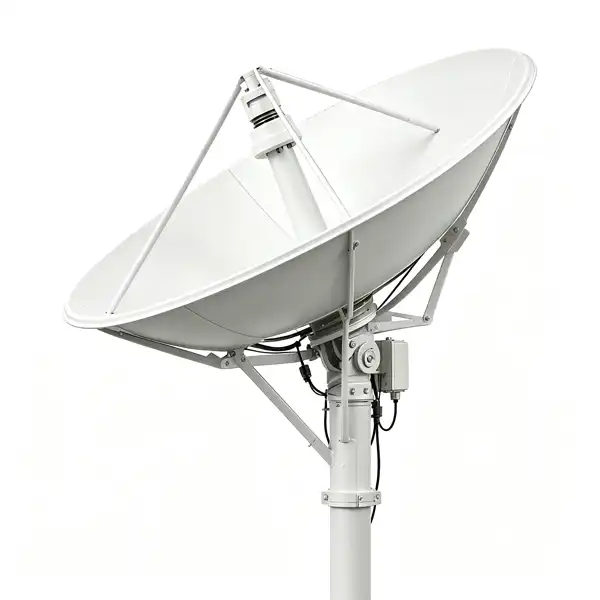
Hebei Mota Electronics Technology Co., Ltd., or MOTA, has been making things for nine years and has ISO9001, ISO14001, and ISO45001 certifications. Our anti-interference fixed satellite antenna manufacturer offers full OEM/ODM customization, quality processes that are in line with GJB 9001C, and expert help available 24 hours a day, seven days a week. Standard orders can be filled right away from ready stock, while special systems take 45 to 90 days to ship. To get specs, third-party test results, or a custom procurement quote, email our engineering team at hebei_mota@163.com or visit motasat.com.
References
1. International Telecommunication Union. (2022). Radio Regulations and Interference Coordination for Satellite Networks. ITU-R.
2. ITU Radiocommunication Sector. (2021). Recommendation ITU-R S.580-6: Radiation Diagrams for Use as Design Objectives for Antennas of Earth Stations.
3. International Organization for Standardization. (2022). ISO 9227:2022 Corrosion Tests in Artificial Atmospheres — Salt Spray Tests.
4. Elbert, B. R. (2008). Introduction to Satellite Communication (3rd ed.). Artech House.
5. Sturza, M. A., & Winters, J. H. (2020). Adaptive Beamforming and Interference Mitigation in Satellite Ground Terminals. IEEE Transactions on Antennas and Propagation, 68(4), 2891–2903.
6. Satellite Industry Association. (2023). State of the Satellite Industry Report 2023. SIA.
Tell us your requirements – get a tailored quote and technical support within 24 hours.