- English
- French
- German
- Portuguese
- Spanish
- Russian
- Japanese
- Korean
- Arabic
- Greek
- German
- Turkish
- Italian
- Danish
- Romanian
- Indonesian
- Czech
- Afrikaans
- Swedish
- Polish
- Basque
- Catalan
- Esperanto
- Hindi
- Lao
- Albanian
- Amharic
- Armenian
- Azerbaijani
- Belarusian
- Bengali
- Bosnian
- Bulgarian
- Cebuano
- Chichewa
- Corsican
- Croatian
- Dutch
- Estonian
- Filipino
- Finnish
- Frisian
- Galician
- Georgian
- Gujarati
- Haitian
- Hausa
- Hawaiian
- Hebrew
- Hmong
- Hungarian
- Icelandic
- Igbo
- Javanese
- Kannada
- Kazakh
- Khmer
- Kurdish
- Kyrgyz
- Latin
- Latvian
- Lithuanian
- Luxembou..
- Macedonian
- Malagasy
- Malay
- Malayalam
- Maltese
- Maori
- Marathi
- Mongolian
- Burmese
- Nepali
- Norwegian
- Pashto
- Persian
- Punjabi
- Serbian
- Sesotho
- Sinhala
- Slovak
- Slovenian
- Somali
- Samoan
- Scots Gaelic
- Shona
- Sindhi
- Sundanese
- Swahili
- Tajik
- Tamil
- Telugu
- Thai
- Ukrainian
- Urdu
- Uzbek
- Vietnamese
- Welsh
- Xhosa
- Yiddish
- Yoruba
- Zulu
Best Industrial-grade Fixed Satellite Antenna for Harsh Environments
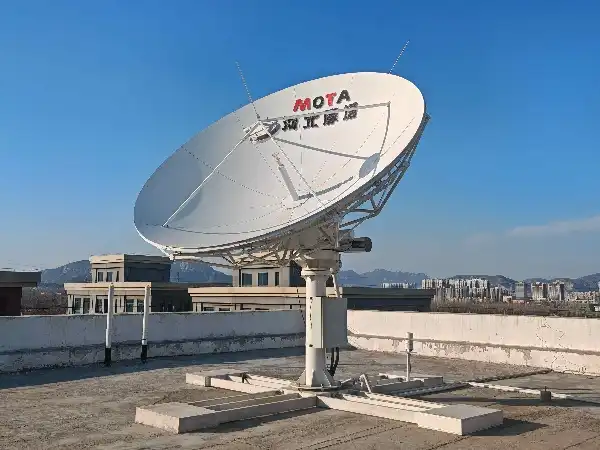
When remote power stations, open-pit mines, and offshore platforms lose terrestrial network coverage, the consequences reach far beyond a dropped connection. The right industrial-grade fixed satellite antenna becomes the sole lifeline for SCADA data backhaul, real-time monitoring, and operational command. This guide walks procurement engineers and automation directors through what separates a genuinely ruggedized ground-station terminal from a rebranded commercial dish — and shows how MOTA's enterprise satellite systems hold up where others quit.
What Makes a Fixed Satellite Antenna Truly Industrial-Grade?
Beyond the IP Rating
Even though an IP65 enclosure keeps dust and water jets out, that's not even close to what is needed for industrial use. A real industrial-grade fixed satellite antenna has aircraft-grade reflector panels with RMS surface errors below 0.5 mm, hot-dip galvanized steel pedestals, and cross-polarization isolation above 30 dB to stay within the ITU-R S.580 sidelobe limits. The ITU Radiocommunication Sector's regulatory framework (ITU-R S.580, 2023), says that going over sidelobe limits can cause interference with nearby satellites, which is something that satellite operators can punish by suspending service. This is a risk that no energy group can take in the middle of a project.
RF Performance That Industry Actually Demands
Standard consumer VSAT units are made to save money, not to keep working. For industrial-grade fixed satellite antennas, Mean Time Between Failures (MTBF) is measured in decades, not years, and G/T ratios are published after being tested under operational wind loads. The MOTA antenna line has a first sidelobe level of -16 dB and receiver isolation of 88 dB. These are very important numbers in places with a lot of electromagnetic fields, like high-voltage substations or paths for heavy mining equipment.
Key Considerations When Selecting a Satellite Ground Terminal
It is very expensive to make the wrong choice of aperture size or frequency band for an industrial-grade fixed satellite antenna, and you don't realize it until after the fact. These are the main evaluation criteria that procurement teams and SCADA engineers always put the most weight on.
Structural wind load tolerance is a standard that can't be changed. The ASCE 7-22 standard from the American Society of Civil Engineers says that fixed outdoor buildings in open areas must be able to withstand wind speeds of more than 150 km/h. If you put terminals on hilltop energy stations or coastal industrial parks, they need to meet or beat this level without the reflector getting distorted. These mechanical stress standards are used to prove that MOTA's reinforced housing architecture works.
How much infrastructure costs depends on how flexible the frequency bands are. When satellite capacity contracts change or when regional operators move transponder assignments, a terminal that is locked to a single band needs to be replaced, which costs a lot of money. With controlled switching, the MOTA system works with the Ku, Ka, S, X, C, and Qv bands. This makes the gear useful for projects that last for many years.
The true availability is based on the thermal operating range. The temperature inside data centers is set to 21°C. In the winter, remote substations in Wyoming and in the summer, desert solar farms in Nevada do not. There is a secret risk of downtime with a device that is only rated for 0°C to +45°C. MOTA's system works all the time from -30°C to +55°C, so there's no need for environmental enclosures or extra heating systems that are expensive and hard to keep up.
MOTA Industrial Satellite Antenna: Specifications That Speak to Engineers
Hebei Mota Electronics Technology Co., Ltd. has been working on satellite communication systems for nine years. They have ISO 9001, ISO 14001, and ISO 45001 management certifications, as well as GJB 9001C military-standard quality assurance. Because of this, a line of products goes into procurement bids with real credentials instead of marketing speak.
The main technical specs of the MOTA industrial-grade fixed satellite antenna are shown below:
- Aperture options: You can choose from 2.4 m, 3.3 m, 4.5 m, 5.4 m, 6.2 m, 7.3 m, 9 m, 11 m, and 13 m apertures, so it can work as anything from a main teleport hub to a spread IoT node.
- Satellite acquisition time: The satellite acquisition time is three minutes from turning on to locking on a signal, which is very important for emergency operations and quick field setup.
- Video backhaul stability: Sustained 1080p transmission kept going even when the wind speed was near gale (50–61 km/h) on the Beaufort Scale 7.
- Protection class: IP65, which includes performance against water, dust, and rust for open industrial sites.
- Stabilization: Two-axis self-stabilizing platform with a unique pointing method that makes up for heavy machinery shaking the ground.
- Integrated modules: Industrial-grade BUC/LNB, a high-speed modem, and smart power management are all built into a plug-and-play assembly.
Because of these benefits, the total cost of ownership goes down. When a SCADA expert doesn't have to find a different modem, external BUC, or power conditioning unit, the list of things they need to buy and the time it takes to set up the system go down. That's important for project-contracted energy operations, where the cost of workers and moving materials goes up every day.
The failure area is also smaller because of the combined design. When there are fewer interface points between subsystems, there are fewer possible fault sites for field technicians to check during a 3 a.m. power outage at a faraway wind farm.
Procurement Pathway: How Energy Groups and EPC Contractors Buy Right
Industrial-grade fixed satellite antenna procurement in the energy and heavy industries usually happen every six to twelve months. This includes planning for yearly capital expenditures, doing a feasibility study, holding an open bidding, and completing the project. At each gate, certain documents are important.
For technical qualification, purchase reviewers look for quality management systems that are ISO-certified, results from environmental stress screenings like ASTM B117 salt-spray tests for marine or offshore sites, and MTBF data that has been confirmed in the field. To help with tenders, MOTA gives full technical dossiers that cover all of these points.
For delivery and operations peace of mind, the production cycle for custom large-aperture systems is 45 to 90 days, and normal aperture sizes are offered on stock units. MOTA's cross-border logistics network includes international dedicated freight, sea freight, and air freight. It includes professional packing that protects against shock and moisture, end-to-end tracking, and customs clearance coordination, which makes it easier for the buying team to handle import paperwork.
For peace of mind after the sale, there is a 7x24 remote technical support channel that helps with installation, finding problems, and updating firmware. Cooperation channels make it possible for localized on-site service and a quick supply chain for spare parts. This directly answers the most common question plant operations managers have, which is what happens when a part fails six months after it was installed?
Conclusion
It's not easy to choose an industrial-grade fixed satellite antenna for a mining or energy operation in a harsh climate. Whether the system works well for years or needs to be serviced every three months depends on its aperture size, frequency band, structural wind grade, EMI isolation numbers, and certification history. MOTA's line of industrial-grade fixed satellite antennas has an aperture range of 2.4 m to 13 m, supports six frequency bands, is ISO and GJB 9001C certified, and has been tested to work 24 hours a day, seven days a week. The company has also been making these antennas for nine years. This platform should be carefully looked at by EPC contractors and automation department heads who are planning to include communication infrastructure in their next project.
FAQ
1. What frequency bands does the MOTA fixed satellite terminal support?
You can manually switch between the Ku, Ka, S, X, C, and Qv bands on this system. This range includes the most common commercial VSAT bands as well as government and military frequencies. This means that the industrial-grade fixed satellite antenna can be used for a wide range of projects without having to update any hardware.
2. How does the antenna perform in environments with heavy electromagnetic interference?
We can say that the MOTA industrial-grade fixed satellite antenna has a first sidelobe level of -16 dB and transmission separation of 88 dB. These numbers are especially useful for placement near motor drive cabinets, high-voltage transmission lines, and industrial welding equipment, all of which are popular in heavy-manufacturing and energy sites.
3. What maintenance schedule does a fixed industrial terminal require?
We suggest checking the structure once a year, the feed horn window every three months for water entry, and the base pin bolts every so often to keep the pointing accurate. Compared to open-frame designs, the sealed IP65 housing makes regular repair much less common and easier for the industrial-grade fixed satellite antenna.
4. Can the system integrate with existing SCADA and PLC architectures?
Yes. Standard industrial transmission connections can be used with the built-in modem. The tech team at MOTA helps with configuration before rollout and on-site commissioning to make sure the industrial-grade fixed satellite antenna works with current automation infrastructure.
Partner With MOTA for Your Next Industrial Satellite Deployment
MOTA provides business-class satellite connections in places where land-based networks can't reach. We are a certified industrial-grade fixed satellite antenna maker with nine years of producing experience in the field. Our aperture sizes range from 2.4 m to 13 m, and we offer full multi-band support and expert help 24 hours a day, seven days a week. Contact our engineering team today at hebei_mota@163.com or visit motasat.com to request a project-specific configuration and quotation.

References
1. International Telecommunication Union. (2023). ITU-R S.580: Radiation diagrams for use as design objectives for antennas of earth stations operating with geostationary satellites. ITU Radiocommunication Sector.
2. American Society of Civil Engineers. (2022). ASCE 7-22: Minimum Design Loads and Associated Criteria for Buildings and Other Structures. ASCE Library.
3. ASTM International. (2019). ASTM B117-19: Standard Practice for Operating Salt Spray (Fog) Apparatus. ASTM International.
4. Federal Communications Commission. (2023). FCC Part 25 — Satellite Communications: Technical Standards for Earth Station Antennas. FCC Electronic Code of Federal Regulations.
5. IEEE Standards Association. (2021). IEEE 1613: Standard Environmental and Testing Requirements for Communications Networking Devices Installed in Electric Power Substations. IEEE Xplore.
6. SIA — Satellite Industry Association. (2023). State of the Satellite Industry Report 2023. Satellite Industry Association.
Tell us your requirements – get a tailored quote and technical support within 24 hours.