- English
- French
- German
- Portuguese
- Spanish
- Russian
- Japanese
- Korean
- Arabic
- Greek
- German
- Turkish
- Italian
- Danish
- Romanian
- Indonesian
- Czech
- Afrikaans
- Swedish
- Polish
- Basque
- Catalan
- Esperanto
- Hindi
- Lao
- Albanian
- Amharic
- Armenian
- Azerbaijani
- Belarusian
- Bengali
- Bosnian
- Bulgarian
- Cebuano
- Chichewa
- Corsican
- Croatian
- Dutch
- Estonian
- Filipino
- Finnish
- Frisian
- Galician
- Georgian
- Gujarati
- Haitian
- Hausa
- Hawaiian
- Hebrew
- Hmong
- Hungarian
- Icelandic
- Igbo
- Javanese
- Kannada
- Kazakh
- Khmer
- Kurdish
- Kyrgyz
- Latin
- Latvian
- Lithuanian
- Luxembou..
- Macedonian
- Malagasy
- Malay
- Malayalam
- Maltese
- Maori
- Marathi
- Mongolian
- Burmese
- Nepali
- Norwegian
- Pashto
- Persian
- Punjabi
- Serbian
- Sesotho
- Sinhala
- Slovak
- Slovenian
- Somali
- Samoan
- Scots Gaelic
- Shona
- Sindhi
- Sundanese
- Swahili
- Tajik
- Tamil
- Telugu
- Thai
- Ukrainian
- Urdu
- Uzbek
- Vietnamese
- Welsh
- Xhosa
- Yiddish
- Yoruba
- Zulu
Standard TT&C Antenna for Satellite Tracking and Telemetry Systems
A standard TT&C antenna links your ground station to a satellite or launch vehicle. It sends commands up, brings telemetry down, and tracks the target's position, so you always know where your asset is. For S-band missions, MOTA builds this antenna with monopulse tracking accuracy of 0.03° or better, an uplink of 2025–2120 MHz, a downlink of 2200–2300 MHz, and apertures from 2.4 m to 13 m. This guide explains how these systems work, how to compare options, and what to check before you buy, so your team can move from specification to station with fewer surprises.
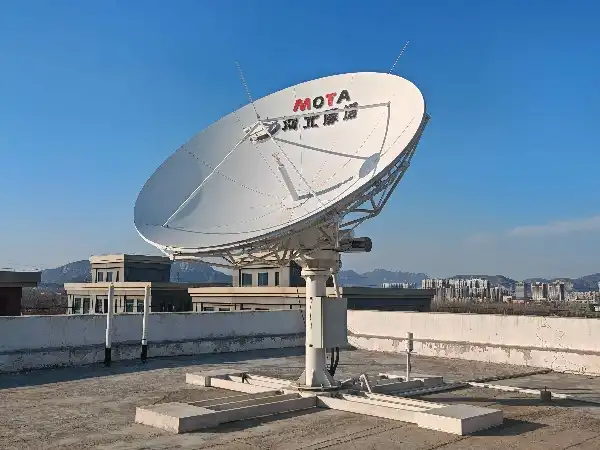
Understanding the Standard TT&C Antenna and Its Applications
What a Standard TT&C Antenna Does
Tracking, telemetry, and command are what TT&C stands for. All three are done by the antenna. It sends uplink commands to spacecraft that tell them what to do. It gets health data like temperature, voltage, attitude, and more through telemetry. It also finds out the direction of the satellite, which helps the people in charge figure out its orbit. Launch, early operations, and routine passes all depend on this link for teams on the ground.
Operators can't see what's going on with the spaceship if the link goes down. That's why buyers pay attention to low noise, send and receive separation, and command delivery that doesn't make mistakes. That's exactly what our standard TT&C antenna is made for; it has high isolation, low noise, and lossless telemetry reception.
Where Ground Stations Put It to Work
This antenna is usually bought by procurement teams to do one of four things. It is used by satellite base stations to tell LEO and MEO satellites what to do by sending them through multiple passes. Launch sites use it to get data from rockets as they rise, when the vehicle is moving quickly and shaking a lot.
It is used by people who work in remote sensing to get picture data and stay in touch with their sensors. A lot of satellites in deep space and low Earth orbit (LEO) use it to track and give orders over long distances. GEO satellites also need TT&C links, but because they don't move around much, they have different tracking needs. Find an antenna that works with your orbit before you look at prices.
Why S-Band Remains the Common Choice
For a long time, S-band has been the best choice for TT&C. Our antenna has a transmission frequency range of 2025–2120 MHz and a downlink frequency range of 2200–2300 MHz. It is designed to meet the measurement and control standards for aircraft. It rains less on lower frequencies than on X-band or Ka-band, so it doesn't have as much of an effect on S-band links.
A lot of space agencies use the radio frequency and modulation recommendations put out by the Consultative Committee for Space Data Systems (CCSDS) as a guide. Let us know early on if your mission needs a different band. We can change the frequency, interfaces, and certifications to fit the rules of the target country through our ODM/OEM service. We won't have to redesign later.
Types and Design Principles of Standard TT&C Antennas
Antenna Types Compared
Standard TT&C antennas can be broken down into four groups. Spacecraft have omnidirectional and patch antennas that serve a wide area for communication and command, even if the satellite moves around. Some types of antennas, like horns and helices, give more gain in one direction. A big dish catches weak signals and focuses send power into a narrow beam, which is why parabolic reflectors are the most common type of ground station.
Our product is a parabolic ground station, and its apertures range from 2.4 m to 13 m. The trade-off is easy to understand: bigger dishes have a narrower beam and higher gain, so they need to be tracked more precisely. A smaller dish is easier to store and aim, but it has less link margin.
Key Design Parameters
Performance is affected by a number of factors. Frequency sets the link band, which could be S, X, or Ka. The figure of merit for receive sensitivity is G/T, which is made up of gain and noise temperature. For this reason, our antenna instantly changes between RHCP and LHCP because the polarization needs to match the satellite. As the aperture gets bigger, the beamwidth gets smaller, which makes pointing harder.
Tracking method is most important for things that are moving. Monopulse tracking doesn't need slow scanning because it gets its direction error from signals that are all collected at the same time. It helps our system get to a tracking accuracy of no more than 0.03°, and then it fixes the angle in milliseconds. That speed keeps the beam where it needs to be.
Mechanical and Environmental Standards
Outdoor stations have to deal with wind, rain, dust, and changes in temperature for years. Our antenna is made to keep out dust and water (IP68) and wind (Level 12). It can work in temperatures ranging from -40°C to +70°C and is meant to last more than 15 years. The IP number is based on IEC 60529. A 6 means that the device is dust-tight, and an 8 means that it is protected against continued immersion in water under conditions set by the manufacturer.
The antenna can be powered by either 220VAC or 48VDC, and can work from 7am to 24pm. You can ask any seller to show you the environmental test results that back up these claims. During technical review, we talk with qualified buyers about the test documentation that is available.
How to Choose the Best TT&C Antenna for Your Satellite Project
Match Aperture to Your Link Budget
The first big choice you need to make is aperture. Our dish sizes are 13 m, 11 m, 9 m, 7.3 m, 6.2 m, 5.4 m, 4.5 m, 3.3 m, and 2.4 m. Make a link budget that includes the satellite's orbital height, send power, data rate, and the amount of room you need for error. Larger dishes are usually needed for messages that are weaker and in higher orbits.
It is cheaper to build and set up smaller dishes, which makes them good for missions that need strong downlinks. Also, the size of the site is important. For example, a 13-meter dish needs a bigger base and more space around it than a 2.4-meter dish. You can show our engineers your orbit and site plan, and they will help you choose the right size.
Compare Tracking Performance
Keeping the satellite in the beam depends on how well you can track it. Our antenna has an accuracy of 0.03° or better, instantly finds the satellite, and can change its direction within milliseconds. A late correction can cause loss of lock when a satellite moves or a rocket quickly changes direction.
This is when these numbers are most important. Aside from the static accuracy number, you should also ask for the loss-of-lock rate when you are moving the machine. Also, find out how the system handles the first capture before the satellite's direction is set. Answers that are clear on these points tell you more than just a paper number.
Check Baseband Compatibility and Integration Time
Hardware is only useful if it works with what you already have. Our standard TT&C antenna works with most TT&C baseband gear, and its modular design makes it easy to put together and take apart. When compared to traditional systems, our design cuts integration time by up to 40%. This is helpful when there isn't much time before a launch window.
In your first message, list your baseband model, interface type, and protocol needs. For projects in other countries, we can change the look, feel, and interface protocols to fit the rules there. Also, decide early on who is responsible for what when it comes to public works, foundations, and system integration. Not knowing who is responsible for what can slow down installation.
Procurement Considerations: Suppliers, Pricing, and After-Sales Support
Building the Supplier Shortlist
These are the first things most buyers do: they make a list of sellers. It often lists both well-known companies and younger ones, like L3Harris, Cobham, and Airbus. Check out each candidate's credentials, test results, and track record of delivering results. Hebei Mota (name MOTA) was established in 2017 and has been making things for nine years.
We have been certified by ISO 9001, ISO 14001, and ISO 45001, as well as by the GJB 9001C military quality system and the government for radio transmission equipment. We are also a national high-tech company and a company that fuses military and civilian technology. Our main technology includes high-precision tracking algorithms and satellite communication antennas. This technology is backed by a number of intellectual property rights.
Pricing, Lead Time, and Compliance
The price is different for each job because it depends on the aperture, feed setup, interface needs, and local compliance work. We keep enough normal goods in stock, but it takes 45 to 90 days to make custom and large systems. If you plan ahead, you can add the steps around that window: testing in the factory, shipping, installation on-site, and joint commissioning.
US buyers should also make sure they have the right frequency licenses for send operations and talk to their compliance team about the rules for exporting and importing before placing an order. By starting these reviews early, you can keep your launch date safe. We have reasonable prices and easy payment options, and we can also prepare the paperwork your customs broker needs for the standard TT&C antenna.
Documents to Request Before You Sign
To protect your plan, get these three record sets before you sign.
• Test and certification records: Ask for reports on the weather that include IP68, wind load, temperature range, and RF measurements like G/T, isolation, and tracked accuracy. Third-party managers often look over these files line by line, so having full records speeds up acceptance and cuts down on rework during commissioning. Ask for them before the deal is official.
• Interface documents: Get the interface control paper, protocol list, and information about the connectors for your baseband gear. With these, your RF and servo engineers can make sure that everything works together on paper before the hardware even arrives. They can also find gaps in the integration while it's still cheap to make changes. It also lets you see who controls each interface.
• Service terms: Get written terms for the length of the guarantee, the sale of spare parts, software updates, and help on-site. With a design life of more than 15 years, that only works if parts and updates are always available. That's why it's important to be clear about the scale and cost of these things early on, so there are no mistakes later on. Write down everything in the contract.
These records answer the questions that a design review usually brings up.
After-Sales Support and Logistics
Help is given after the standard TT&C antenna ships. Our team is available 24 hours a day, seven days a week to help with installation, troubleshooting, and system upgrades. They also take orders at any time. The guarantee on the whole unit is in line with foreign standards, and there are different payment plans to choose from.
Through working together, we can set up on-site expert support and quick delivery of extra parts. We use foreign specialized lines, sea freight, or air freight to ship our goods. Precision electronics are shipped in packaging that is resistant to shock and moisture. They are tracked from start to finish, help is provided for customs clearance, and they are stored overseas to lower the risk of crossing borders. Our service team also takes care of paperwork and running the business.
Future Trends in TT&C Antenna Technology
Growth of LEO Constellations
The way stations are built is changing because of the constellations of satellites. A constellation of many LEO satellites makes a lot of short passes every day, so operators need a lot of stations and quick switching between them. Most projects begin with one to four stations and add more as the fleet grows. This method works best with antennas that can be used at more than one spot and have the same interfaces and spare parts.
Then, stable moving between stations and operation 24 hours a day, seven days a week mean just as much as peak performance on a single pass. As you plan the first step, talk to your provider about how repeat orders will work and how long it will take to get parts for later stations.
Electronically Steered Arrays and Compact Designs
Phased arrays that are controlled by electricity point their beams without any moving parts. This works well for links that quickly switch between many satellites. Small satellites can also use designs that are small. What they do, though, is still clear. A parabolic reflector with monopulse tracking is still a good way to pick up weak signals from far away, and big openings make the gain high.
These days, a lot of operators will probably use both types: arrays when speed is important and reflectors when sensitivity is important. Any array offer should go through the same process. Ask for measured gain, accuracy in pointing, and tracking performance instead of numbers from a catalog.
Planning for Upgrades
As technology changes, pick hardware that can adapt to those changes. A modular structure makes it easier to add or remove useful sections. Through our 7x24 online service, we can help you update your software. AI is also being tested in research groups to help with signal processing jobs like finding clutter and sending out alerts for strange behavior.
We see this as an emerging area, not something that needs to be bought right now. Write down what each supplier says about how its interfaces will work with new baseband or software. Also, get spare parts ready ahead of time, because after 15 years, a station will need to be replaced.
Conclusion
A standard TT&C antenna connects a control station on the ground to a satellite or launch vehicle so that it can send commands, talk, and be tracked. S-band is still a good choice because it doesn't get damaged by rain as much as X-band or Ka-band. Parabolic mirrors work best for ground stations, while smaller antennas work best for satellites.
Before picking a seller, buyers should make sure that the aperture fits their link budget, check the accuracy of monopulse tracking and loss-of-lock behavior, and make sure that the baseband works with the provider. Acceptance risk is lowered by test reports, interface documents, and written service terms.
The schedule is kept safe by spectrum and export checks. Costs for projects are also affected by things like lead time, guarantee, spare parts, and transportation. As LEO constellations grow, they like modular, repeatable stations. Along with tried-and-true reflector systems, phased arrays and AI tools are also starting to appear.
FAQ
What frequencies does your standard TT&C antenna cover?
It has an S-band uplink between 2025 and 2120 MHz and a downlink between 2200 and 2300 MHz. For dual circular polarization, it automatically switches between RHCP and LHCP.
Which aperture sizes can I order?
We have 13 m, 11 m, 9 m, 7.3 m, 6.2 m, 5.4 m, 4.5 m, 3.3 m, and 2.4 m. The best fit will depend on your link budget and the health of your site.
Will it work with my baseband equipment?
Most common standard TT&C antenna baseband gear can use it. Send us your model and list of interfaces, and we'll make sure they work together. You can also get our ODM/OEM service to meet the interaction rules of the target country.
How long does delivery take?
Products that are normally sold are shipped from stock that is ready to go. Before they are shipped and set up, big and customized systems take 45 to 90 days to make. Lead time depends on the aperture and how it is set up.
Can the station keep running during a power outage?
The antenna can work with either 220VAC or 48VDC power, and it has an automatic DC backup failover feature that keeps tracking windows open when the power goes out.
Contact MOTA for a Standard TT&C Antenna Quote
Send information about your orbit, frequency, aperture, and baseband to hebei_mota@163.com. Our engineers will get back to you with a setup that works. We help with projects from the planning stage all the way through delivery as a standard TT&C antenna maker with ISO-certified production, ready-to-ship items, and 45–90 day wait times for custom systems. Our team answers 7 days a week. You can find project details and specs at motasat.com. Then, start your request right away.

References
1. Satellite Communications, 3rd Edition (Pratt and Allnutt), Wiley, 2019
2. Satellite Communications Systems: Systems, Techniques and Technology, 6th Edition (Maral, Bousquet, and Sun), Wiley, 2020
3. Antenna Theory and Design, 3rd Edition (Stutzman and Thiele), Wiley, 2012
4. Radar Handbook, 3rd Edition (Skolnik), McGraw-Hill, 2008
5. IEC 60529, Degrees of Protection Provided by Enclosures (IP Code), International Electrotechnical Commission, 2013
6. ECSS-E-ST-50-05C Rev. 2, Radio Frequency and Modulation, European Cooperation for Space Standardization, 2011
Tell us your requirements – get a tailored quote and technical support within 24 hours.