- English
- French
- German
- Portuguese
- Spanish
- Russian
- Japanese
- Korean
- Arabic
- Greek
- German
- Turkish
- Italian
- Danish
- Romanian
- Indonesian
- Czech
- Afrikaans
- Swedish
- Polish
- Basque
- Catalan
- Esperanto
- Hindi
- Lao
- Albanian
- Amharic
- Armenian
- Azerbaijani
- Belarusian
- Bengali
- Bosnian
- Bulgarian
- Cebuano
- Chichewa
- Corsican
- Croatian
- Dutch
- Estonian
- Filipino
- Finnish
- Frisian
- Galician
- Georgian
- Gujarati
- Haitian
- Hausa
- Hawaiian
- Hebrew
- Hmong
- Hungarian
- Icelandic
- Igbo
- Javanese
- Kannada
- Kazakh
- Khmer
- Kurdish
- Kyrgyz
- Latin
- Latvian
- Lithuanian
- Luxembou..
- Macedonian
- Malagasy
- Malay
- Malayalam
- Maltese
- Maori
- Marathi
- Mongolian
- Burmese
- Nepali
- Norwegian
- Pashto
- Persian
- Punjabi
- Serbian
- Sesotho
- Sinhala
- Slovak
- Slovenian
- Somali
- Samoan
- Scots Gaelic
- Shona
- Sindhi
- Sundanese
- Swahili
- Tajik
- Tamil
- Telugu
- Thai
- Ukrainian
- Urdu
- Uzbek
- Vietnamese
- Welsh
- Xhosa
- Yiddish
- Yoruba
- Zulu
Can a Miniature Fixed Satellite Antenna Support High-Bandwidth Communication?
Yes, a miniature fixed satellite antenna can support high-bandwidth communication when the application fits its size. A compact Ku-band terminal with a stationary link, low receiver noise, and strong transmit-receive isolation can carry camera streams, sensor data, and basic office traffic. It will not match the throughput of a large dish, because physics ties gain to aperture. Our MOTA unit measures ≤15cm across, ≤3cm thick, and ≤0.8kg, so it fits small terminals where bigger dishes cannot go.
I wrote this guide for engineers and buyers who are stuck on volume, weight, and power. Each section gives numbers you can check against your own cavity and power design.
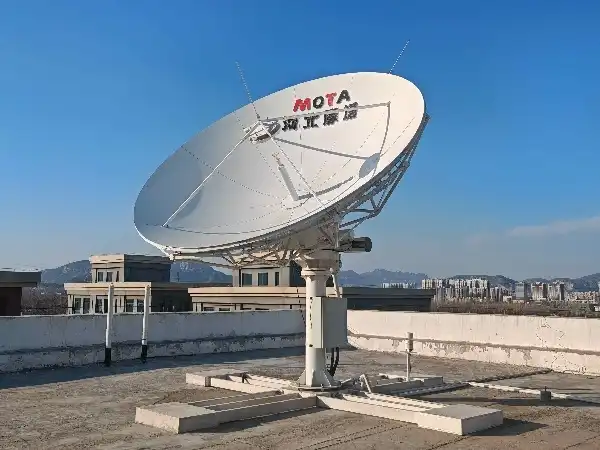
Understanding Miniature Fixed Satellite Antennas and Their Role in High-Speed Communication
How a Fixed Satellite Link Works
An end that is fixed points to one satellite and stays there. The antenna doesn't need motors, gyros, or tracking software after the first alignment. This gets rid of parts, power needs, and failure points. Being able to keep a fixed modulation mode is possible because the data level stays the same.
By dropping to slower, safer modes when the signal drops, modems protect throughput by keeping things steady. Because of this, a small-aperture satellite terminal that doesn't move can provide more stable data rates than one that does. It takes our miniature fixed satellite antenna about a minute to set up a link and align the satellites.
Why Ku-Band Fits Small Terminals
That's only about 2.5 cm, since Ku-band is close to 12 GHz. When frequencies are short, energy can be focused into a smaller beam by a small panel than a panel with lower bands, like L-band, could handle for the same size. 10.7–12.75GHz is covered by the MOTA antenna.
A lot of commercial satellites use this band for video and broadband, and the supply of parts is well established. The trade-off is rain fade, because strong rain blocks signals at these frequencies. People who buy in wet parts of the U.S., like the Gulf Coast, should plan for extra link cushion.
Fixed Designs Versus Mobile Designs
A computer on a moving platform has to keep an eye on a satellite as the platform moves back and forth. That needs more power, more software, and motors or groups that are controlled electrically. All of that is skipped by a fixed unit. The base stays put for a camera on a pole, a field office, or a sensor box, so tracking just adds weight and cost. The MOTA terminal sticks on with magnetic suction and glue, so you don't need to drill or use any tools. Its IP64 rating means that it is protected against dust and water splashes. If your goods moves quickly, you should use a tracking system.
Evaluating Whether Miniature Fixed Satellite Antennas Can Support High-Data-Rate Applications
Aperture, Gain, and the Physics Limit
G = η(πD/λ)² is the formula for antenna gain. D is the diameter, λ is the wavelength, and η is the efficiency. A 15 cm opening gives about 25 dBi at 11.7 GHz at full efficiency and about 23 dBi at 60% efficiency. That is just a guess for how big it could be; it's not a real MOTA number. The main beam is also pretty big—about 12 degrees wide.
With a bigger dish, you can get a higher gain and a smaller beam, which means it has more room for faster modulation. When the satellite signal is strong, a miniature fixed satellite antenna can still carry useful data, but I wouldn't promise that it could stream HD video to multiple users at once.
Noise Figure, Isolation, and Channel Capacity
Shannon's theorem says that capacity goes up as channel width and signal-to-noise ratio go up. Low reception noise is important because a small antenna has less gain to begin with. A noise figure of ≤1.2 dB means that the noise temperature is about 92 K, which keeps the amount of extra noise low.
With transceiver isolation of ≥80 dB, broadcast energy can't get into the receive line and cover up weak satellite signals. Together, these two specs protect the signal-to-noise ratio in a way that a small aperture by itself can't. In an anechoic chamber, we test antenna patterns and make sure they work across the frequency range they are supposed to.
Power Draw and Realistic Use Cases
You can power the device from a USB port or a small lithium battery. It has a working power of ≤5W and an idle power of ≤1W. At 5V, 5W is equal to 1A, so a simple USB 2.0 port (500 mA) won't be enough. To give you an idea, a 37 Wh pack (10000 mAh at 3.7V) can power a 5W load for about six hours after switching losses. Small camera uplinks, sensor backhaul, a home micro-office, and temporary field points can all fit in these numbers. It's better to set that limit early on so that the miniature fixed satellite antenna prototype doesn't fail.
Comparing Miniature Fixed Satellite Antennas with Alternative Solutions
Fixed Versus Portable and Tracking Terminals
Portable tracking terminals can point a beam toward the satellite on their own. In order to make that work better when the user moves, it needs wheels or phased-array technology, which adds weight, cost, and power. Bigger fixed dishes get more gain and faster data rates, but they need a bigger hole, a mast, and planning for wind loads.
The miniature fixed satellite antenna sits at the end of the range. It has the smallest size, weight, and power, but it also has the lowest peak throughput. If the size of the cavity and the battery life are important to your design, the small fixed unit makes sense. If top speed is important, pick a bigger lens.
Reading a Spec Sheet Side by Side
When you look at different sources, join the ones that fit into one table. This is what our unit lists for its miniature fixed satellite antenna.
| Parameter | MOTA Specification |
|---|---|
| Frequency | Ku-band, 10.7–12.75GHz |
| Size | Diameter ≤15cm, thickness ≤3cm |
| Weight | ≤0.8kg |
| Noise figure | ≤1.2dB |
| Transceiver isolation | ≥80dB |
| Power | ≤5W working, ≤1W standby |
| Source | USB or small lithium battery |
| Protection | IP64 |
| Alignment | About 1 minute |
Because different brands use different test methods, ask all of them for the same numbers and recorded data.
OEM and ODM Customization
A lot of sellers only sell finished terminals. We can do both OEM and ODM work. The way the hardware looks, the interface protocols, and the functional modules can be changed to fit your product and the rules in the country where it will be sold. Private-label housings, packaging, and manuals are all part of this.
When working with hardware, the plan is often set by how well the interfaces match up, so share information about your main driver early on. Standard models are always in stock, but custom builds and big systems take 45 to 90 days to make. In your first question, make the NDA and regional secrecy rules stronger so that both sides can write them down.
Practical Guidance on Procurement and Installation for Stable High-Speed Links
Check Your Cavity and Power Budget
Before you ask for samples, make sure three things match your design.
• Mechanical fit: Make sure your hole doesn't go over the Ø ≤15 cm, ≤3 cm, or ≤0.8 kg limits. Then, leave room for the wire bend radius and the mounting surface. Keep metal parts and electronics that are thick away from the antenna face. Conductors close by can bend the beam and block your view of the sky.
• Power supply: If you connect it to a 5V USB port, make sure the port can handle at least 1A and has low ripple. This is because switching noise from a bad converter can get into a sensitive receiver. Set a budget of ≦5W for working and ≦1W for rest. Then, compare your battery runtime to your own job cycle.
• Interface protocol: Send your early needs for the type of main processor, the connector, and the interface. Most of the time, interface matching takes longer than planned. A short call between your engineers and ours can cut down on this time. For OEM and ODM projects, we change the way interface protocols and functional modules work.
Before the first sample is made, these checks find most problems with how the miniature fixed satellite antenna parts work together.
Install and Align in About a Minute
You don't need to drill or use any other tools to mount something because it uses magnetic force and glue. Place the antenna in a place that has a good view of the satellite and is not blocked by trees, walls, or overhangs. Then, line it up. It takes about a minute to align and set up the link. If the spot is outside, IP64 guards against dust and splashing water, but not immersion or high-pressure jets, so use a drip loop to move the wire. Before you press, clean and dry the surface of the glue. If the point is outside, check it again after a storm or strong wind.
Samples, Consistency, and U.S. Compliance
First, I recommend a small sample batch for testing on a bench. Next, tune the joint structure and interface. Finally, do a pilot run. Before you send out the pilot order, agree on acceptance tests for noise figure and isolation spread. This way, your assembly line will have a clear "pass" or "fail" rule. For the U.S. market, satellite earth-station rules are in 47 CFR Part 25.
Other FCC parts may be needed to authorize a device, so check with a compliance lab to make sure you know the right way to go. Write down your choice: will you, as the brand owner, handle certification, or will we? For radio transmitting equipment, we have a domestic type approval, and we make sure that certifications are in line with the rules of each target country.
Future Trends and Innovations in Miniature Fixed Satellite Antenna Technology
Thinner Panels and Integrated RF Front Ends
To get gain from thin, low-profile apertures, flat panel arrays and metamaterial surface antennas are being worked on. Also, the low-noise receiver and power amplifier are folded into the antenna body so that there is no loss in signal between the steps. At 12 GHz, cable loss adds noise to the area where the signal is weaker.
Shorter RF lines are better for the link because they help it. Low-loss laminates and light composites cut down on weight without going down on performance. Aperture physics will still decide how much gain is possible, but compact miniature fixed satellite antennas are likely to keep getting thinner and lighter.
IoT Growth and Data-Hungry Edge Devices
More sensors, cameras, and tracks are now able to work away from cell towers, and the companies that make them want to include our miniature fixed satellite antenna as a satellite backup in their products. For this reason, people want connections that can be powered by USB or batteries, don't need any tools to be installed, and can talk to small controls.
It also forces buyers to choose flexible parts they can get from more than one source instead of finished units made by a single seller. Edge video analytics lowers the number of uploads because a camera can send alerts or short clips instead of a steady stream. That way of doing things works with what a small aperture can hold.
Choosing a Long-Term Manufacturing Partner
Miniature fixed satellite antenna supplier stability is important because terminals are in your bill of materials for a long time. MOTA was started in 2017 and is run by Hebei Mota. It has both plant and trade operations. We are a National High-Tech Enterprise and have ISO 9001, ISO 14001, and ISO 45001 certifications.
We also have GJB 9001C for managing the quality of defense products. Setup, troubleshooting, and upgrades can all be done remotely 24 hours a day, seven days a week. Products come with a customizable guarantee that covers the whole unit and is based on international standards. Cross-border logistics includes shipping by air, sea, and specialized lines, and the packing is made to keep out shocks and wetness.
Conclusion
A miniature fixed satellite antenna can support fast data lines that are useful, but its aperture limits what it can do. Ku-band panels that are less than 15 cm thick have a theoretical gain of 23–25 dBi, which means they are better for small camera uplinks, sensor backhaul, micro-offices, and temporary points than for heavy multi-user streaming.
High separation (≥80 dB) and a low noise figure (≤1.2 dB) protect the signal-to-noise ratio of the miniature fixed satellite antenna, which is what capacity is based on. If you compare it to tracking or bigger fixed ports, it gives up peak output for smaller size, weight, and power. Sound selection starts with the cavity, the USB or battery budget, the input protocol, batch consistency, and compliance duty.
FAQ
Can it stream HD video?
That relies on the satellite service and the speed of your connection. A 15 cm aperture is designed to handle a single compressed camera stream, but many users streaming at the same time is too much for it.
How does weather affect performance?
Ku-band signals get lost in heavy rain, and a miniature fixed satellite antenna doesn't have as much room to spare. IP64 keeps dust and splashes off of the hardware, but it doesn't stop rain fade. Make sure the link margin fits your region.
Can I customize it for my terminal?
Yes. Based on the rules in the country you want to sell to, we can make OEM and ODM changes to the look, the interface protocol, and the functional modules. There are ready-to-ship models, and it takes 45–90 days to make a custom one.
How is it powered?
It can be charged via USB or a small lithium battery, using 5W when it's on and 1W when it's not. Make sure that the current coming from your port is enough.
Request a Miniature Fixed Satellite Antenna Quote from MOTA
Are you looking for a small fixed satellite antenna provider that can change the structure and connections to fit your needs? Send your hole size, power source, and target market to hebei_mota@163.com, and our team will get back to you right away. Standard models are ready to ship right away, while custom builds take 45 to 90 days. You can find specs at motasat.com, and you can also ask about OEM and ODM choices right now.

References
1. Satellite Communications, 4th Edition, Dennis Roddy, McGraw-Hill, 2006.
2. Antenna Theory: Analysis and Design, 4th Edition, Constantine A. Balanis, Wiley, 2016.
3. Satellite Communications Systems: Systems, Techniques and Technology, 6th Edition, Gérard Maral, Michel Bousquet, and Zhili Sun, Wiley, 2020.
4. A Mathematical Theory of Communication, Claude E. Shannon, Bell System Technical Journal, 1948.
5. ITU-R Recommendation S.580-6, Radiation Diagrams for Use as Design Objectives for Antennas of Earth Stations Operating with Geostationary Satellites, 2004.
6. IEC 60529, Degrees of Protection Provided by Enclosures (IP Code), 2013.
Tell us your requirements – get a tailored quote and technical support within 24 hours.