- English
- French
- German
- Portuguese
- Spanish
- Russian
- Japanese
- Korean
- Arabic
- Greek
- German
- Turkish
- Italian
- Danish
- Romanian
- Indonesian
- Czech
- Afrikaans
- Swedish
- Polish
- Basque
- Catalan
- Esperanto
- Hindi
- Lao
- Albanian
- Amharic
- Armenian
- Azerbaijani
- Belarusian
- Bengali
- Bosnian
- Bulgarian
- Cebuano
- Chichewa
- Corsican
- Croatian
- Dutch
- Estonian
- Filipino
- Finnish
- Frisian
- Galician
- Georgian
- Gujarati
- Haitian
- Hausa
- Hawaiian
- Hebrew
- Hmong
- Hungarian
- Icelandic
- Igbo
- Javanese
- Kannada
- Kazakh
- Khmer
- Kurdish
- Kyrgyz
- Latin
- Latvian
- Lithuanian
- Luxembou..
- Macedonian
- Malagasy
- Malay
- Malayalam
- Maltese
- Maori
- Marathi
- Mongolian
- Burmese
- Nepali
- Norwegian
- Pashto
- Persian
- Punjabi
- Serbian
- Sesotho
- Sinhala
- Slovak
- Slovenian
- Somali
- Samoan
- Scots Gaelic
- Shona
- Sindhi
- Sundanese
- Swahili
- Tajik
- Tamil
- Telugu
- Thai
- Ukrainian
- Urdu
- Uzbek
- Vietnamese
- Welsh
- Xhosa
- Yiddish
- Yoruba
- Zulu
What Is a TT&C Antenna and How Does It Work?
A TT&C antenna carries the telemetry, tracking, and command link between a ground station and a satellite or launch vehicle. A standard TT&C antenna sends commands up to the spacecraft and receives health and status data on the downlink. It also measures angle, range, and Doppler shift, so operators know where the vehicle is. It works by pointing a high-gain dish at the target and matching polarization. A monopulse tracking system holds the beam on target, usually in the S-band. In this guide, I explain the working principle, compare antenna types, and share practical selection advice for U.S. buyers.
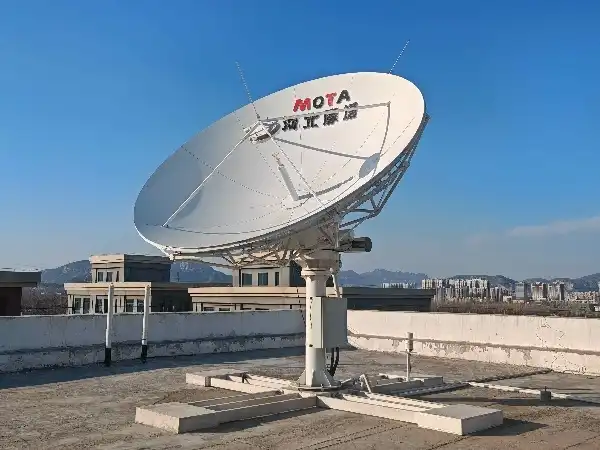
Understanding TT&C Antennas: Definition and Working Principle
What a TT&C Antenna Does
TT&C stands for telemetry, tracking, and command. Telemetry sends information from the satellite to the ground, like the battery voltage, temperature, and position. The ground sends commands to the ship, like a rocket burn or a gear change. The same radio link is used for tracking to measure angle, range, and Doppler shift. These readings are used to figure out the path.
During launch, early orbit, normal activities, and disposal, these lines stay open. Most of the time, payload data takes a different path. Low-rate data that the mission can't lose is handled by a standard TT&C antenna. This is because a missed order or a lost telemetry frame could put the spacecraft at risk.
How the Signal Chain Works
The baseband unit is the first link in the chain. It modifies a carrier with commands. The signal is made stronger by an upconverter and a high-power amplifier. It is then sent to the reflector by the feed. A narrow beam is aimed at the spaceship by the mirror.
The dish picks up a weak downlink signal on the way back. A low-noise amplifier boosts it with little noise, and a downconverter sends it to the baseband gear. That piece of gear demodulates telemetry and pulls out tracking data.
The base is moved by a motor loop, which makes the beam follow the target. When you use monopulse tracking, you compare the information from different feed sources at the same time. It makes an angle mistake and tells the servo about it. Signal fading doesn't cause a false error reading because the comparison only takes place once.
Frequency Bands, Gain, and Polarization
The S-band is where most TT&C links are found, but X-band and Ka-band are also used for some missions. S-band doesn't fade much in the rain, which is good for a link that needs to stay open in bad weather. The ITU Radio Regulations set aside frequencies for space operations between 2025 and 2110 MHz and 2200 and 2290 MHz. The uplink range of our standard TT&C antenna is 2025–2120 MHz, and the downlink range is 2200–2300 MHz.
Gain tells you how much signal the dish gets. G/T checks that gain against the noise temperature of the machine. An easy way to figure out beamwidth is to divide wavelength by diameter and multiply by 70. So, at 2.2 GHz, a 9-meter dish has a beam that is close to 1 degree.
The spacecraft must have the same polarization. Our antenna automatically changes between RHCP and LHCP, so there is no mismatch loss.
TT&C Antennas Versus Standard Communication Antennas
Many times, a payload transmission antenna moves a lot of user data at X-band or Ka-band, and it can handle short power failures. A TT&C antenna doesn't move much data, but it needs to stay linked.
TT&C also needs to be able to accurately track angles and measure range and Doppler. The link needs to make sure that commands are correct, since a bad command can hurt the spacecraft. A general data receiver might not be able to do any of these things. I think of the TT&C dish as a different system when I look over a project. It has its own link budget, tracking needs, and baseband interface.
Types and Technologies of TT&C Antennas: A Comparative Overview
High-Gain Versus Low-Gain TT&C Antennas
On top of the spacecraft are low-gain antennas. Patch, helix, and bidirectional designs all work at large angles, so the link stays strong even if the satellite falls or hasn't settled yet. Rate and range are limited by their weak gain.
A narrow beam of energy is focused by high-gain antennas, which are usually parabolic reflectors on the ground. For long distances and weak signals, they give you the extra room you need. Ground stations connect the two types: a spacecraft with low-gain antennas talks to a dish with high gain.
The trade-off is set by the aperture. A 13-meter dish has a smaller beam and more gain. Since the range is shorter in LEO, a 2.4 m dish can work better and costs less.
Tracking Methods and Telemetry-Only Antennas
Antennas that only send telemetry point in a set direction or follow a program track that was made from estimates of the orbit. Not only do they cost less, but the pointing error gets worse over time.
Tracking antennas close the loop on the signal that they receive. Step track moves the dish slowly and checks the signal strength every so often. A cone scan sends the beam in a small circle around the target. Skolnik writes about a method called "monopulse" in radar literature. It gets the angle error from a single signal pulse, so it can respond quickly to target movement.
Monopulse tracking with an accuracy of 0.03° or better and millisecond angle correction are what our standard TT&C antenna does. That response speed works best for LEO satellites and launch vehicles that move quickly.
Phased Arrays, Small Satellites, and Technology Trends
Beams in phased arrays can follow more than one target without having to move the dish. They are still the most popular choice when a station needs high G/T, even though they cost more when the opening is big.
For TT&C, CubeSats often use small UHF or S-band antennas on the spacecraft side. Since they are small, they can't get as much gain, so the ground dish has to pay for more of the link budget.
More automation is being used for satellites, remote station control, and baseband technology that runs on software. There are three technical checks I think you should do first. In all of them, open interfaces are important because the antenna needs to work with the baseband gear the station already has.
Selecting the Right TT&C Antenna: Criteria and Procurement Considerations
Core Technical Criteria
Here are the three technical checks I recommend first.
• Frequency and standards compliance: Make sure that the uplink and downlink bands work with your approved frequencies and the transponder on your spacecraft. Find out what standards the antenna uses for measuring and controlling things in space. When you make a match on paper, you don't have to do any expensive work again after installation, and your frequency coordination file stays the same as the hardware.
• Gain, G/T, and tracking accuracy: As you work backward from the link budget, you can find the gain, G/T, and tracking accuracy. Place the G/T you need at the lowest point you want to follow. Next, check the accuracy of the tracking and how the lock works during moves. These numbers lead to aperture because a bigger dish costs more for the base, the pedestal, and the upkeep.
• Baseband and interface compatibility: Name the baseband units that are already in your station and what ports they connect to. To find out how the antenna connects to them and how much work needs to be done to make it work, ask the vendor. Open interface protocols and a modular structure make projects easier and less risky.
Settling these three items early keeps the design review short and focused.
Specifications of the MOTA Standard TT&C Antenna
The table below lists the main parameters of our product.
| Parameter | MOTA Standard TT&C Antenna |
|---|---|
| Band | S-band; uplink 2025–2120 MHz, downlink 2200–2300 MHz |
| Aperture options | 13 m, 11 m, 9 m, 7.3 m, 6.2 m, 5.4 m, 4.5 m, 3.3 m, 2.4 m |
| Tracking | Monopulse, accuracy ≤0.03°, millisecond angle compensation |
| Polarization | Dual circular (RHCP/LHCP), automatic switching |
| Environment | IP68, 12-level wind resistance, -40°C to +70°C |
| Power | 220 VAC / 48 VDC, 7×24 operation |
| Design life | More than 15 years |
The standard TT&C antenna has good isolation, little noise, no command errors, and can receive telemetry without any loss. It can be put together quickly because it is made up of separate modules, and it works with most TT&C radio equipment. We think it will take up to 40% less time to integrate than with standard methods.
Lead Times, Certifications, and Logistics
We always have standard types in stock. It takes 45 to 90 days to make customized and large systems, so let people know when you want to start or hire them early.
We have ISO 9001, ISO 14001, ISO 45001, and GJB 9001C certificates for our management system. We also have type approval for equipment that sends radio waves. We move things with foreign dedicated lines, by sea freight, and by air freight. We use packaging that is resistant to shock and water, and we help with tracking, clearing customs, and storing goods overseas.
U.S. buyers should check with their compliance team about FCC and NTIA frequency authorization as well as any import or export rules. It may take longer to get approvals than to make things. Make sure you know which contractor is responsible for the foundation, the wiring, and the system integration so that there are no overlaps.
Warranty, Support, and Supplier Evaluation
To find the best standard TT&C antenna manufacturer or supplier, you should write down what you want, such as test reports, completed-site references, terms for spare parts, and terms for software upgrades. Ask all of the vendors the same questions. That includes us.
MOTA offers remote technical help 24 hours a day, seven days a week for system updates, installation, and troubleshooting. Our full-unit warranty meets international standards, and we can make plans that work for you. We offer regional service through cooperative methods, such as expert help on-site and quick delivery of spare parts.
Our ODM/OEM service for installers changes the way hardware looks, how it interacts with other devices, and what functions it has based on the rules in the target country. When the design life is more than 15 years, long-term spare parts supply is an important thing to talk about before signing.
Practical Applications of TT&C Antennas
I describe each scenario below by matching published specifications to operating needs. I do not quote unverified mission results. Ask our team for test reports and references that fit your project.
Satellite Ground Stations and LEO Constellations
A LEO satellite only goes by a station for a short time, so the antenna needs to quickly receive and lock on. Our standard TT&C antenna has a wide field of view that helps with initial acquisition when a satellite hasn't yet become stable. The beam stays on target thanks to automatic capture and correction for millisecond angle changes.
They usually start by building one to four stations and then add more as the fleet grows. Hardware that is the same across sites makes it easier to get extra parts, train operators, and switch between stations. For example, a team that is planning three sites can pick the same opening and baseband link for all of them. Then, later, that team can add a fourth site without having to change the way the website looks.
Launch Vehicle Telemetry
Rangers need constant telemetry from the time the rocket takes off until it enters orbit. A rocket moves quickly and shakes a lot, so the antenna on the ground has to move with it without losing its lock. Monopulse tracking fixes angle errors as they happen, which helps keep the track even when the path changes quickly.
Engineers can read the health data of the vehicle in real time and may need to send commands, so lossless telemetry and command errors are important. The site stays powered even if the power goes out on launch day thanks to two 220 VAC and 48 VDC supplies. The antenna can work outside thanks to its IP68 grade and 12-level wind protection.
Remote Sensing and Deep-Space Support
Some satellites that do remote sensing use TT&C links to send and receive health data and commands. Image data usually comes down on its own, faster pathways. So, S-band TT&C works with the data reception antenna instead of replacing it.
It gets weaker as you get farther away for long-range missions. A bigger aperture, like 13 m, and low noise reception make the link stronger. The cost of your link determines if a certain opening meets your needs. We have the same line of S-band products for low-orbit constellations and deep space. Based on your numbers, we help you choose the right amount.
Operating Around the Clock in Harsh Weather
Most of the time, ground stations are placed in remote, open areas. It can work in rain, heat, and cold thanks to IP68 protection, 12-level wind resistance, and an operating range of -40°C to +70°C.
Tracking windows can stay open even when the power goes out thanks to their dual power supply and 24x7 operation. Because modular construction makes taking things apart and putting them back together faster, maintenance teams can fix things more quickly. When added to the fact that the station is meant to last more than 15 years, these traits make it cheaper to run and maintain over its lifetime.
Conclusion
The telemetry, tracking, and order link that keeps a spaceship under control from launch to disposal are sent by a standard TT&C antenna. Baseband equipment, amplification, a feed, a mirror, and a servo loop make up the signal chain that makes this possible. Monopulse tracking keeps the beam on target. Most links use the S-band because it has low rain fade. The link margin is determined by gain, G/T, and polarization.
Spacecraft antennas with low gain work with ground dishes with high gain. Phased arrays, which cost more, add electronic steering. First, buyers should decide how much the link will cost. Then, they should look at frequency compliance, tracking accuracy, baseband compatibility, lead time, certifications, and support terms. When the mission's aperture is right, the same type of antenna can be used for ground stations, launch sites, remote sensing stations, and long-range missions.
FAQ
Which frequency bands do TT&C antennas use?
One or two tasks use X-band or Ka-band. Most of them use S-band. The input frequency ranges from 2025 to 2120 MHz and the downlink frequency ranges from 2200 to 2300 MHz on our standard TT&C antenna.
How does antenna gain affect telemetry and command?
A bigger opening makes the beam narrower and raises the gain. The station can then clearly receive weak telemetry and give commands with more room to spare. G/T measures awareness as a whole. It's also important to track a narrow beam accurately.
What should I prepare to order a customized antenna?
Get ready to give us your site's location, orbit, bands, target aperture, baseband model and connections, power and weather conditions, and when you need the package delivered. After that, we suggest a configuration. It takes 45 to 90 days to make customized systems.
Talk to MOTA About Your Standard TT&C Antenna Project
MOTA is a company that made standard TT&C antennas and started up in 2017. They can match your station plan with aperture, tracking, and baseband connections. Send your plan, frequencies, and site information to hebei_mota@163.com. Our team will get back to you with a setup and price. There is a full-unit warranty and technical support available 24 hours a day, seven days a week. Go to motasat.com to find out more about the product and its specs.

References
1. Satellite Communications Systems (Maral, Bousquet, Sun), 6th Edition, 2020
2. Space Mission Analysis and Design (Wertz, Larson), 3rd Edition, 1999
3. Radio Regulations, International Telecommunication Union, 2020
4. Introduction to Radar Systems (Skolnik), 3rd Edition, 2001
5. Antenna Theory and Design (Stutzman, Thiele), 3rd Edition, 2012
6. Satellite Communications (Pratt, Bostian, Allnutt), 2nd Edition, 2003
Tell us your requirements – get a tailored quote and technical support within 24 hours.