- English
- French
- German
- Portuguese
- Spanish
- Russian
- Japanese
- Korean
- Arabic
- Greek
- German
- Turkish
- Italian
- Danish
- Romanian
- Indonesian
- Czech
- Afrikaans
- Swedish
- Polish
- Basque
- Catalan
- Esperanto
- Hindi
- Lao
- Albanian
- Amharic
- Armenian
- Azerbaijani
- Belarusian
- Bengali
- Bosnian
- Bulgarian
- Cebuano
- Chichewa
- Corsican
- Croatian
- Dutch
- Estonian
- Filipino
- Finnish
- Frisian
- Galician
- Georgian
- Gujarati
- Haitian
- Hausa
- Hawaiian
- Hebrew
- Hmong
- Hungarian
- Icelandic
- Igbo
- Javanese
- Kannada
- Kazakh
- Khmer
- Kurdish
- Kyrgyz
- Latin
- Latvian
- Lithuanian
- Luxembou..
- Macedonian
- Malagasy
- Malay
- Malayalam
- Maltese
- Maori
- Marathi
- Mongolian
- Burmese
- Nepali
- Norwegian
- Pashto
- Persian
- Punjabi
- Serbian
- Sesotho
- Sinhala
- Slovak
- Slovenian
- Somali
- Samoan
- Scots Gaelic
- Shona
- Sindhi
- Sundanese
- Swahili
- Tajik
- Tamil
- Telugu
- Thai
- Ukrainian
- Urdu
- Uzbek
- Vietnamese
- Welsh
- Xhosa
- Yiddish
- Yoruba
- Zulu
How Does a Low-Profile Fixed Satellite Antenna Improve System Integration?
A low-profile fixed satellite antenna improves system integration by shrinking the hardware that installers, property managers, and builders must fit into a project. At 3 cm thick or less, the unit sits close to a roof, balcony, or exterior wall. It passes appearance reviews more easily and adds little projecting structure to the wind. Bolt-and-sealant fixation protects the building, and manual alignment takes about two minutes with clear guidelines. Low power draw, IP65 protection, and Ku-band performance across 10.7–12.75 GHz complete the package. In short, the antenna fits the building, the schedule, and the signal chain at the same time.
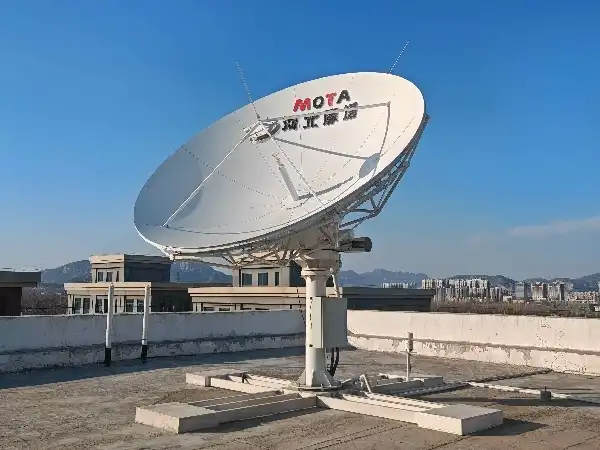
Understanding Low-Profile Fixed Satellite Antennas and Their System Integration Benefits
What Sets the Ultra-Thin Design Apart
A traditional fixed dish sticks out from the wall or roof. It's easy to see, but really tight in some places. However, our low-profile fixed satellite antenna, which was made by Hebei Mota Electronics Technology Co., Ltd., works the other way around. It can sit flat on a surface because its base is only 3 cm thick.
You can pick an aperture of 2.4 m, 3.3 m, or 4.5 m. From the outside, that shape doesn't stand out as much, and it gives you more room for wires, fences, and other rooftop gear. A thinner terminal makes it easier for an integrator to get clearance and makes it less likely that mistakes will be made after the site study is over.
Core Specifications That Matter to Integrators
These are the specs that have the most weight when deciding how to integrate:
- Signal performance: Ku-band activity from 10.7 to 12.75 GHz, with noise levels of 1.1 dB or less and receiver isolation levels of 82 dB or more. They help keep the send and receive routes separate in the same terminal and make sure that the receiving is clear. This way, your techs can use a stable link while they set up.
- Build and mounting: It should be less than 3 cm thick, have an IP65 rating to protect against dust and water jets, and be able to take light hits. The unit is put together with bolts and sealant. It stays in place and the holes around each clamp on roofs, walls, and platforms are closed off. The shelter can stay outside all the time.
- Power and operation: The working power is 5 W or less and the backup power is 1 W or less, so even if you leave it on all the time, it won't add much to your electricity cost. It is possible to align by hand, and with clear instructions, a normal person can point in about two minutes. Your workers will have less time to spend on each visit because of this.
Together, these figures give integrators a terminal that is easy to explain, write down, and set up.
How the Thin Body Supports Easier Installation and Alignment
When traders hand off their work, the system doesn't always work together again. A third person points the dish while the dish is placed by the first person. With a thin bolt-and-sealant mount, the operator only has to come out once to put the unit in place, seal the bolts, and then move on to aligning it.
The positioning guide is simple enough that even people who aren't tech-savvy can understand it. The first thing installation teams do is ask each tech how many units they can finish each day. The answer is clear: an easy mount and a two-minute pointing step. This will also make it less likely that you will need to go back.
Key Challenges in Satellite Antenna System Integration and How Low-Profile Designs Solve Them
Property Approval and Appearance Limits
People are often stopped by how the low-profile fixed satellite antenna looks first. A lot of people are interested in historic districts, building managers, and equipment that doesn't stand out. Many rules are loosed by the FCC's OTARD rule in the US for antennas that are one meter or less and are set up so that the user has full control or use of them. However, it doesn't cover everything.
A lot of the time, the owner or group has to agree to bigger buildings and roofs that are shared. The profile should be flat and no more than 3 cm thick. This makes your case stronger because the judge can see how little it sticks out from the wall. We recommend that every request for permission come with size plans and pictures of the placement.
Wind Load, Weather, and Leak Risk
Everything on the roof gets hit by wind and rain every day. It is thought that total force rises with open area and wind pressure rises with the square of wind speed. This is what ASCE/SEI 7 is based on. A thin unit close to the ground sticks out less than a short dish on a mast.
If the enclosure is IP65, it means it is dust-tight and can handle water jets but not immersion. This means that each bolt still needs to be properly sealed. Our bolt-and-sealant method takes care of that by sealing off the holes where leaks usually start. Installers should still follow the rules for building in their area.
Signal Interference and Space Limits in Vehicles and Modular Buildings
Because there is only so much room, more troubles arise. RV builders, modular building builders, and mobile guard booth builders all need a thin terminal that doesn't take up too much space inside, keeps the roof drag low, and links safely to the body structure. The strength of the signal is also important. It is important that the noise figure is 1.1 dB or less so that the receiver can handle weak messages.
Also, the sending and receiving routes should be 82 dB or more so that they don't interfere with each other. Because each country has its own rules, we change how the hardware looks, how it talks to other devices, and what it can do for OEM projects. They can then check the terminal to make sure it works with all new models.
Comparing Low-Profile Fixed Satellite Antennas with Alternative Solutions
Compared with Standard Parabolic Dishes
They know that a basic parabolic dish is a good value for the money. Only some sites show its flaws. The mast makes the reflection higher and it sticks out from the water. It's simple to see everything from the street. A low-profile fixed satellite antenna has a body that is 3 cm or less flat so it doesn't stick out like that.
You don't have to worry about motors because you can still use it while it's stable and make changes by hand. If approval or how they look is the main thing stopping a buyer, that deal often makes the order. In the country, where there are no rules about how to look, it might still make sense to use a traditional dish.
Compared with Motorized and Dome Systems
Tracking gear with motors and dome systems with radomes can keep an eye on ships and platforms that are moving. It's well known that KVH, Intellian, and Cobham Satcom are all in that field. For these systems to move the platform and steer the antenna at the same time, they need motors, a balancing device, and a bigger base.
Because our antenna is fixed to a building, it doesn't move as well as other antennas. It competes in height, how simple it is to set up, and how easy it is to use. Before you buy, think about how you will use it. A ship that is moving needs to be kept an eye on. A mount on the roof, balcony, or wall almost never does, and with a fixed unit, you don't have to worry about the moving parts.
Operating Cost and Maintenance Over Time
There is more to the lifecycle cost than just the price of the item. A solid antenna doesn't have any of those problems. It just has parts that need to be checked and can break. A lot of units also use a lot of electricity. We use no more than 5 W of power when it's on and no more than 1 W when it's off.
This keeps the price of power for each place low. Making sure the bolts and glue are tight is part of taking care of a fixed unit. You should also clean the surface and check the fixing points. Service calls for mechanical parts in dozens or hundreds of buildings cost more than short checks like these.
Practical Steps for Successful Integration of Low-Profile Fixed Satellite Antennas
Site Selection and Mounting
First, check out the site. For the best view of the satellite, choose a wall, roof, or deck. Also, make sure the surface can hold bolts. Before you drill, ask the owner or the group what the rules are. Figure out where the cable will go and add a drip loop to keep water from following it inside. After mounting the bolts, make sure they are all in the same place. Then, cover each one with sealant and let it dry the way the sealant maker tells you to. Take a picture of each step. In case a customer comes back and asks about a leak or damage, those shots will help you.
Alignment and Commissioning in About Two Minutes
If the guide is clear, it's easy to point by hand. Follow the steps in the instructions and point the antenna at the satellite you want to connect to. Make any necessary changes until the signal strength is strongest, and then set it in place. Write down the last reading along with the date and place.
Our team can help with alignment, and you can get tech support online seven days a week, 24 hours a day. Because they are trained, technicians can usually do the job faster than a normal user. This gives the customer time to learn how to do it. You should save the reading so that you can use it as a guide when you do more checks.
Maintenance and Network Compatibility
You should go there once or twice a year, or when the weather is bad. Check the nuts, sealing lines, and places where the wires enter, and clean off any dust or dirt you find. If you want to connect the computer to other networks, like LTE or fiber backup, make sure you know the input protocol right away.
When we do ODM and OEM work, we change software interfaces, function modules, and interface protocols to meet the needs of the customer and the rules of the country where the work is being done. When you get your order, we'll give you a full-unit guarantee that meets foreign standards. You can change plans with us at any time, and we offer online help 24 hours a day, seven days a week.
Future Outlook: How Low-Profile Fixed Satellite Antennas Shape B2B Procurement and System Design
Procurement Decisions Start With Documentation
A lot of buyers look at both the price and the proof for the low-profile fixed satellite antenna. A dealer can speed up the approval process by showing size plans, pictures of the product installed, mounting instructions, and an installation guide. Paperwork for compliance is also important. As proof of our good management, we have ISO 9001, ISO 14001, and ISO 45001 certifications.
On top of that, we have a GJB 9001C quality system and radio transmission equipment that is type approved by China. We will make sure that the hardware, interface protocols, and certifications you need are right for the market where you sell. Just let us know.
Customization for OEM and Project Buyers
Most of the time, people who buy projects only need one basic unit. A group of real estate engineers wants apartments in different buildings to match. A business that makes movable buildings or RVs wants the next model to have a thinner body, a certain finish, or a different way of putting things.
Every couple of months, models are made, and sales can range from a dozen to several hundred. Since we are both makers and traders, we plan to make things, test them, and then make a lot of them all at once. Systems that are made just for you or on a large scale take 45 to 90 days to build, so send in your plans early.
Supply, Logistics, and Support From MOTA
A good plan won't work if there isn't enough stock during the busy installation season. At MOTA, we always have a good amount of stock on hand so that we can ship out a lot of goods quickly. It is possible for our cross-border logistics system to work with international dedicated lines, air freight, and sea freight.
We also use packaging that is resistant to shock and water to keep fragile electronics safe. Tracking from beginning to end, help with clearing customs, and overseas warehousing help lower shipping risk. On top of that, our team helps with paperwork and running the business. For long-term partners, we offer low prices and flexible payment terms.
Conclusion
When you use a low-profile fixed satellite antenna, you don't have to worry about mounting risk, weather exposure, or installation time, which are all real issues that slow down projects. It gets good reviews because it's 3 cm thick or less. The house is safe because it is held together with bolts and glue, and it can be used outside all the time because it has an IP65 rating. Low noise, good transceiver separation, and low power draw in the Ku band make stable service possible.
This dish doesn't look as good as other dishes. It is not motorized or dome-shaped, so it does not have any moving parts for fixed sites. It's still important to carefully seal, keep clear records of alignment, and make sure the documents you use are right for the market. It is always available and can be changed, so integrators and OEM makers can use the same terminal in a range of buildings and cars.
FAQ
Which frequency band does the antenna use?
It operates on the Ku band, 10.7–12.75 GHz, with a noise figure of 1.1 dB or lower and transceiver isolation of 82 dB or higher.
Can it handle rain and dust?
The enclosure carries an IP65 rating, which means it is dust-tight and protected against water jets. It also resists light impacts. Proper sealant application at each bolt remains necessary.
How long does alignment take?
With the clear alignment guidelines, an ordinary user can complete manual pointing in about two minutes.
What warranty and support do you offer?
Each unit carries a full-unit warranty under international standards, with flexible plans. We also provide remote technical support around the clock for installation, troubleshooting, and system upgrades.
Can you customize the antenna for my market?
Yes. Our ODM and OEM service adapts hardware appearance, interface protocols, function modules, and certifications to the target country's regulations. Customized orders take 45 to 90 days.
Request Your Low-Profile Fixed Satellite Antenna Quote from MOTA
Talk to MOTA about your next project on a car, roof, or balcony. We are a low-profile fixed satellite antenna supplier with items that are ready to ship, the ability to do both OEM and ODM, and a response time of 7x24. We can give you prices, directions on how to place, and sizes that work for your market. You can email your amount and site type to hebei_mota@163.com, or you can visit motasat.com to learn more. The people on our team always answer.

References
1. Over-the-Air Reception Devices Rule, 47 CFR § 1.4000, Federal Communications Commission, 1996.
2. IEC 60529, Degrees of Protection Provided by Enclosures (IP Code), International Electrotechnical Commission, 2013.
3. Minimum Design Loads and Associated Criteria for Buildings and Other Structures (ASCE/SEI 7-22), American Society of Civil Engineers, 2022.
4. Satellite Communications Systems: Systems, Techniques and Technology, Wiley, 2020.
5. Antenna Theory: Analysis and Design, Wiley, 2016.
6. Recommendation ITU-R S.465-6, International Telecommunication Union, 2010.
Tell us your requirements – get a tailored quote and technical support within 24 hours.