- English
- French
- German
- Portuguese
- Spanish
- Russian
- Japanese
- Korean
- Arabic
- Greek
- German
- Turkish
- Italian
- Danish
- Romanian
- Indonesian
- Czech
- Afrikaans
- Swedish
- Polish
- Basque
- Catalan
- Esperanto
- Hindi
- Lao
- Albanian
- Amharic
- Armenian
- Azerbaijani
- Belarusian
- Bengali
- Bosnian
- Bulgarian
- Cebuano
- Chichewa
- Corsican
- Croatian
- Dutch
- Estonian
- Filipino
- Finnish
- Frisian
- Galician
- Georgian
- Gujarati
- Haitian
- Hausa
- Hawaiian
- Hebrew
- Hmong
- Hungarian
- Icelandic
- Igbo
- Javanese
- Kannada
- Kazakh
- Khmer
- Kurdish
- Kyrgyz
- Latin
- Latvian
- Lithuanian
- Luxembou..
- Macedonian
- Malagasy
- Malay
- Malayalam
- Maltese
- Maori
- Marathi
- Mongolian
- Burmese
- Nepali
- Norwegian
- Pashto
- Persian
- Punjabi
- Serbian
- Sesotho
- Sinhala
- Slovak
- Slovenian
- Somali
- Samoan
- Scots Gaelic
- Shona
- Sindhi
- Sundanese
- Swahili
- Tajik
- Tamil
- Telugu
- Thai
- Ukrainian
- Urdu
- Uzbek
- Vietnamese
- Welsh
- Xhosa
- Yiddish
- Yoruba
- Zulu
Everything You Need To Know About Marine Antenna
A marine antenna is any antenna built to send or receive signals on a vessel, and the satellite type connects a ship to broadband, voice, and monitoring services far from shore. A marine fixed satellite antenna is mounted permanently on a mast or deck, and a stabilizing platform keeps its dish aimed at the satellite while the hull moves. Crews rely on that link for weather data, video monitoring, and emergency calls. Four checks decide a good purchase: frequency band, motion stabilization, corrosion protection, and power draw. I walk through each check below and use the MOTA Ku-band model as a worked example.
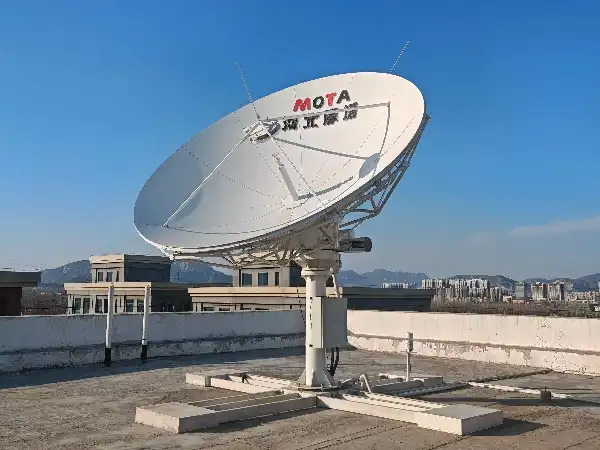
What Is a Marine Fixed Satellite Antenna and How Does It Work?
Core Components of a Fixed-Mount Marine Satellite Antenna
A marine satellite system is more than just a dish. The reflector dish, the feed with a low-noise receiver, the stabilizing platform that keeps the dish stable, and the controller that finds and follows the satellite are the four main parts. "Fixed" means that the unit stays on the ship and can't be moved around like a movable terminal can.
The stabilizing platform keeps the dish pointed even when the ship rocks back and forth. The device then tells the computer on board the difference between the weak satellite signal and the background noise. Boats that are used for fishing, carrying goods, pleasure, and other reasons use this plan.
How the Link Stays Connected at Sea
It is 35,786 km above the equator and is home to a daily Ku-band satellite. In other words, the dish must always face the same part of the sky. A moving body is always pulling the dish away from that spot. The offset is fixed by moving the dish the other way on the stabilizing platform. It can handle level-8 wind and waves and fix issues with the ship shaking. The MOTA unit has a special marine stabilizing platform for this. Just so you know, Beaufort force 8 means a gale with winds of 34 to 40 knots. Data, calls, and tracking will not drop as long as the dish stays pointed that way.
Why Salt, Wind, and Ship Power Shape the Design
Conditions at sea show why gear used at sea is different from gear used on land. A lot of people use the ASTM B117 salt fog test to see how resistant different things are to rust. Salt spray can hurt metal and joints. IEC 60945 sets broad standards for environmental conditions for radiocommunication and navigation tools used at sea. Because of waves and wind, stabilizing platforms need to be able to move. A third limit comes from ship power.
Most boats have 12V or 24V DC systems with generators that can only hold a certain amount of power or less. That's all the MOTA antenna needs. It's made of marine-grade stainless steel, has an IP68 rating, a stable stabilizing platform, and can connect to both 12V and 24V power sources. That mix tries to meet the two main needs of buyers in this business: it stays online at sea and doesn't rust over time.
Types and Specifications of Marine Fixed Satellite Antennas
Ku-Band, Ka-Band, and C-Band Compared
If you want to connect, the C-band is about 4 GHz, the Ku-band is about 10.7 to 12.75 GHz, and the Ka-band is about 20 GHz. These plates need to be bigger because they work better when it rains. In terms of rain fade, C-band has the least. However, most small fishing boats can't use its dish because it's too big.
The signal for Ka-band is weaker when it rains, but small dishes can still use it. Our marine fixed satellite antenna covers the commonly adopted Ku-band solution. Since Ku-band is in the middle, it's often used on business ships and yachts. It can work with frequencies between 10.7 and 12.75 GHz and has an aperture range of 0.8 m to 1.2 m. This makes it perfect for ships that need a dish size that is just right for their link strength.
Dish Size and Antenna Gain
The gain depends on how big the dish is and how long the signal is. MOTA has holes that are 1.2 m, 1.0 m, 0.9 m, and 0.8 m wide. Based on my calculations, the 1.2 m dish will provide about 41 dBi of gain at 12 GHz, while the 0.8 m dish will provide about 38 dBi of gain. They are just guesses based on theory; they are not claims about the goods.
Up to 3.5 dB stronger signal is picked up by the 1.2 m dish. This gives you more choices when it rains or when you're close to the edge of a satellite beam. The 0.8 m dish works well on decks that don't have a lot of space or wind. Figure out where you want to put it and what size you need for your service area.
Key MOTA Specifications at a Glance
I made a list of the important MOTA numbers to help you figure out if an antenna will work with your boat. If the noise figure is 0.9 dB or less, the noise temperature is around 67 K, which keeps the receiver's noise level low. For transceiver isolation of 88 dB or more, it helps stop marine interference. The beam widths are 1.2 m, 1.0 m, 0.9 m, and 0.8 m, and the frequency range is 10.7–12.75 GHz (Ku-band).
There is less than 0.9 dB of noise, and the transceiver isolation is at least 88 dB. Marine-grade stainless steel (IP68) protects it, and you can either align it by hand or have it done automatically. The power source is 12V/24V, and the power that works is about 10W.
How to Choose the Best Marine Fixed Satellite Antenna: A Buyer's Guide
Match the Antenna to Your Vessel and Route
Take a look at the ship and how it works first. Dishes that come in different sizes and cover more space are needed for boats that fish near the coast, carry goods along set routes, and cross seas. First, check to see if the satellite provider's beam goes to the places you fish or where ships go. Next, pick a dish that is the right size and weight for your deck.
Next, check to see if your electricity works. It only needs 10 W of power when it's on and can work with either 12V or 24V. That's 0.83 A at 12V and 0.42 A at 24V, or up to 240 Wh per day, which is fine for small battery banks. The budget should include more than just the price of the unit. It should also include the cost of installation and replacement parts.
Comparing Known Brands and Total Cost of Ownership
Most short lists have more than one name on them, as you can see. Smart marine VSAT receivers are made by Intellian and Sea Tel, which is a brand name of Cobham Satcom. Kymeta makes flat-panel antennas that are electronically steered. The company was known for its controlled marine services before Speedcast bought it in 2016. When you compare brands, don't just look at price.
Also check the warranty terms, the time it takes to get spare parts, and how easy it is to find a shop in your area for your marine fixed satellite antenna. Going down costs ships more than the tech itself. Not being able to fish or deliver goods on time can be worth more than the cost of the unit itself. To get the total cost of ownership, you need to add up how many times something breaks, needs to be fixed, and needs to be replaced. MOTA's design is based on service support and resistance to rust.
Questions Distributors and Fleet Buyers Should Ask
Fleet managers and distributors can use a short list of questions to check out potential suppliers. For salt spray tests, you should ask for the number of hours of contact and the measure that the lab used. After the warranty is over, you should find out how often parts break and how long it takes to get new ones. Check to see if the interface works with the routers and other transmitting terminals you already have.
Also, make sure the instructions are written in a language that your employees can understand. People who want to buy teams should also ask what the acceptance standards are and show proof that each batch performs the same. Before they place an order, people in the US should check with the FCC to see if transmitting terminals need to be approved. Finally, don't wait to talk about regional terms and prices.
Installation, Maintenance, and Troubleshooting of Marine Fixed Satellite Antennas
Step-by-Step Installation
The place needs to be in good shape for the work to go well. Pick a spot to mount it that doesn't block the view of the satellite and is away from anything that could block radar beams or masts. Put the base on a strong frame and connect it with stainless steel hardware. Then, cover all the holes for thers. Power and data lines should have drip loops put on them so that water doesn't follow them into a connection.
After plugging in the 12V or 24V power source, turn the unit on. The MOTA antenna aligns itself with the satellites in 4 minutes once it is set up, no matter if it is in automatic or manual mode. The signal quality from the controller needs to be checked. Write down the numbers and keep them as a baseline for when you want to compare things in the future. After professional commissioning, call-backs are less likely to happen, which is helpful when the ship works far from port.
Routine Maintenance Checklist
It's important to take care of it regularly because salt forms a crust that stops signals and holds water. Clean the dish and housing with clean water after trips in heavy spray. Check the bolts, wire connections, and seals for green or white corrosion. Check the plate's base for rust lines, especially where stainless steel parts meet other metals.
Write down the signal levels every month and check them against your baseline. Before fishing season starts or before a long trip, you should check the alignment in both modes. Marine-grade stainless steel and IP68 seals keep out salt and water, but a clean and tight fitting lasts longer.
Troubleshooting Signal Loss and Hardware Faults
A short list of everyday things that can damage your signal. First, make sure you can see. The dish could be blocked by a new crane or a stack of cargo. The voltage from the power source needs to be checked next. A long 12V cable run can mess up the controller if the voltage drops. Then check to see if there is water in the wires. If the unit can't find the satellite on its own, put it in manual mode and use the location your service provider gives you to point it.
Weak Ku-band signals can happen when it rains a lot, but the link usually gets stronger again after the storm is over for your marine fixed satellite antenna. Fix the problem if it keeps happening. Online installation, troubleshooting, and system updates can be done 24 hours a day, seven days a week by MOTA. Service and spare parts can be brought to the spot by cooperative routes.
Procurement Transactions and Services: Where and How to Buy Marine Fixed Satellite Antennas
Vetting Manufacturers and Certifications
First look at the certificates to see how the factory makes sure the quality is good. For nine years, Hebei MOTA has been making things. Management systems have been certified for ISO 9001, ISO 14001, and ISO 45001, and defense systems have been certified for GJB 9001C. Radio transmission equipment has also been given domestic type approval. It is also a state high-tech business and a business for bringing military and civilian life together.
Many intellectual property rights protect the satellite communication antennas and high-precision tracking algorithms that the company made on its own and are used in its products. Anyone who sells you something can give you copies of certificates, choices for workplace audits, and sample test records. It's helpful for your tech team to know how likely it is that something will break during fix before you place a large order.
Purchase Options, RFQs, and Order Planning
People can buy brand-new units, rent them from a service, or look at what's already out there. Before you put gear on the hull, you should buy brand-new units that come with a warranty. This is because salt damage can hide in used housings. A clear RFQ makes the price-setting process go faster. You should list the type of ship, dish size, source voltage, number, interface needs, end port, and certificates you want. First, a dealer gets a sample.
Then, they do a sea trial for 4 to 8 weeks, place their first order of 50 to 100 units, and then they place another order every three months. MOTA always has a lot of stock on hand for sales. Small or large systems take 45 to 90 days to make. ODM/OEM services make sure that the hardware's design, functions, licenses, and connections are all legal in every country.
Shipping, Warranty, and After-Sales Support
Shipping risk is important for electronics that are easily broken. International dedicated lines, sea freight, and air freight are all ways that MOTA packs units so that they are safe from shock and water. Wait times at the border are cut down by tracking, getting help with customs, and storing things abroad. The full-unit guarantee is based on norms from around the world, and you can pick from different plans.
Because they work together, MOTA sets up regional support, like expert service on-site and fast supply of extra parts. Order questions can be sent to a customer service line that is open 24 hours a day, seven days a week. There are times when you can talk about mixed-container loading and area words. Before you place your first order, take care of these things. A ship at sea doesn't have time to wait for parts.
Conclusion
Fixed to a boat, a marine fixed satellite antenna is made up of a dish, a supporting stabilizing platform, and a receiver. It keeps the boat connected so that it can get directions, watch videos, and call for help. You can pick by band, dish size, and how long it lasts. Ku-band is a good compromise between dish size and rain resistance. The case is made of stainless steel and covered with IP68 technology to keep salt spray and water out. Bigger dishes give you more gain. There is less wind and wave when the stabilizing platform is in use, and it can work with both 12V and 24V.
This keeps the ship's electrical system safe. Downtime is kept to a minimum by installing things carefully, cleaning and inspecting them often, and following a set order for finding problems. When someone buys something, they should look at how it tested, how much it costs to own, how much it costs to replace parts, and the terms of the warranty. Because broken gear costs less than being at sea for a long time.
FAQ
Is a fixed antenna different from a mobile marine antenna?
Yes. A fixed-mount unit stays on the ship, while a portable terminal can be moved around. The extra stabilizing platform on the MOTA fixed type keeps the boat stable when the deck shakes.
How often should I maintain it?
Rinse with clean water after a strong spray, and every month check the seals, caps, and screws. You should check the alignment every season or before a long trip.
Which vessels can use the MOTA antenna?
It can be used on fishing boats, cargo ships, yachts, and other special-purpose boats to make navigation communication, track videos, and make emergency calls. You can pick a dish that is 1.2 m, 1.0 m, 0.9 m, or 0.8 m long.
Does it work with my vessel's power system?
Yes. No more than 10 W is used when it's on and only 2 W when it's off. It works with both 12V and 24V DC marine systems.
How fast does it find the satellite?
It takes 4 minutes to align after anchoring, whether you use automatic or manual mode.
Contact MOTA for Your Marine Antenna Quote
The company MOTA makes marine fixed satellite antennas and always has some on hand for regular sales. You can also choose ODM or OEM, and they're open 24 hours a day, seven days a week. Email hebei_mota@163.com with your vessel type, dish size, and number. Our team will get back to you with a price and more details about how it works. At motasat.com, you can look at the Ku-band range for yachts, fishing boats, and cargo ships. Then, you can ask about a test unit for your next test at sea.

References
1. IEC 60529: Degrees of Protection Provided by Enclosures (IP Code), International Electrotechnical Commission, 2013
2. ASTM B117: Standard Practice for Operating Salt Spray (Fog) Apparatus, ASTM International, 2019
3. IEC 60945: Maritime Navigation and Radiocommunication Equipment and Systems – General Requirements, International Electrotechnical Commission, 2002
4. Radio Regulations, International Telecommunication Union, 2020
5. Satellite Communications, Dennis Roddy, McGraw-Hill, 2006
6. Satellite Communication Systems, Gérard Maral and Michel Bousquet, Wiley, 2009
Tell us your requirements – get a tailored quote and technical support within 24 hours.