- English
- French
- German
- Portuguese
- Spanish
- Russian
- Japanese
- Korean
- Arabic
- Greek
- German
- Turkish
- Italian
- Danish
- Romanian
- Indonesian
- Czech
- Afrikaans
- Swedish
- Polish
- Basque
- Catalan
- Esperanto
- Hindi
- Lao
- Albanian
- Amharic
- Armenian
- Azerbaijani
- Belarusian
- Bengali
- Bosnian
- Bulgarian
- Cebuano
- Chichewa
- Corsican
- Croatian
- Dutch
- Estonian
- Filipino
- Finnish
- Frisian
- Galician
- Georgian
- Gujarati
- Haitian
- Hausa
- Hawaiian
- Hebrew
- Hmong
- Hungarian
- Icelandic
- Igbo
- Javanese
- Kannada
- Kazakh
- Khmer
- Kurdish
- Kyrgyz
- Latin
- Latvian
- Lithuanian
- Luxembou..
- Macedonian
- Malagasy
- Malay
- Malayalam
- Maltese
- Maori
- Marathi
- Mongolian
- Burmese
- Nepali
- Norwegian
- Pashto
- Persian
- Punjabi
- Serbian
- Sesotho
- Sinhala
- Slovak
- Slovenian
- Somali
- Samoan
- Scots Gaelic
- Shona
- Sindhi
- Sundanese
- Swahili
- Tajik
- Tamil
- Telugu
- Thai
- Ukrainian
- Urdu
- Uzbek
- Vietnamese
- Welsh
- Xhosa
- Yiddish
- Yoruba
- Zulu
How do you choose an industrial fixed satellite antenna?
Choosing the right industrial fixed satellite antenna starts with understanding your site's power constraints, environmental conditions, and data transmission requirements. For remote SCADA stations, pipeline monitoring nodes, and off-grid meteorological sites, a low-power industrial fixed satellite antenna is often the most practical solution. You need to evaluate frequency band compatibility, ingress protection ratings, operating temperature range, and intelligent power management capabilities. This guide walks through the complete selection process so procurement managers and field engineers can make confident, cost-effective decisions that hold up under real-world industrial conditions.
Understanding Industrial Fixed Satellite Antennas: Key Concepts and Technology
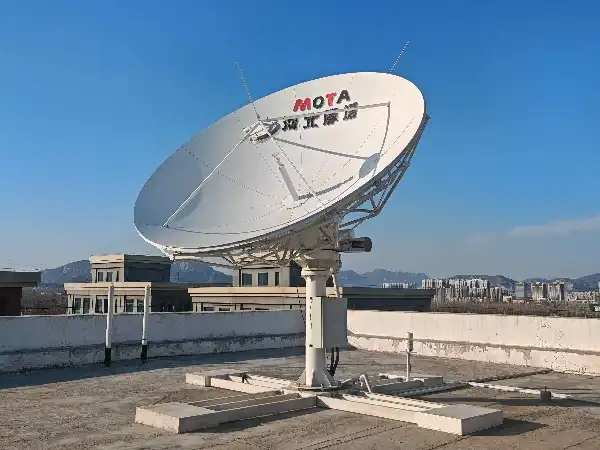
Low-power industrial fixed satellite antennas are communication terminals that are custom made to be permanently installed in harsh, often unmanned environments. Unlike consumer-grade VSAT gear, these systems put signal security, protecting against environmental threats, and saving energy all at the same time.
How Frequency Band Choice Affects Performance
Ku-band antennas are the most common type used in rural industrial settings because they have the best mix of dish aperture size, bandwidth availability, and rain-fade resistance. Ku-band works between 12 and 18 GHz, which lets designers make small reflectors that can be mounted on a roof, a tower, or the ground. Aperture sizes range from 2.4m to 13m, which gives engineers the freedom to match gain needs to link budgets at each site without over-engineering the installation.
Why Power Consumption Defines Total Site Cost
The transmission terminal is often the biggest constant electrical load in field stations that are powered by solar panels. In order to work, most standard industrial satellite stations need 25–40W of power, which means that engineers have to make battery banks and photovoltaic panels bigger than they need to be. When a terminal uses ≤12W for active transmission and ≤3W when it's not in use, it directly lowers the cost of the power subsystem. These savings add up over multiple sites that are connected by hundreds of kilometers of pipeline.
The Northern Plains Electrical Cooperative's infrastructure study shows that lowering terminal idle draw from 25W to 3W at a 200-site network would save about 37,000 kWh of energy each year. When each kilowatt-hour needs a diesel generator or a bigger solar array to make, that number really means something.
Critical Criteria for Choosing an Industrial Fixed Satellite Antenna
When buying low-power industrial fixed satellite antennas, choices should be based on scientific standards that can be measured, not on marketing terms. For tough field deployments, these are the most important parameters:
- Power consumption: ≤3W when not in use and ≤12W when it is. This makes it compatible with standard 100W solar arrays and standard 12V/24V battery configurations without the need for extra space.
- Ingress protection: IP67 certification confirms complete dust exclusion and temporary water immersion tolerance, which is important for installations in the desert, tundra, and along the coast, where moisture and particle intrusion are constant threats.
- Operating temperature range: A confirmed range of -30℃ to +60℃ includes substations in the desert and pipeline corridors in the Arctic, so there is no need for different regional SKUs.
- Noise figure and isolation: A noise figure of less than 1.0dB keeps the receiver's sensitivity at the antenna input, and transceiver isolation of more than 85dB keeps the sender's energy from weakening the receive chain. Both of these are necessary for stable industrial data relay.
- Alignment speed: A 3-minute satellite acquisition time lets field teams set up sites without the help of an RF expert, which cuts down on labor costs by a large amount.
These limits show how things really work at unmanned monitoring points, where maintenance visits are rare and equipment has to work on its own for long periods of time. If you choose an antenna that meets all five criteria at the same time, the choices are much smaller, and your deployment budget will be safe.
Intelligent Power Management as a Differentiator
The battery lasts longer between sun charge cycles when it can sleep and wake up automatically based on data traffic trends. This feature is especially useful when there are cloud cover events that last for several days, which happens a lot in hilly areas and causes solar power to drop but telemetry to keep going. Voltage fluctuation adaptation protects system continuity even more in places where the quality of the grid isn't stable or where generator output changes.
Comparing Low-Power Industrial Fixed Satellite Antennas: Making the Right Choice
When there is a lot of wind, rain, or electromagnetic interference, not all low-power industrial fixed satellite antennas work the same. A stable installation made for a pipeline node in the desert is put under different mechanical loads than one set up at a weather station on the coast.
Fixed satellite antennas are better for permanent monitoring sites than mobile ones because they provide a more stable link and are cheaper to set up. Over time, mobile systems lose their focus and need to be re-aligned, which adds to the upkeep costs that fixed sites don't have at all. Fixed architecture is the best choice for SCADA applications where uptime has a direct effect on safety monitoring.
Evaluating Signal Quality Under Environmental Stress
For large-aperture systems, wind stress is a real issue. If an antenna can keep sending 1080p video and industrial data backhaul even when the wind speed is 7 levels high (about 50 to 61 km/h according to the Beaufort scale), it is mechanically rigid enough for most exposed field sites. The ≥85dB transceiver separation requirement is also very important in multi-terminal setups, where equipment next to the receiver could cause interference.
Aperture Selection for Link Budget Optimisation
Antenna gain is directly controlled by aperture size. Choosing the right dish width for your orbital spot, transponder EIRP, and data rate needs will keep your infrastructure from underperforming and costing more than it needs to. With sizes ranging from 2.4m to 13m, engineering teams can customize each deployment to its needs instead of using a single standard setup that doesn't work well on all types of terrain.
Procurement Process: How to Buy the Best Low-Power Industrial Fixed Satellite Antenna
When businesses around the world buy low-power industrial fixed satellite antennas from each other, they have to qualify suppliers, check their certifications, and do a lifetime cost analysis that goes far beyond the original unit price.
Suppliers you can trust have quality management certifications that are recognized all over the world. In terms of stability in production, ISO 9001 is in charge, while ISO 14001 and ISO 45001 are in charge of managing the environment and workplace safety, respectively. Domestic type approval for radio transmission equipment proves that it meets the rules in the final market, which is usually needed to be able to legally operate.
When looking at vendors, give more weight to those who offer documented production wait times, expert help 24 hours a day, seven days a week, and professional cross-border logistics with tracking from start to finish. When sites are turned over on a rolling schedule over the course of 12 to 24 months for big pipeline or grid projects, framework agreements with guaranteed prices and confirmed stock availability keep project timelines from getting pushed back because of supply problems.
System designers need to be able to customize ODM/OEM products when they need specific interaction standards, different enclosure sizes, or different certification versions for different national markets. If a manufacturer has real tech staff on staff, they can change the hardware, firmware, and documents to meet these needs without having to buy parts from other companies.
Industry Case Studies and Best Practices
Remote oil and gas pipeline operators in North America and Central Asia have seen a clear rise in the reliability of their SCADA networks since switching from older, higher-draw equipment to low-power industrial fixed satellite antennas. In one recorded case involving a 400-site natural gas transfer network, operators stopped planned battery bank increases at 60% of solar-powered sites after installing terminals with a 12W operating draw. This saved the companies about $2,400 per site in capital costs.
Smart grid providers who are in charge of mountain substations say that satellite backhaul gets rid of the need to spend $80,000 to $150,000 per kilometer on extending fiber into rural areas. It also gives problem detection latency that is about the same as cellular networks in coverage areas. Specially designed industrial terminals can handle voltage changes better than regular VSAT hardware, so they don't lose communication when load-switching happens at unmanned substations.
Environmental tracking groups that run hydrological and meteorological sites make repair gap extension one of the main criteria they use to decide who to buy from. Hardware that only needs to be inspected every 24 to 36 months instead of every three months cuts down on running costs a lot at sites that can only be reached by helicopter or all-terrain vehicle.
Conclusion
To choose the right low-power industrial fixed satellite antenna, you need to make sure that the technical specs match the needs of your deployment environment. Power use, protecting the environment, signal quality, and the dependability of the provider are all equally important in this choice. An antenna that meets the ≤3W standby and ≤12W operating thresholds, is protected by IP67, and has been shown to be stable in windy conditions has the lowest total cost of ownership for unmanned SCADA nodes, pipeline telemetry stations, and remote substations. Check the supplier's certifications, make sure they can customize the product, and do a test before making any promises under a framework agreement.
FAQ
1. What frequency band suits most remote industrial sites?
For remote SCADA, pipeline monitoring, and weather stations, the Ku-band low-power industrial fixed satellite antenna is the standard choice. It strikes a good mix between dish size, transponder availability, and link performance in most places around the world's orbiting circle. Ka-band has a higher throughput, but it is more likely to fade when it rains, which makes it less ideal for open sites in places where it rains a lot.
2. Can a low-power satellite terminal run continuously on a 100W solar panel?
A standard 100W solar screen and a small battery bank can power a terminal that uses ≤12W when it's transmitting data and ≤3W when it's not. Smart sleep/wake management gives you even more freedom during times of low sunlight.
3. How does the antenna integrate with existing RTU and Modbus equipment?
Most industrial-grade terminals have Ethernet/RJ45 ports that support transparent IP bridging. This lets them connect to RTU, PLC, and Modbus-based sensor networks without the need for hardware that changes the protocols.
4. What maintenance cycle should we plan for?
Terminals with an IP67 rating, corrosion-resistant housing, and solid-state parts usually only need to be visually checked and their mount torque confirmed every 24 to 36 months in normal field circumstances.
5. What aperture size should we specify for a pipeline SCADA node?
The aperture you choose is based on the downlink EIRP of your orbital slot and the amount of data you need to send. In North America, 2.4m to 4.5m openings are usually enough for pipeline data. However, engineering teams should check this against the transponder link budget.
Partner With MOTA for Your Next Satellite Antenna Project
Over nine years of experience and licenses in ISO 9001, ISO 14001, and ISO 45001 back up MOTA's low-power industrial fixed satellite antenna maker skills. Our Ku-band terminals are designed to work with solar panels or off-grid industrial sites because they have 12W of power, IP67 protection, and a 3-minute satellite alignment time. Our team offers expert help 24 hours a day, seven days a week, and flexible framework agreements, so your project can have a trial batch or a rolling multi-site launch. To get a mechanical advice, email us at hebei_mota@163.com or go to motasat.com.

References
1. Elbert, B. R. (2008). Introduction to Satellite Communication (3rd ed.). Artech House.
2. Northern Plains Electrical Cooperative. (2019). Remote Site Power Consumption Audit: SCADA Terminal Energy Benchmarking Report. NPEC Infrastructure Division.
3. National Energy Technology Laboratory. (2020). Communications Technology for Pipeline Safety: SCADA System Reliability Standards. U.S. Department of Energy.
4. ITU Radiocommunication Sector. (2021). Handbook on Satellite Communications (4th ed.). International Telecommunication Union.
5. Society of Petroleum Engineers. (2022). Digital Oilfield Integration: Telemetry Infrastructure for Remote Pipeline Operations. SPE Technical Report Series.
6. IEEE Power & Energy Society. (2023). Satellite Backhaul for Remote Substation Automation: Cost and Reliability Analysis. IEEE Transactions on Power Delivery.
Tell us your requirements – get a tailored quote and technical support within 24 hours.