- English
- French
- German
- Portuguese
- Spanish
- Russian
- Japanese
- Korean
- Arabic
- Greek
- German
- Turkish
- Italian
- Danish
- Romanian
- Indonesian
- Czech
- Afrikaans
- Swedish
- Polish
- Basque
- Catalan
- Esperanto
- Hindi
- Lao
- Albanian
- Amharic
- Armenian
- Azerbaijani
- Belarusian
- Bengali
- Bosnian
- Bulgarian
- Cebuano
- Chichewa
- Corsican
- Croatian
- Dutch
- Estonian
- Filipino
- Finnish
- Frisian
- Galician
- Georgian
- Gujarati
- Haitian
- Hausa
- Hawaiian
- Hebrew
- Hmong
- Hungarian
- Icelandic
- Igbo
- Javanese
- Kannada
- Kazakh
- Khmer
- Kurdish
- Kyrgyz
- Latin
- Latvian
- Lithuanian
- Luxembou..
- Macedonian
- Malagasy
- Malay
- Malayalam
- Maltese
- Maori
- Marathi
- Mongolian
- Burmese
- Nepali
- Norwegian
- Pashto
- Persian
- Punjabi
- Serbian
- Sesotho
- Sinhala
- Slovak
- Slovenian
- Somali
- Samoan
- Scots Gaelic
- Shona
- Sindhi
- Sundanese
- Swahili
- Tajik
- Tamil
- Telugu
- Thai
- Ukrainian
- Urdu
- Uzbek
- Vietnamese
- Welsh
- Xhosa
- Yiddish
- Yoruba
- Zulu
How Does a Dual-Band High-Power Fixed Satellite Antenna Work?
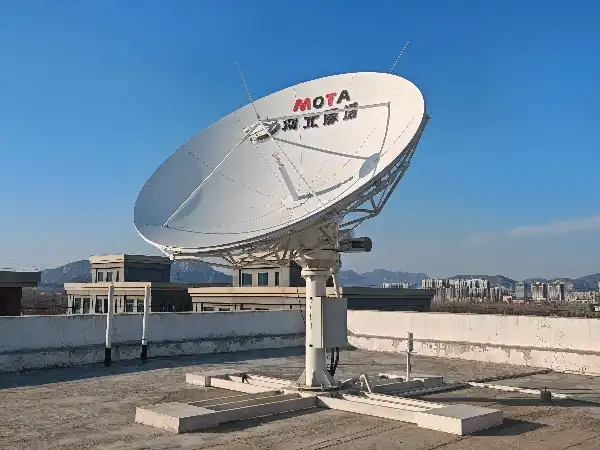
The dual-band high-power fixed satellite antenna gives a satellite a concentrated radio signal and receives signals in two frequency bands. A parabolic reflector concentrates radio waves, while the feed assembly directs send and receive signals. High-power amplifiers boost uplink signal power, whereas low-noise amplifiers boost downlink signal output with little noise. A control module points the antenna and chooses the working band. Because the dish stays in one spot, it gives steady capacity for network hubs, data centers, and broadcast backhaul. Each part has a measurable job.
This article explains how a dual-band high-power fixed satellite antenna works, which requirements purchasers should assess, how antenna configurations compare, and what to consider from quote to installation from MOTA's manufacturer viewpoint. Since accurate capacity planning requires quantifiable performance, it emphasises clear explanations and verified technical facts.
Understanding Dual-Band High-Power Fixed Satellite Antennas
What Dual-Band and High-Power Mean
A dual-band antenna may operate in C-band or Ku-band, depending on its arrangement. Satellite uplink allocations typically vary from 5.9–6.4 GHz for C-band services to 14.0–14.5 GHz for Ku-band services, depending on the allocation and service. C-band transmissions have less rain attenuation than Ku- and Ka-band signals under similar connection circumstances. Rainfall intensity, route length, antenna gain, and system design affect performance.
High-power in satellite communications refers to the antenna system's RF transmission capabilities, usually backed by an amplifier. Higher uplink power helps enhance connection budget and compensate for propagation losses from long transmission distances and bad weather. Link margin relies on antenna gain, receiver performance, frequency band, and transmission restrictions. MOTA models provide antenna configurations for Ku, Ka, S, X, C, and Q/V frequency bands. Dual-band antennas support two bands instead of all. A smart band-recognition module lets the chosen model move between supported bands based on its control logic and operational needs. Buyers should verify model-specific bands and switching circumstances.
How the Signal Path Works
The modem creates the uplink transmission signal, which flows via RF equipment and a high-power amplifier to reach the antenna feed. The feed lights the parabolic reflector, which directs radio signals to the satellite. The reflector guides satellite signals to the feed for downlink. A low-noise amplifier boosts the signal while reducing noise.
Isolation is important because the feed goes to both paths, and if power leaks from one path to the other, it can overwhelm the receiver. The noise level must be 0.7 dB or less, which is about 51 K, and the separation must be at least 95 dB. The high-power transceiver and control module are both built into one unit. This makes it simple to set up over a network.
Key Specifications Buyers Should Check
These are the first things I look at on every datasheet:
• Transmit power: MOTA requires 50 W or more for the antenna design. If adaptive power regulation is supported, the model may adjust output to operational needs and link circumstances. Bandwidth, modulation, coding, antenna gain, satellite capacity, and regulatory constraints affect 8K video transmission and data-center backhaul. Buyers should verify rated output power and measured performance under test circumstances.
• Sidelobe level and pointing accuracy: Pointing inaccuracy is limited to 0.1°, and the first sidelobe level is -20 dB or less. Low sidelobes limit emission toward nearby satellites and other directions, while accurate aiming keeps the primary beam aligned with the satellite. Buyers should check reference axis, measuring technique, and radiation-pattern requirements. The antenna can be aligned either by hand or automatically, so crews can fine-tune it on the spot.
• Environmental protection and housing: The enclosure is IP67 and the operational temperature range is -30°C to +60°C, depending on the model. IEC 60529 defines IP67 as dust-tight and temporary immersion protection under test circumstances. IP67 does not protect against salt spray, extended humidity, sand abrasion, or other outside situations, although an aluminum-alloy housing may give structural protection. Customers should also check the manufacturer's corrosion-resistance, weatherproofing, and environmental test results.
These specifications help buyers assess whether the dual-band high-power fixed satellite antenna can meet the required link-performance targets. Each parameter should be checked against the applicable acceptance criteria and supported by verifiable test data.
Benefits and Applications of High-Power Dual-Band Antennas
Frequency Flexibility Reduces Model Variety
Spare parts, operator training, and documentation must be managed between locations and satellite connections by network designers. A dual-band antenna that supports two frequency bands may minimise the number of network antenna types. MOTA supports Ku, Ka, S, X, C, and Q/V bands depending on the model. Buyers should ensure the configuration satisfies coverage, capacity, and compatibility needs.
Frequency selection influences weather-related connection performance. In ITU-R P.618, propagation effects, including rain attenuation, on Earth-space communications are estimated. Higher-frequency connections often attenuate rain better under equivalent circumstances, depending on rainfall rate, route length, polarisation, and system design. If supported, buyers should obtain band-switching time and link recovery behaviour statistics, especially for broadcast and data-center applications that need service continuity.
Signal Integrity and Lifecycle Cost
Signal integrity relies on transmit-receive isolation, receiver noise figure, antenna gain, pointing precision, and sidelobe performance. Buyers should check the MOTA configuration's isolation of at least 95 dB, noise figure of 0.7 dB, and initial sidelobe level of -20 dB against the appropriate test results. These parameters measure receiver protection, signal sensitivity, and unwanted radiation, but the link budget determines connection quality.
When the antenna offers remote monitoring and diagnostics, site visits may be reduced. Automatic alerts may help the network operations center find defects faster, but reaction times rely on the monitoring system and maintenance. Standardising antenna models may save spare-parts inventory and training. Buyers should calculate total cost of ownership including installation, energy consumption, maintenance, replacement parts, and remote assistance.
Where These Antennas Are Used
The dual-band high-power fixed satellite antenna supports many fixed satellite communication applications. Satellite connections may connect data centers and provide data backhaul, while business and government network hubs can utilise them for specialised communications. Broadcasters may employ satellite connection for high-bandwidth video contribution and distribution, depending on bandwidth and link budget.
Satellite connections may connect rural places when fibre infrastructure is unavailable or expensive. This may include rural areas, isolated industrial locations, and energy facilities in the US. Fixed antennas are useful for applications with stable terminal locations and satellite coverage if the installation fulfils structural, environmental, and link-performance requirements.
Comparing Dual-Band High-Power Models with Alternatives
Dual-Band Versus Single-Band Designs
When the application needs just one frequency band, a single-band antenna may be cheaper and easier to configure. A single-band architecture may be less flexible if the network has to shift frequency bands for various operational requirements. If the model and satellite service support both bands, a dual-band antenna may provide an operational option. The bandwidth, satellite capacity, weather, and connection budget determine whether Ku-band is better for rain attenuation than C-band. MOTA provides Ku, Ka, S, X, C, and Q/V Band variants, however purchasers should check model capabilities.
High-Power Versus Low-Power Designs
Let's talk about link margin for the dual-band high-power fixed satellite antenna. Link margin is the extra signal strength that keeps a link going when the signal strength drops. A 50 W or higher amplifier can handle faster data rates and a bigger rain cushion on the same dish as a 50 W or less amplifier. But having more power isn't always better. Off-axis emissions are regulated by the FCC and satellite operators to protect adjacent satellites.
This is also why a high-power antenna needs to be pointed right and have low sidelobes. At 30 GHz, a 1.2-meter dish has a half-power beamwidth of about 0.6°. This means that a mistake of 0.1° costs about 0.35 dB. Then, smart power regulation makes sure that the amount of power being sent stays the same as the amount that is being used.
Fixed Versus Mobile Antennas
Include satellite service, supported frequency bands, goal data rate, availability, and contingency plans in the connection needs and budget. Then check the antenna's send power, transmit-receive isolation, receiver noise figure, and pointing accuracy for project requirements. Request factory acceptance test results and site acceptance test plans from suppliers. Check regulatory requirements early in the procurement process for licensing, coordination, or installation issues.
Procurement and Installation: What B2B Buyers Need to Know
Selecting Specifications and Verifying Claims
Plan how much you can spend on your link, taking into account the satellite, bands, data rate, and a backup plan in case something goes wrong. After that, check that the antenna has the right power, separation, noise figure, and pointing figure for your needs. Ask each supplier to give you a report on the factory test and a plan for an acceptance test that will be done on-site. Early on, look over the rules.
Depending on the service and operational configuration, 47 CFR Part 25 may need licensing and other restrictions for satellite earth-station operations in the US. Buyers should assess authorisation needs early since regulatory permission and collaboration may delay projects. Site design should include antenna positioning, structural loads, electrical supply, cabling, grounding, lightning protection, and equipment-room needs. OEM and ODM vendors may alter hardware configurations, interfaces, and documentation to meet the target market, but product and jurisdiction-specific certification or regulatory authorisation must be validated.
Ordering, Lead Times, and Shipping
MOTA stocks certain common goods, but customised or large-scale systems take 45–90 days to produce. Before setting project milestones, buyers should check stock availability, manufacturing timeline, shipping, and delivery date in the purchase contract. RF equipment should be packaged using shock- and moisture-resistant materials to prevent damage during shipment.
As part of our cross-border logistics, we handle international dedicated lines, sea freight, and air freight. We also help clear customs and store goods abroad. Our payment terms for big jobs are different for each job, and we give you a choice. The people on our team also do paperwork and take care of business matters.
Installation and Maintenance Steps
There is a clear procedure for installing the dual-band high-power fixed satellite antenna. First, look around to make sure the satellite line of sight is clear. Second, construct the foundation and cabling, with proper lightning protection. Third, mount the feed assembly and connect power and indoor equipment. Fourth, align the dish manually to obtain a rough pointing position. Then, use automatic alignment to achieve optimal signal. Lastly, activate the link and configure alarms for remote monitoring.
After that, keep an eye on the seals, connectors, and mounting hardware. Help from afar is useful in places where there isn't a service team nearby. MOTA offers full-unit warranties that are based on international standards. They also offer remote technical support 24 hours a day, seven days a week for system upgrades, installation, and troubleshooting.
Leading Brands and Market Solutions for Fixed Satellite Antennas
How to Evaluate Manufacturers
I don't just trust the rankings that come out once a year because they don't always explain how the tests were made. A short report is better. Check to see if the business has security certifications like ISO 9001, ISO 14001, and ISO 45001. Pay attention to the measures for power, separation, and noise tone.
Browse through bands and websites that are like yours to get ideas, and compare the document to customer reviews. You can use the same model on more than one site by copying it. Make sure the seller will keep it on hand in case you need it in the future. Before you place an order, watch a video check or go to the plant.
OEM and ODM Partnerships
Authorized OEM and ODM outlets let a brand or integrator change hardware to fit their own product. Some of the things that can be changed about MOTA are how it looks, how it works, what software it uses, how it looks, and what certifications it has for each country. The service does everything, from making the plan and a sample to making a lot of them.
The people who run VSATs can change how networks are managed and how bands are combined. Distributors can also make sure that all areas sell the same products. It's important to talk about technology issues early on because once a tender is out, the specs are usually set in stone. Give us your needs before the specs are set in stone, and our developers will make sure the tools can meet them.
Where MOTA Fits
MOTA is the name of the company Hebei Mota, which has been around since 2017 and makes and sells things. We have certificates like ISO 9001, ISO 14001, and ISO 45001. We also have the GJB 9001C military quality management system and radio transmission equipment type approval in China. Our high-tech company helps the military and civilians work together across the country.
In the course of our work, which is covered by several intellectual property rights, we made our own satellite transmission antennas and high-precision tracking algorithms. Our Ku/Ka/S/X/C/Qv antenna sends out at least 50 W of power and is smart about how it uses that power. For US buyers, the FCC approval is still needed in their own country, and we change the papers and displays to fit the needs of each country.
Conclusion
A strong, narrow beam is sent through a feed and reflector by the dual-band high-power fixed satellite antenna. Then, it amplifies weak downlink signals with low noise and maintains high isolation to keep the two paths separated. It is valued for its output power of 50 W or higher, 95 dB isolation, 0.7 dB noise figure, first sidelobe of -20 dB or lower, and pointing error of 0.1°.
It supports fewer model types and has more band options than single-band or low-power designs. It also has a stronger link margin. You can mount it permanently, so it works well in hubs, data centers, and broadcast sites as well. If you want to do a good job with procurement, you need to check the test data, make sure that the legal steps are clear, set wait times, and plan for installation and online support.
FAQ
Which frequency bands does the antenna support?
A MOTA model determines the frequency ranges supported. The firm sells dual-band antennas for Ku, Ka, S, X, C, and Q/V bands, however some only support two. The model's technical documentation should validate automatic band switching's working circumstances and switching logic.
How does it handle harsh weather?
The heat range for this thing is -30°C to +60°C. It has an IP67 rating and is made of a strong aluminum shell. Also, picking the right band is important because lower frequencies lose less data when it rains a lot.
Does it support manual and automatic alignment?
Model selection determines alignment choices. MOTA requires manual and automated alignment with a 0.1° pointing inaccuracy for setups that provide both functionalities. Buyers should verify pointing-accuracy definition and test circumstances before buying.
Can I monitor it remotely?
With the right type and control system, remote monitoring and fault alerts are possible. Buyers should check communication interfaces, protocols, monitoring features, and alarm settings. Subject to technological feasibility and project constraints, MOTA's OEM/ODM services may enable interface customisation.
What is the delivery time?
MOTA says conventional goods may be in stock, but customised or large-scale systems take 45–90 days to produce. Model availability, configuration, order quantity, and shipping options determine delivery time. Buyers should check manufacturing and delivery dates in the contract.
Request a Quote for a Dual-Band High-Power Fixed Satellite Antenna

ISO 9001, ISO 14001, and ISO 45001 have all approved MOTA's dual-band high-power fixed satellite antennas. These antennas have an output of 50 W or more and can work 24 hours a day, seven days a week. Hebei_mota@163.com is where you should send your site conditions, release times, and band plan. Our engineers will give you a full suggestion when they get back to you. We'll let you know right away about lead times, no matter if you need one hub terminal or an order for several places. You can find out more about the things at motasat.com as well.
References
1. Satellite Communications (4th Edition), McGraw-Hill, 2006
2. Satellite Communications Systems: Systems, Techniques and Technology (6th Edition), Wiley, 2020
3. Recommendation ITU-R P.618: Propagation Data and Prediction Methods Required for the Design of Earth-Space Telecommunication Systems, International Telecommunication Union, 2023
4. Title 47 Code of Federal Regulations Part 25: Satellite Communications, Federal Communications Commission, 2024
5. IEC 60529: Degrees of Protection Provided by Enclosures (IP Code), International Electrotechnical Commission, 2013
6. The Satellite Communication Ground Segment and Earth Station Handbook (2nd Edition), Artech House, 2014
Tell us your requirements – get a tailored quote and technical support within 24 hours.