- English
- French
- German
- Portuguese
- Spanish
- Russian
- Japanese
- Korean
- Arabic
- Greek
- German
- Turkish
- Italian
- Danish
- Romanian
- Indonesian
- Czech
- Afrikaans
- Swedish
- Polish
- Basque
- Catalan
- Esperanto
- Hindi
- Lao
- Albanian
- Amharic
- Armenian
- Azerbaijani
- Belarusian
- Bengali
- Bosnian
- Bulgarian
- Cebuano
- Chichewa
- Corsican
- Croatian
- Dutch
- Estonian
- Filipino
- Finnish
- Frisian
- Galician
- Georgian
- Gujarati
- Haitian
- Hausa
- Hawaiian
- Hebrew
- Hmong
- Hungarian
- Icelandic
- Igbo
- Javanese
- Kannada
- Kazakh
- Khmer
- Kurdish
- Kyrgyz
- Latin
- Latvian
- Lithuanian
- Luxembou..
- Macedonian
- Malagasy
- Malay
- Malayalam
- Maltese
- Maori
- Marathi
- Mongolian
- Burmese
- Nepali
- Norwegian
- Pashto
- Persian
- Punjabi
- Serbian
- Sesotho
- Sinhala
- Slovak
- Slovenian
- Somali
- Samoan
- Scots Gaelic
- Shona
- Sindhi
- Sundanese
- Swahili
- Tajik
- Tamil
- Telugu
- Thai
- Ukrainian
- Urdu
- Uzbek
- Vietnamese
- Welsh
- Xhosa
- Yiddish
- Yoruba
- Zulu
How Does a Ka-band Fixed Satellite Antenna Work?
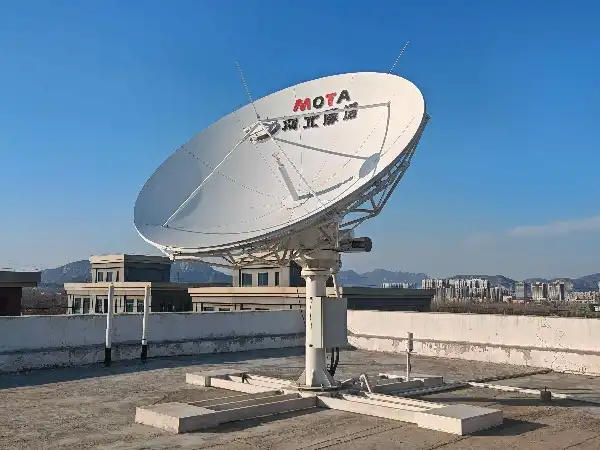
A ka-band fixed satellite antenna operates by transmitting and receiving microwave signals in the 17.7–21.2 GHz downlink and 27.5–31 GHz uplink ranges. The parabolic reflector concentrates incoming signals onto a feed assembly, where the LNB amplifies and downconverts them for the modem. Simultaneously, the BUC upconverts and amplifies outgoing signals before they travel to the satellite. Fixed alignment—maintained by precision mechanical mounts and tracking algorithms—keeps the narrow Ka-band beam locked onto the geostationary satellite, sustaining high-throughput data links that power enterprise broadband, 4K video backhaul, and IoT connectivity across remote and mission-critical environments.
Understanding the Technology Behind Ka-Band Ground Station Antennas
Core Components and Signal Flow
A high-frequency satellite ground terminal is made up of three subsystems that work together and depend on each other. The parabolic reflector, whose aperture can be anywhere from 2.4m to 13m based on the output needs, gathers and concentrates radio frequency energy. At the center, the feed horn assembly sends this energy to the LNB so it can be received or takes it from the BUC so it can be sent. Surface accuracy is very important: at Ka-band wavelengths of about 1 cm, an RMS surface error greater than 0.3mm leads to noticeable gain loss, which is a sensitivity that Ku-band systems tend to avoid .
Ka-Band vs. Ku-Band: Key Technical Distinctions
Ka-band is farther away in the microwave spectrum than Ku-band (12–18 GHz). This means that beamwidths are narrower and frequencies can be reused a lot more in High Throughput Satellite (HTS) spot-beam architectures. The ITU-R S.580 standard says that these smaller beams need tighter sidelobe control—the MOTA antenna gets a first sidelobe level of -16 dB—to stop interference in orbital environments with a lot of other signals . The downside is that the link is more likely to be affected by atmospheric attenuation, especially rain fade, which needs to be taken into account when the link is being designed for a lightweight fixed satellite antenna.
Core Benefits and Why Operators Choose Ka-Band Fixed Antennas
ISPs and business operators have changed how they think about satellite capacity because Ka-band HTS satellites offer extra bandwidth. A traditional Ku-band transponder might send 36–72 MHz of usable bandwidth. A modern Ka-band HTS spot beam regularly sends hundreds of megahertz to a single earth station. This makes it possible for services like uninterrupted 4K video backhaul and real-time IoT data aggregation that weren't possible over satellite before.
Here are the core performance characteristics that drive procurement decisions in this segment:
- High gain with compact aperture: A 3.3m Ka-band dish has the same gain as a much larger Ku-band reflector, but it doesn't cost as much or create as much structural load or mounting difficulty.
- Transceiver isolation ≥88 dB: MOTA's design achieves this level of transmit-receive isolation, which stops self-interference that would otherwise overload the low-noise receive chain, protecting throughput integrity during simultaneous full-duplex operation.
- IP65-rated all-weather enclosure: Electronics sealed to IP65 can resist dust ingress and water jets, sustaining reliable operation across temperature extremes from -25°C to +55°C—critical for offshore platforms, desert gateways, and high-altitude remote sites.
- Plug-and-play integration: Pre-integrated high-power BUC/LNB modules, a high-speed modem, and clever power management eliminate multi-vendor compatibility testing, compressing deployment timelines significantly.
Together, these characteristics allow a single operator to complete satellite alignment and establish live communication links within 3 minutes—a measurable operational advantage for time-sensitive deployments. These advantages effectively resolve the bandwidth cost and deployment complexity problems that challenge regional satellite ISPs scaling their HTS capacity.
Selection Criteria and What to Evaluate Before Purchasing
To pick the best Ka-band fixed satellite antenna, you need to carefully consider a number of technical and business factors. Enterprise-grade systems usually take 3–9 months to buy. During that time, the link budget is looked over, prototypes are tested for interoperability, and a small-scale pilot deployment takes place before the full rollout.
MOTA's antenna lineup spans nine aperture sizes—2.4m, 3.3m, 4.5m, 5.4m, 6.2m, 7.3m, 9m, 11m, and 13m—covering everything from branch-office VSAT termination to gateway earth station applications. When evaluating any Ka-band fixed satellite antenna provider, the following parameters warrant close scrutiny:
- G/T ratio and Eb/N0 margin: These numbers—the G/T ratio and the Eb/N0 margin—show if your link budget can reliably close in the worst-case rain fade scenario for your area.
- BUC output power class: Higher EIRP headroom supports Adaptive Coding and Modulation (ACM) algorithms that maintain throughput during precipitation events rather than dropping the link entirely [3].
- Modem interoperability: Verify compatibility with your existing DVB-S2X or unique HTS waveform platform before committing to hardware.
- Certification status: CE and FCC compliance is non-negotiable for deployments in North American and European markets; MOTA holds ISO9001, ISO14001, and ISO45001 certifications alongside domestic radio type approval.
Customization depth matters as much as off-the-shelf specifications. MOTA is a practical Ka-band fixed satellite antenna manufacturer for operators building unique service platforms because it can do everything from designing hardware to adapting interface protocols to software integration and market-specific certification support.
Installation, Maintenance, and Long-Term Reliability
Site Survey and Alignment
Before a stable installation is made, the spot is carefully surveyed. Engineers make sure there is a clear line of sight to the goal orbital slot, look for possible multipath reflectors, and make sure the base can hold more weight for bigger apertures. The two-axis self-stabilizing platform and proprietary pointing algorithm of MOTA make manual alignment much easier. Within three minutes of powering up, the system automatically acquires the satellite and locks the link.
Ongoing Maintenance Best Practices
A structured maintenance schedule is needed for long-term performance. Checking the accuracy of the mirror surface once a year with photogrammetry or a laser tracker finds panel warping before it affects gain. Firmware updates for the modem and tracking controller keep up with changes in the needs of the satellite platform, such as adding support for multi-operator switching—a practical necessity for ISPs operating across HTS constellations from different satellite operators. With professional anti-corrosion coatings and regular mechanical checks, these systems will keep working perfectly for 15 to 20 years. During this lifecycle, MOTA offers online technical support 7x24, covering installation guidance, fault diagnosis, and system upgrades.
Procurement Insights: Securing the Right Ka-Band Antenna Partner
To find a Ka-band fixed satellite antenna on a large scale, you need to do more than just compare the numbers on a data sheet. Customized large-aperture systems have lead times of 45 to 90 days; maintaining a buffer stock strategy aligned to your satellite capacity expansion roadmap prevents deployment bottlenecks. MOTA has enough ready inventory for standard configurations and maintains a stable mass-delivery capability backed by a mature cross-border logistics network covering international dedicated lines, sea freight, and air freight with professional shockproof and moisture-proof packaging.
For operators evaluating Ka-band fixed satellite antennas for sale from multiple vendors, MOTA's nine years of manufacturing experience, combined with independently developed tracking algorithms and satellite-terrestrial integrated communication IP, represent a verifiable technical barrier—not a marketing claim. Explore the full product range at motasat.com.
Conclusion
Ka-band fixed satellite antennas deliver the throughput density, spectral efficiency, and deployment speed that modern HTS networks demand. From the feed assembly physics to the procurement logistics, every layer of this technology rewards careful engineering and disciplined supplier selection. MOTA's ground station antenna series—spanning nine aperture sizes, rated IP65, aligned in 3 minutes, and certified to international standards—addresses the full spectrum of requirements that satellite ISPs, enterprise network operators, and critical infrastructure managers face when scaling Ka-band capacity.
FAQ
1. What differentiates Ka-band from Ku-band in a fixed satellite antenna?
Ka-band operates at higher frequencies (17.7–31 GHz) than Ku-band (12–18 GHz), enabling narrower spot beams and greater frequency reuse across HTS constellations. This translates to higher available throughput per terminal, but also increased rain fade risk—mitigated through ACM and Uplink Power Control (UPC).
2. How does the system handle rain fade?
The built-in high-power BUC in MOTA gives the EIRP headroom that ACM needs to change the modulation and coding rate on the fly during heavy rain, maintaining connectivity rather than dropping the link entirely.
3. What aperture size do I need for my application?
Aperture selection depends on your link budget, target satellite EIRP, required data rate, and geographic rain zone. MOTA offers nine sizes from 2.4m to 13m and provides link budget consultation as part of the pre-sales technical review process.
4. Can the antenna support multiple satellite platforms?
Yes. The modem and tracking software support platform switching, accommodating operators who manage capacity across multiple HTS operators—a key procurement consideration for regional ISPs.
5. What is the typical installation timeline?
Site survey and foundation work vary by location, but the antenna system itself achieves satellite lock within 3 minutes of mechanical alignment completion.
Partner with MOTA for Your Next Ka-Band Deployment
MOTA delivers proven Ka-band fixed satellite antenna solutions engineered for the throughput demands of HTS networks. With nine years of manufacturing expertise, ISO-certified quality systems, and 7x24 technical support, we provide reliable infrastructure from prototype testing through mass deployment. Contact our engineering team today to request a link budget review, product specifications, or a volume quote. Reach us at hebei_mota@163.com or visit motasat.com.

References
1. Maral, G., Bousquet, M., & Sun, Z. (2020). Satellite Communications Systems: Systems, Techniques and Technology (6th ed.). Wiley.
2. ITU-R. (2021). Recommendation ITU-R S.580-6: Radiation diagrams for use as design objectives for antennas of earth stations operating with geostationary satellites. International Telecommunication Union.
3. Kyrgiazos, A., Evans, B., & Thompson, P. (2014). On the gateway diversity for HTS systems. International Journal of Satellite Communications and Networking, 32(5), 392–409.
4. Roddy, D. (2006). Satellite Communications (4th ed.). McGraw-Hill.
5. Fenech, H., Amos, S., Tomatis, A., & Soumpholphakdy, V. (2015). High throughput satellite systems: An analytical approach. IEEE Transactions on Aerospace and Electronic Systems, 51(1), 192–202.
6. Evans, B. G. (Ed.). (1999). Satellite Communication Systems (3rd ed.). IET.
Tell us your requirements – get a tailored quote and technical support within 24 hours.