- English
- French
- German
- Portuguese
- Spanish
- Russian
- Japanese
- Korean
- Arabic
- Greek
- German
- Turkish
- Italian
- Danish
- Romanian
- Indonesian
- Czech
- Afrikaans
- Swedish
- Polish
- Basque
- Catalan
- Esperanto
- Hindi
- Lao
- Albanian
- Amharic
- Armenian
- Azerbaijani
- Belarusian
- Bengali
- Bosnian
- Bulgarian
- Cebuano
- Chichewa
- Corsican
- Croatian
- Dutch
- Estonian
- Filipino
- Finnish
- Frisian
- Galician
- Georgian
- Gujarati
- Haitian
- Hausa
- Hawaiian
- Hebrew
- Hmong
- Hungarian
- Icelandic
- Igbo
- Javanese
- Kannada
- Kazakh
- Khmer
- Kurdish
- Kyrgyz
- Latin
- Latvian
- Lithuanian
- Luxembou..
- Macedonian
- Malagasy
- Malay
- Malayalam
- Maltese
- Maori
- Marathi
- Mongolian
- Burmese
- Nepali
- Norwegian
- Pashto
- Persian
- Punjabi
- Serbian
- Sesotho
- Sinhala
- Slovak
- Slovenian
- Somali
- Samoan
- Scots Gaelic
- Shona
- Sindhi
- Sundanese
- Swahili
- Tajik
- Tamil
- Telugu
- Thai
- Ukrainian
- Urdu
- Uzbek
- Vietnamese
- Welsh
- Xhosa
- Yiddish
- Yoruba
- Zulu
How does an energy-efficient satellite antenna reduce power consumption?
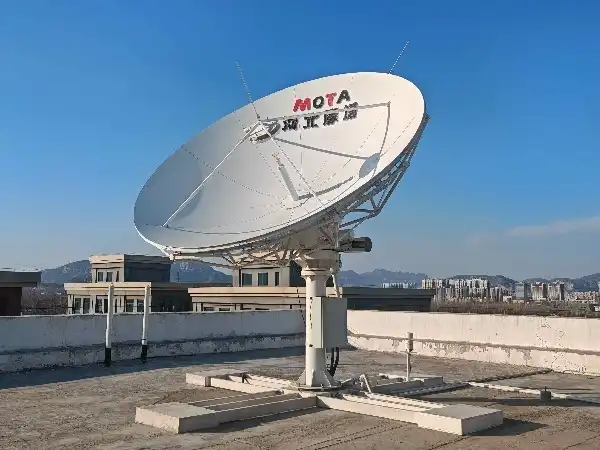
An energy-efficient satellite antenna reduces power consumption by lowering the electrical load of the parts that run around the clock. A well-designed energy-saving fixed satellite antenna pairs a low-noise receive chain with a stable signal path, so the system does not need extra gain or power to hold the link. Sleep and wake control then cuts idle draw. Our MOTA model holds standby power at 5 W or less and operating power at 15 W or less, which cuts energy use by over 40% compared with conventional satellite antennas. Below, I explain how each part works and what it means for your project budget.
If you build rural broadband or universal service networks, power often decides the budget before data capacity does. The ITU estimated that 2.6 billion people were still offline in 2023, and internet use reached 81% in urban areas against 46% in rural areas. Many unconnected communities sit far from stable grids, so every watt counts.
Before comparing products, it helps to know where a terminal actually spends its energy.
Understanding Energy Consumption in Fixed Satellite Antennas
A satellite dish's antenna is inactive, which means it doesn't use any power by itself. The electronics that are connected to it cause the load. These include the modem, the control circuits, the transmit amplifier, the low noise block downconverter (LNB) on the receive side, and the modem. In a two-way terminal, the transmit amplifier usually gets the most attention because it only slightly changes direct current into radio-frequency power.
A chain that only receives draws a lot less. When you compare products, this breakdown is important. That design saves more energy than one that just swaps a few small parts because it lowers the duty to communicate and the duty to rest. Some books on satellite engineering, like those by Ippolito and Maral and Bousquet, talk about amplifier power and link margin as choices that are closely related to each other.
Where the Watts Go
A few extra watts don't make a difference on the bill at an office that is linked to the power grid. They decide how big the power system is at an off-grid site. The Tracking SDG 7 energy development report found that in 2021, about 675 million people still did not have access to power. Most of these people lived in rural areas.
The result can be seen with a simple math problem. There are 360 watt-hours used every day by a 15 W load that stays on, and 120 watt-hours used by a 5 W load that stays on. With a little extra room for charging losses and cloudy days, every extra watt of constant load adds 24 watt-hours to the daily battery demand. More load means bigger batteries, bigger panels, and more trips to the gas station to fuel the engine.
Why Remote Sites Feel Every Watt
Power needs of a device depend on a number of things. The first things that are needed for a link are the data rate, the satellite coverage, and the rain margin you want. The size of the antenna is important because a bigger opening increases gain and can lower the amount of power needed for the same link. The angle of elevation is also important, since low angles send the signal through more air.
The weather is another factor because heat and cold can affect how well gadgets work. Ku-band, which has IEEE letter designations between 12 and 18 GHz, can handle rain better than Ka-band, but you should still expect fade in places with a lot of rain. Last, task cycle is important. A website that is only used four hours a day shouldn't be the same size as one that streams video all day.
Core Technologies Behind Energy-Efficient Satellite Antennas
Low-Power Electronics and a Low Noise Figure
Noise figure tells you how much extra noise a radio makes when there isn't much satellite signal. A noise figure of 1.1 dB or less and an energy-saving LNB module are features of MOTA's energy-saving fixed satellite antenna. Because a quiet receive chain doesn't add extra gain or power to other parts of the system, it doesn't have to make up for lost signal. The unit also comes with a basic modem built in, so you don't have to find parts from different companies to match. For a contractor who works on dozens of sites, having fewer different parts also means having fewer types of items to keep on hand as backups.
Intelligent Sleep and Wake Control
Out in the country, most terminals are empty for part of the day. Our smart power management puts the radio to sleep when it's not being used and wakes it up to full power when transmission needs to happen again. The draw when the device is not in use stays at 5 W or less, and the draw when it is: 15 W or less.
This is an example that shows how those higher limits can be used. A place that works for eight hours and then doesn't do anything for sixteen hours uses 200 watt-hours per day instead of 360 watt-hours when the power stays at 15 W. That is 44% less than that. The exact number will depend on traffic, but the math shows why sleep control is important for solar and battery budgets.
Signal Quality That Avoids Wasted Power
Low consumption only helps if the link stays up and running. It is not allowed for more than 85 dB of transmit energy to leak into the receive path. A first sidelobe level of -14 dB or less lowers the energy that is radiated off the main beam. This helps keep nearby satellites from getting messed up. These numbers, along with the low noise figure, support a stable link. The unit can send 720p video even when there is level 6 wind. A steady link keeps you from having to send and fix things over and over again, which wastes power and expert time.
Comparing Energy-Saving vs. Conventional Fixed Satellite Antennas
Power Draw Side by Side
With standby power of 5 W or less and operating power of 15 W or less, MOTA's energy-saving fixed satellite antenna operates on the Ku band and reduces energy consumption by over 40% when compared to traditional satellite antennas. It's possible to choose an opening size between 13 m, 11 m, 9 m, 7.3 m, 6.2 m, 5.4 m, 4.5 m, 3.3 m, 2.4 m, 6.2 m, and 5.4 m, so you don't have to buy too much. Because conventional units come in a lot of different brands and styles, I don't give them a single number. Find out from any supplier how much power is used and in standby mode, then compare that to the 5 W and 15 W limits.
Solar and Battery Savings
The rest of the power system gets smaller when the load goes down. A computer that runs at 15 W all the time needs 360 watt-hours every day. When the site is quiet, sleep mode cuts that amount even more. When loads are smaller, solar panels and battery banks can be smaller, and at hybrid sites, generators don't have to run as long.
The number of panels, batteries, charge controllers, and mounting tools needed increases with the load when using an energy-saving fixed satellite antenna. It also costs more to move extra panels and batteries to remote places. It doesn't take long to save a lot of money when you have hundreds of sites to tender. Talk to your solar designer about the right size for your home. They will take into account the number of sun hours and days of autonomy in your area.
Maintenance, Deployment, and Total Cost
As a whole, the total cost of ownership is shaped by the following benefits:
- Less energy use: The system lets you use smaller solar panels and batteries because it uses over 40% less energy than regular satellite antennas. This lowers the initial cost of each site, shortens the time that hybrid sites can use their generators, and keeps the size of the battery bank you have to buy, ship, and replace smaller over the course of the contract.
- Quick and easy deployment: Aligning the satellites only takes three minutes, and the people working in the field don't need any special skills or complicated tools to do it. A village installation team only needs simple instructions. This cuts down on site visits, training costs, and the time it takes to complete installations when there is a tight bidding schedule. The unit comes ready to connect because it is plug-and-play.
- Designed for use in the field: The antenna works from -20°C to +50°C, has an IP64 rating that protects it from dust and splashing water, and can keep 720p video even in level-6 wind. These ratings are good for rural and outdoor posts where weather and dust are always a problem. They also help cut down on unplanned service visits caused by bad weather.
The main costs that affect off-grid builds are power hardware, workers on-site, and repair calls. These benefits cover these costs.
Practical Guide to Cutting Energy Use in Fixed Satellite Antenna Systems
Placement and Alignment
The link margin is safest when it is positioned well, and the terminal can work with little extra power if the margin is strong. Pick a place that has a clear view of the satellite and isn't blocked by trees, buildings, or planned construction. Then, use the satellite operator's data to set the elevation and azimuth.
Place the dish on a stable base so that the wind doesn't swing it around. It only takes three minutes for MOTA's antenna to line up, which means that a trained crew can quickly do it at many places. After storms or when the ground settles, check the direction again because small mistakes can lower the signal quality.
Maintenance Routine
A low-power system works well with a short routine. Check the cable connectors for corrosion every time you check, clean the reflector of dust and dirt, make sure the mount bolts are tight, and read the power logs from your battery or controller. A rapid rise in daily consumption is often a sign of a shifting point, a failing part, or a worn battery.
Catching it early saves money on bigger fixes. The IP64 grade and the working range of -20°C to +50°C are enough to meet our needs, but it's still a good idea to check it regularly. Keep a few extra cables and connectors on hand, and before you sign, ask your supplier how long it takes to get spare parts.
Supplier Checks for Bulk Projects
Check the supplier's paperwork and support before giving them a batch order for your energy-saving fixed satellite antenna. MOTA has been making things for nine years and has management system certifications in ISO 9001, ISO 14001, and ISO 45001, as well as GJB 9001C for defense product quality. We keep a lot of stock on hand for regular orders. It takes 45 to 90 days to make custom or large-scale systems.
We provide ODM and OEM customization, a full-unit warranty that meets international standards, remote technical support 7 days a week, after-sales help in your area through cooperative channels, and spare parts. We also take care of customs paperwork, tracking, and storing goods overseas. For large purchases, we can also talk about flexible payment terms.
Future Trends and Innovations in Energy-Efficient Satellite Antenna Technology
Smarter Power Control
Uplink power control is already used by satellite networks to change the send power based on things like rain fade. In the future, this job will probably be done by machine learning, which can predict demand and change power more quickly than rules can. The number of watts needed per link will keep going down as amplifiers and low-noise parts become more efficient. A 3 dB change in power is about the same as a factor of two, so even small changes can have an effect on battery costs. A good part of that benefit is already available today thanks to intelligent sleep and wake control.
Solar Plus Storage and Remote Monitoring
Solar and battery systems are getting better all the time, and many remote sites now use IoT devices to send power data to an operations center. Watching lets teams find a weak battery or a problem with the pointing before the service goes down. It also keeps teams from having to make unnecessary trips to sites that take hours to get to.
You can use a low-power terminal with this method because the antenna and the monitoring gear can both be powered by the same small solar system. Make sure there is extra space in the battery bank for sensors, and pick tools with known standby and working power so your model is accurate.
Procurement Standards Shift Toward Lifecycle Cost
People who buy things for rural projects financed by the government often compare lifecycle cost instead of just unit price. That amount is changed by things like energy use, spare parts, training, fitting time, and warranty. Certifications for safety and environmental management, like ISO 14001 and ISO 45001, are often found when suppliers are checked.
It's easier to make these kinds of comparisons when the supplier writes down power numbers and ships from stock or according to a set production schedule. When you are making your next bid, don't just ask for a headline savings; ask each vendor for measured standby and operating power as well.
Conclusion
An energy-efficient satellite antenna lowers power use by limiting the load on the electronics that are always on, mainly the receive chain, the send stage, and the modem, and by limiting the draw of power when the antenna is not in use through sleep control. This means that solar panels, batteries, and generators are used less at off-grid places, which lowers the total cost of ownership.
With a standby power of 5 W or less, an operating power of 15 W or less, and energy use over 40% lower than traditional satellite antennas, MOTA's energy-saving fixed satellite antenna demonstrates the approach. It also maintains a noise figure of 1.1 dB or less and transceiver isolation of 85 dB or higher. Savings stay the same over the course of a project thanks to good siting, simple upkeep, and careful checks on suppliers.
FAQ
How much energy can an energy-saving fixed satellite antenna save?
The model from MOTA uses more than 40% less energy than regular satellite antennas. Its standby power is 5 W or less and its operating power is 15 W or less. How much you save on your site depends on how many people visit and how the links are set up.
Does lower power reduce signal quality?
A noise figure of 1.1 dB or less, transceiver isolation of 85 dB or more, and a first sidelobe level of -14 dB or less are all things that the energy-saving fixed satellite antenna does not let through. It can also play stable 720p video in level-6 wind.
Can it run on solar power?
For off-grid places, its low draw makes it a good fit for solar and battery devices. Tell your solar designer how big the array and batteries need to be based on how much sun you get where you live and any extra loads you add.
What are the lead times for bulk orders?
Regular orders are met by ready stock. It takes 45 to 90 days to make customized and large systems. We ship on foreign specialized lines, by sea freight, or by air freight, and our boxes are designed to keep out shocks and moisture.
Request an Energy-Saving Fixed Satellite Antenna Quote from MOTA
For your country or off-grid projects, are you looking for a reliable energy-saving fixed satellite antenna supplier? MOTA has ready-to-ship items, can make customized and large-scale systems in 45 to 90 days, offers ODM and OEM customization, flexible payment terms, and help 24 hours a day, seven days a week. Every order is backed by nine years of manufacturing experience and ISO 9001, ISO 14001, and ISO 45001 certifications. You can email us at hebei_mota@163.com with your site count and aperture needs, and we'll get back to you with a quote. For more information, go to motasat.com.

References
1. International Telecommunication Union, Measuring Digital Development: Facts and Figures, 2023
2. IEA, IRENA, UNSD, World Bank, and WHO, Tracking SDG 7: The Energy Progress Report, 2023
3. Maral, G. and Bousquet, M., Satellite Communications Systems: Systems, Techniques and Technology, 2020
4. Ippolito, L. J., Satellite Communications Systems Engineering: Atmospheric Effects, Satellite Link Design and System Performance, 2017
5. Pratt, T., Bostian, C., and Allnutt, J., Satellite Communications, 2019
6. IEEE Std 521, IEEE Standard Letter Designations for Radar-Frequency Bands, 2019
Tell us your requirements – get a tailored quote and technical support within 24 hours.