- English
- French
- German
- Portuguese
- Spanish
- Russian
- Japanese
- Korean
- Arabic
- Greek
- German
- Turkish
- Italian
- Danish
- Romanian
- Indonesian
- Czech
- Afrikaans
- Swedish
- Polish
- Basque
- Catalan
- Esperanto
- Hindi
- Lao
- Albanian
- Amharic
- Armenian
- Azerbaijani
- Belarusian
- Bengali
- Bosnian
- Bulgarian
- Cebuano
- Chichewa
- Corsican
- Croatian
- Dutch
- Estonian
- Filipino
- Finnish
- Frisian
- Galician
- Georgian
- Gujarati
- Haitian
- Hausa
- Hawaiian
- Hebrew
- Hmong
- Hungarian
- Icelandic
- Igbo
- Javanese
- Kannada
- Kazakh
- Khmer
- Kurdish
- Kyrgyz
- Latin
- Latvian
- Lithuanian
- Luxembou..
- Macedonian
- Malagasy
- Malay
- Malayalam
- Maltese
- Maori
- Marathi
- Mongolian
- Burmese
- Nepali
- Norwegian
- Pashto
- Persian
- Punjabi
- Serbian
- Sesotho
- Sinhala
- Slovak
- Slovenian
- Somali
- Samoan
- Scots Gaelic
- Shona
- Sindhi
- Sundanese
- Swahili
- Tajik
- Tamil
- Telugu
- Thai
- Ukrainian
- Urdu
- Uzbek
- Vietnamese
- Welsh
- Xhosa
- Yiddish
- Yoruba
- Zulu
What Affects the Performance of a Vehicle-mounted Fixed Satellite Antenna?
Several factors decide how well a vehicle-mounted fixed satellite antenna performs. They include the frequency band, dish size, noise figure, and transmit-receive isolation. They also include how firmly the unit stays on the vehicle, its mounting position and sky view, the stability of the power supply, and exposure to rain, dust, and heat. Finally, they include how accurately the antenna aligns with the satellite after parking.
Each factor affects link quality differently, and a weakness in one area can cancel out strengths in another. In this article, I explain each factor in plain language and compare the main options. I also share what upfitters, fleet operators, and procurement teams in the United States should check before ordering.
Understanding the Basics of Vehicle-mounted Fixed Satellite Antennas
What a Vehicle-mounted Fixed Satellite Antenna Does
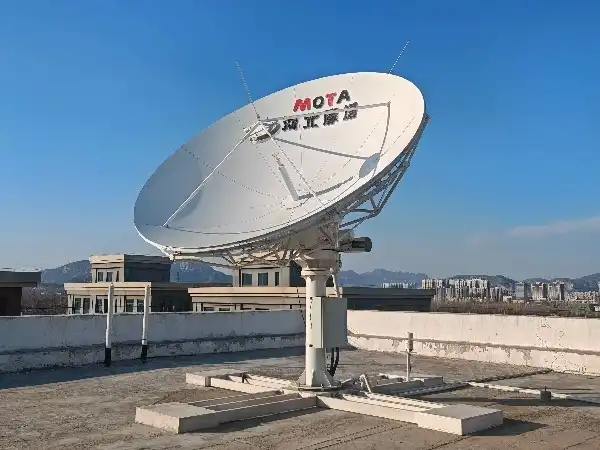
An RV, truck, bus, or other vehicle can have a vehicle-mounted fixed satellite antenna that stays on top of it. People often call this style "Comms-on-the-Pause." When the antenna finds the satellite, the car stops, and the fast connection starts. A satellite doesn't follow the car while it's moving.
This choice gets rid of the need for a stable base that systems that move around need. This keeps the design simple. When cell service is bad, our MOTA model can still be used for mobile offices, navigation, voice calls, and video calls. Some fleet managers use this kind of truck satellite dish on the job, at rest stops along the way, and in setting up areas.
Ku-Band and Dish Size Set the Starting Point
Satellite antennas can work in more than one band. When it rains, C-band doesn't get as wet, but dishes need to be bigger most of the time. Ka-band can send a lot of bits at once, but when it rains, the signal gets weaker. Ku-band is used by a lot of vehicle ports since it's in the middle. It has an aperture of 0.45 m and works with frequencies between 10.7 GHz and 12.75 GHz.
As a general rule, beamwidth is equal to 70 times the frequency divided by the dish's diameter. For a 12 GHz signal, that gives this dish about 4 degrees. It's important to point a narrow beam in the right direction because it concentrates gain. This makes the quality of the line a key performance factor.
Noise Figure and Isolation Inside a Busy Vehicle
It's too noisy for radio messages to work well in a car. Electricity makes noise on board from the engines, alternators, generators, lights, and speakers. This is where we can use two numbers. The noise figure tells you how much noise the device adds to a weak satellite signal. It stays at or below 1.0 dB with our antenna.
It checks how well the path to send stays different from the path to receive. It needs to be at least 85 dB, which is about 300 million times stronger than ours. These numbers help keep equipment on board from interfering. This makes it easier to send data and make video calls while the engine and other electronics are close by.
Major Factors Influencing Antenna Performance
Weather, Rain Fade, and Enclosure Protection
A lot of people know that rain can hurt Ku-band links. Droplets of rain that pick up and spread microwave energy lose it. When it rains more, the loss is bigger. As long as engineers follow ITU-R Recommendation P.618 they can guess this loss and then add extra link margin to account for it. A case won't stop rain fade, but it will keep the hardware safe.
As per IEC 60529, if something has an IP66 grade, dust can't get in and strong water jets won't hurt it. The IP66 rating of our vehicle-mounted fixed satellite antenna means it will not rust, which is important on coastal roads and when you park outside for a long time. You need to plan for both your gear and your signal because the weather can change them in different ways.
Sky View, Mounting Position, and Roof Material
For it to work, there must be a clear line of sight between the antenna and a geostationary satellite. These satellites can be seen in the southern sky from anywhere in the United States. You can tell how tall they are by where you are. Light bars, ceiling fans, racks, and big things on the roof can get in the way. Trees or overpasses can block it where you park.
The material of the roof is also important. A lot of RV tops are made of aluminum or fiberglass, which magnets don't stick to. In those cases, the bolt fixing and a custom bracket keep everything together. Take a look at the top, mark the clear circle, and double-check the cable route before you place your order.
Vibration, Shock, and the Dual Fixing Design
The roads are bumpy, have sharp turns, and go up and down steep hills. This makes it hard for an antenna on the roof to work all day. Some things that move around can weaken bolts, break solder joints, and move an object's point over time. The magnetic fixing and bolts on our antenna are both very strong, and the core parts are made to handle shock. With the magnet and bolts, it doesn't slide and doesn't come loose on hills or fast turns.
Tests like MIL-STD-810H are used by engineers to find out how much equipment drops and shakes. Do a road test on your own platform during trial tests. This is because every car has a different roof, weight, and path. That step gives both teams real information before they make a lot of things.
Comparing Vehicle-mounted Fixed Satellite Antennas to Other Solutions
Fixed Mount Versus In-Motion Systems
In-motion antennas keep a link open while the car is moving. They are also called Comms-on-the-Move. They need stable bases and tracking gear, which adds to the cost, weight, and complexity. When the car stops, a vehicle-mounted fixed satellite antenna can connect. In real life, that many vehicles are used: trucks stop at depots, police cars park at accident scenes, and RVs park at camps. For people who need to watch videos while driving, a method that works while moving is better. If they need a stable link at every stop, it is easy to make a plan and stick to it. Figure out the use case first, then pick the tool.
Fixed Mount Versus Portable Dishes
It's good to have portable tripod dishes for short-term use. One way to help keep the sky clear is to put them away from house or tree lines. They also need time to set up, a place to keep them, and someone who knows how to use them. They can be left behind by crews. The car powers a fixed roof unit that stays on top of it.
When our antenna sits still for three minutes, it lines up by itself. We also keep a manual mode in case we need to use it. That's the trade-off: a roof unit can only use the skyview that the car has. When something is mounted, most of the steps don't have to be done by hand, which is great for people who just want to park and get to work.
Size, Ruggedness, and Fit on the Vehicle
Dishes that are bigger can pick up more signals, but they are longer, heavier, and less likely to blow over. A 0.45 m opening that covers Ku-band 10.7–12.75 GHz keeps the area small. This frequency range works for cars, vans, special vehicles, and RVs. Being tough is just as important.
Along with the enclosure's rating, you should look at how well it resists corrosion, how well it absorbs shock, and how it can be mounted. A service call can come from one weak spot. Think about how much space you need for things like bridges and sheds and compare that to the fixed height. Before you decide on a layout, our team can look at the drawings of your vehicle and give you options for bases and brackets.
Procurement Considerations for Vehicle-mounted Fixed Satellite Antennas
Electrical Fit with 12V and 24V Systems
12V is used by most light trucks and RV house systems. 24V is used by most heavy trucks and coaches. Our vehicle-mounted fixed satellite antenna can connect directly to either source of power, so one model can do both. Power used is 8W or less, and power used when not in use is 1.5W or less. At 12V, that's about 0.67 amps when it's on and 0.13 amps when it's off. If the unit stays put all day, that's about 3 amp-hours. When you think about how many of them there are, they don't seem like that many. Choose the right wire size, add a fuse, and keep cable runs short to make sure the voltage doesn't drop too much.
Customization of Bases, Brackets, and Harnesses
Parts you can buy in shops don't always work with all roofs. Making braces on-site costs more and takes longer. MOTA does ODM and OEM work, which means they make sure the gear looks good, has the right interface standards, and has the right parts that are useful in each country. People often ask about the magnet base position, the shape of the bracket, the length of the harness, and the type of connector.
You won't have to do extra work on the line if you match these things to your wire plan. You should share your drawings and the amount of room you think the antenna will take up right away so that it can be added to the list of choices for a car. Once that's done, we can talk about installing a test batch and a way to move on to production.
Certifications, Lead Time, and Support
Hebei Mota Electronics Technology Co., Ltd. has been in business since 2017 and has been making things ever since. It is certified by ISO 9001, ISO 14001, and ISO 45001. It is also certified by GJB 9001C. We also have a local type license for equipment used for sending radio waves. In the US, you need to look at FCC 47 CFR Part 25 to get an earth station license. So, find out as soon as possible what permissions your van program needs. For each country, we change the gear, software, and certifications to follow their rules.
Regular orders can be filled right away from stock that is already there. It takes 45 to 90 days for special or large-scale systems. You can reach our team seven days a week, 24 hours a day. We ship things in boxes that are waterproof and shockproof, and we also help with the papers for customs. A full-unit warranty that meets international standards can be set up in a number of different ways.
Practical Tips to Keep Antenna Performance Steady
Choose the Mounting Spot Before You Drill
Look at the roof first. Keep the vehicle-mounted fixed satellite antenna away from racks and vents, and point the straight line toward the south sky. What's on the roof should also be magnet-friendly. Figure out the fastest way for the lines to reach the rack of equipment, and make sure that the roof's holes are all fixed to stop leaks.
Make sure the bolts are tight enough for your vehicle-mounted fixed satellite antenna, and then check again after the first rough route. For fleets, make sure that each type of vehicle has the same layout. Because you can use the same plan more than once, it takes less time to make and use later. You can send us pictures and plans of the job, and if you want, we'll look it over with you again.
Align Carefully and Train the Users
Place the antenna on level ground, away from buildings and trees. It takes the vehicle-specific alignment method about three minutes to finish satellite alignment after parking. If things get tough, the manual mode is there. Give each driver a one-page quick-start card. People who don't know how to do something will ask for help a lot.
Talk about where to park, how long to wait, and what to do if the link stops working. You can get help from us online seven days a week, 24 hours a day. They can answer questions about installation and fix issues, which keeps your customers happy and the assembly line running.
Inspect, Update, and Record
A short check plan can help you avoid most problems in the field. The bolts, magnet contact surfaces, connections, wire jackets, and seals should all be checked regularly. After storms or roads that are rough, add one more check. It can scratch the roof and weaken the connection if there is dirt under the magnet base.
Keep track of the times, what you found, and any broken links. This will help support and guarantee requests go more quickly. We can help you set up new versions of the system when they come out. Make sure you keep test records for each car as you take on emergency and broadcast work. A lot of clients will ask for them.
Conclusion
When put on a car, a vehicle-mounted fixed satellite antenna works well as long as its band, dish size, noise figure, and separation are all good for the job and the installation doesn't damage those factors. When it rains a lot, Ku-band links lose their signal. It's important to have both link margin and a safe place to stay dry. A stable mount, a clear view of the southern sky, and the right roof material are what keep the link on the road.
Systems that move around cost more and are harder to use than fixed units. Our vehicle-mounted fixed satellite antenna suits vehicles that pause for operation. They work best on cars that have to stop to do their job. Buyers choose what to buy based on how well it fits electrically, necessary licenses, and the length of time they have to wait. It stays stable over time because it is carefully aligned, users are trained, and it is checked on a regular basis.
FAQ
Does a fixed antenna work while the vehicle is moving?
No, the link is made after the car has stopped. Our antenna is fully lined up with the satellites about three minutes after we park.
Can one model run on both 12V and 24V?
Yes. It connects directly to a car's 12V or 24V power source. Power used is 8W or less, and power used when not in use is 1.5W or less.
Will heavy rain stop the signal?
Any Ku-band link can lose its strength when it rains a lot. Hardware is safe because of the IP66 case, but it can't stop rain fade, so make sure the link gap is right for your area.
Can MOTA change the base, bracket, or harness?
Yes. We work with both OEM and ODM clients on things like how things look, how they work, how they are put together, how long the harness is, and how the links join. We need prints of your car to make sure they fit.
Contact MOTA for Your Vehicle-mounted Fixed Satellite Antenna Project
Want to find a company that makes vehicle-mounted fixed satellite antennas for cars and can make bases, brackets, and cables that fit your car? MOTA is open 24 hours a day, seven days a week and works on both ODM and OEM projects. They also keep stock on hand for normal sales. Send an email to hebei_mota@163.com with the type of vehicle, roof material, and number of items you need, and our team will get back to you with a custom quote. Visit motasat.com to learn more about the goods.

References
1. Antenna Theory: Analysis and Design, 2016
2. Satellite Communications Systems: Systems, Techniques and Technology, 2020
3. ITU-R Recommendation P.618, 2017
4. MIL-STD-810H, Environmental Engineering Considerations and Laboratory Tests, 2019
5. IEC 60529, Degrees of Protection Provided by Enclosures (IP Code), 2013
6. Electronic Code of Federal Regulations, Title 47 Part 25, Satellite Communications, 2023
Tell us your requirements – get a tailored quote and technical support within 24 hours.