- English
- French
- German
- Portuguese
- Spanish
- Russian
- Japanese
- Korean
- Arabic
- Greek
- German
- Turkish
- Italian
- Danish
- Romanian
- Indonesian
- Czech
- Afrikaans
- Swedish
- Polish
- Basque
- Catalan
- Esperanto
- Hindi
- Lao
- Albanian
- Amharic
- Armenian
- Azerbaijani
- Belarusian
- Bengali
- Bosnian
- Bulgarian
- Cebuano
- Chichewa
- Corsican
- Croatian
- Dutch
- Estonian
- Filipino
- Finnish
- Frisian
- Galician
- Georgian
- Gujarati
- Haitian
- Hausa
- Hawaiian
- Hebrew
- Hmong
- Hungarian
- Icelandic
- Igbo
- Javanese
- Kannada
- Kazakh
- Khmer
- Kurdish
- Kyrgyz
- Latin
- Latvian
- Lithuanian
- Luxembou..
- Macedonian
- Malagasy
- Malay
- Malayalam
- Maltese
- Maori
- Marathi
- Mongolian
- Burmese
- Nepali
- Norwegian
- Pashto
- Persian
- Punjabi
- Serbian
- Sesotho
- Sinhala
- Slovak
- Slovenian
- Somali
- Samoan
- Scots Gaelic
- Shona
- Sindhi
- Sundanese
- Swahili
- Tajik
- Tamil
- Telugu
- Thai
- Ukrainian
- Urdu
- Uzbek
- Vietnamese
- Welsh
- Xhosa
- Yiddish
- Yoruba
- Zulu
Indoor Fixed Satellite Antenna for Reliable Satellite Signal Reception
An indoor fixed satellite antenna can receive reliable satellite signals when it can see the satellite. Typically, it can see the satellite through a window with uncoated glass. The antenna is fixed, requiring little to no digging, and keeps out of direct weather. Results vary on satellite location, window orientation, glass type, wall materials, and local precipitation. MOTA develops a small Ku-band device for desktop and wall applications. This article will tell you how it works, how to install it, and how to pick it.
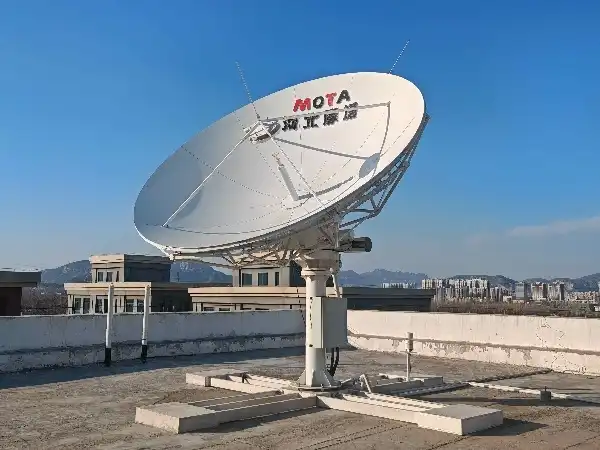
Can a Satellite Antenna Work Indoors?
Realistic Use Cases
Most popular situations are apartment tenants, tiny workplaces, motel rooms, and transient locations. In these instances, a landlord or property management generally bans drilling or work on the roof. In the U.S., the FCC Over-the-Air Reception Devices regulation covers some dish installations up to one metre wide in areas controlled by a tenant. But even so, many individuals choose to forgo balcony railings and external walls. Indoor units are also the choice of satellite service providers, installers and distributors. A brief visit without a ladder reduces labour time and the risk of complaints about damage.
What Indoor Reception Depends On
Geostationary satellites sit about 35,786 km above the equator, so your antenna must see one fixed spot in the sky. Your latitude determines your elevation angle. The direction of your window determines whether you can see that area at all. In the US, satellites near the equator tend to perform best with south-facing windows. Glass matters as well. Clear glass allows microwave signals to pass through with some loss. Low-emissivity glass and solar films have metal layers that may block much more. Reinforced concrete, metal frames and neighbouring structures contribute to the loss.
Signal Strength Versus Signal Quality
Often, a setup is judged by one bar on a screen, yet that figure might be deceiving. Signal strength is the measure of the power received at the receiver. The power received contains noise and interference. Signal quality is how clear the signal is, related to the carrier-to-noise ratio. Stability is how each performs over hours and through weather changes. I would propose you track all three. A powerful but noisy signal may still stop an image, whereas a weak but clear signal can operate smoothly. The DVB-S2 standard receivers provide quality as well as strength, which makes alignment simpler.
How an Indoor Fixed Satellite Antenna Works and What Affects Reception
The Reception Chain
The satellite delivers a microwave signal towards the Earth. It is collected by the indoor fixed satellite antenna surface and focused to a feed where it is amplified by a low-noise block converter (LNB) and shifted down to a lower frequency. The signal is subsequently sent by coaxial cable to a reception device such as a DVB-S2 set-top box. Each link in this chain has to be matched in frequency range, polarisation, impedance, connection type, and receiver power. An amplifier can overcome modest cable loss, but it can’t recover a signal that is blocked by concrete, metal, coated glass, or poor targeting. First fix the road, then worry about gain.
Rain Fade and Building Materials
ITU-R Recommendation P.618 addresses the fact that Ku-band transmissions are more affected by heavy rain than lower bands such as C-band. Microwave radiation is absorbed and scattered by raindrops; thus, a clear-sky connection might be lost in a storm. The hardware will be protected from direct weather in an interior installation, but this will not eliminate this atmospheric loss. Add to it the loss from walls and windows. Before buying, examine the satellite footprint for your location, since a weaker signal at the limit of coverage gives less margin for rain. In weak areas, you want greater benefit than you would in a smaller situation.
MOTA Ku-Band Specifications
The main characteristics of our indoor fixed satellite antenna are as follows from the product data:
- Signal performance: The device operates in the Ku band, 10.7 to 12.75 GHz, with a noise figure of 1.2 dB or less and transceiver isolation of 80 dB or more. Its low noise figure helps the receiver pick up faint signals, and its strong isolation keeps the routes from interfering with each other.
- Size and installation: The antenna is 20 cm x 20 cm × 5 cm or less and weighs 1.2 Kg or less. It sits on a table or hangs on a wall with traceless installation, no drilling required. It takes roughly 1.5 minutes to orient the satellite.
- Power and protection: Silent running. Operating power: 4 W or less. Standby power: 0.8 W or less. It comes with an IP63 classification, which means it is dust-protected and resistant to water splashes. The integrated design plugs straight into TVs, laptops, and tiny monitoring cameras.
- These qualities are useful for households, small workplaces, and interior monitoring where space, noise, and wall protection are of primary importance. We do have a few aperture choices, and we check the proper model with each purchase.
Installation Guide and Troubleshooting
Six-Step Installation Process
The same six processes provide predictable outcomes for homeowners and professionals alike. 1. Check the satellite, frequency, polarisation, and receiver standard. Secondly, check the direction, type of glass, obstacles, and a sturdy surface at the window or spot. Third, set the device down on a desk or install it on the wall using the traceless mount. 4. Connect the cable to your TV, computer, or camera, and keep it short and without severe bends. Fifth, align according to pointing data and signal quality assessments, not just strength. Sixth, experiment with various channels in varied weather, and then write down the readings for future service or multi-site rollouts.
Fixing No Signal or Weak Signal
Begin with settings prior to hardware. For no signal, verify satellite selection, receiver configuration, cable connections, polarisation, and the actual orbital location of the satellite. If you are receiving a weak or poor signal, try moving the antenna closer to the glass, shortening the cable length, replacing any damaged connections, and double-checking the alignment. Intermittent channels may be caused by incorrect voltage switching, electromagnetic interference, or faulty shielding. If drops occur exclusively in severe rain, the link margin is narrow. If coated glass or reinforced walls are still blocking the passage, a professional site study and an outside option may cost less than trying again and again.
Tips for Multi-Room Deployments
Pilot room. Suitable for hotels and housing buildings. Test One Model Unit. Note alignment time, signal quality, and any glass or film problems. Write a brief checklist for crews. Property management permission is frequently easier since the antenna requires no drilling and walls are clean at move-out. Label each unit with room number and satellite settings so you can get faster service later. For bigger projects, please contact us to discuss installation designs and sample units before placing a bulk purchase.
Indoor Fixed Satellite Antenna vs. Alternatives and How to Choose
Versus Outdoor Dishes
Outdoor dishes usually have greater gain, aiming for flexibility and signal margin, so they are still the ideal solution for weak-signal locations and heavy-rain regions. When drilling, access to the roof, landlord consent, or façade alterations are prohibited, an inside fixed satellite antenna is the winner. It’s also wind-, ice-, and sun-resistant, and doesn’t alter the façade of a structure. The trade-off is link margin, as windows and walls take a bite out of the signal. Choose by site, not just by price.
Versus Flat-Panel and Portable Models
Flat-panel types seem unobtrusive and fit inside, but gain, beamwidth, and satellite compatibility vary, so check the data sheets thoroughly. Portable RV and camping antennas are built for easy setup and portability, while permanent interior equipment is built for solid, repeatable placement once you place it. Amplified models may help decrease cable loss, but amplification can’t fix a blocked line of sight or a poor indoor fixed satellite antenna. Ask each provider for gain, beamwidth, and proven compatibility with your target satellite.
Selection Criteria
Match model to application, location, target satellite, and local weather. Check gain, frequency bands, polarisation, LNB noise figure, cable loss, receiver compatibility, size and construction quality. For commercial purchasers, add accessories, paperwork, packing, warranty conditions, replacement parts and response time to the list. Request samples and test in representative rooms prior to authorising a model for wholesale, OEM, hospitality or multi-property usage. Two values you may directly compare are a noise figure of 1.2 dB or less and a draw of 4 W or less.
Applications and B2B Procurement
Home, Office, and Monitoring Applications
At home, it feeds satellite TV receivers for HD programmes without an exterior dish. It can provide a satellite data connection or backup channel in small offices and quiet, meeting-space environments. It can connect tiny monitoring cameras for inside security, and 4W operation keeps operating expenses low. Hotels and long-stay flats like the low-profile design and no-drill installation. But each building requires a site investigation because floor level, window orientation, and materials vary across rooms. First, free-to-air and HD projects need to verify DVB-S2 capability, transponder requirements, and geographical coverage.
What B2B Buyers Should Request
A data sheet is merely the beginning. Ask about gain, frequency range, polarisation, beamwidth, LNB specifications, dimensions, operating conditions, installation instructions, and test data. MOQ, lead time, sample availability, quality control procedures, and accessory kits. Distributors should consider carton efficiency, damage prevention, regional certification, warranty management, and replacement parts. Each country's import and radio permission requirements are different, so find out who does what approval before the first purchase. MOTA is ISO 9001, ISO 14001, and ISO 45001 certified. MOTA has a GJB 9001C military quality system and domestic radio transmission equipment type approvals.
OEM Support, Lead Times, and Selection Process
Some of the OEM and ODM projects may involve private labelling, customised packaging, multilingual handbooks, hardware appearance, interface protocols, and functional modules according to the regulations of a target nation. For regular orders, we have stock. Custom or large-scale systems are 45-90 days to create. To make a sound run procedure. Documentation of satellites, markets, volumes, and compliance requirements. Shortlist models. Test samples in actual rooms to evaluate signal quality, installation time, and stability. Then correct the manufacturing spec, inspection plan, and delivery timetable. Post-launch examination of field complaints and returns by area. Every stage is covered with our 7×24 response and remote help.
Conclusion
If the building materials let microwave signals pass and a window provides a clear line of sight to the satellite, a reliable satellite reception may be achieved using an indoor fixed satellite antenna. Performance varies with satellite location, kind of glass, antenna gain, and weather, and it’s best to judge a setup on signal quality and stability rather than just observing strength. The six-step installation, organised troubleshooting, and sample testing in actual rooms ensure repeatability. Outdoor dishes still have greater room for movement; interior units are better for places where drilling or rooftop construction is not permitted. For homes, small offices, monitoring, and multi-room projects, it’s about making a deployment successful by matching gain, size, power draw, and documentation to the location.
FAQ
1. Can an indoor fixed satellite antenna work through a window?
Yes, if the window faces the satellite and the glass lets microwaves pass. Low-emissivity glass and metal films can block the signal, so test before you commit.
2. Is it as strong as an outdoor dish?
Usually not. Outdoor dishes give more signal margin, while an indoor unit trades some margin for placement without drilling.
3. When does an amplifier help?
It can offset limited cable loss. It cannot fix poor aiming or a blocked path, so align the antenna first.
4. How long does alignment take?
The MOTA unit completes satellite alignment in about 1.5 minutes.
5. What should I send for a quote?
Share your target satellite, location, quantity, room type, accessories, branding needs, and the certification requirements of your destination market.
Request an Indoor Fixed Satellite Antenna Quote from MOTA
Looking for an indoor fixed satellite antenna manufacturer that supports OEM and ODM projects? MOTA keeps stock for regular orders, offers 7×24 response, and provides flexible payment terms. Send your target satellite, quantity, and branding needs to hebei_mota@163.com, and our team will reply with a quotation and delivery plan.
References
1. Satellite Communications, Wiley, 2003
2. ITU-R Recommendation P.618-13, Propagation Data and Prediction Methods Required for the Design of Earth-Space Telecommunication Systems, 2017
3. ITU-R Recommendation P.838-3, Specific Attenuation Model for Rain for Use in Prediction Methods, 2005
4. Satellite Communications Systems Engineering, Wiley, 2017
5. ETSI EN 302 307-1, Digital Video Broadcasting (DVB) Second Generation Framing Structure for Satellite Applications, 2014
6. Federal Communications Commission, Over-the-Air Reception Devices Rule, 1996
Tell us your requirements – get a tailored quote and technical support within 24 hours.