- English
- French
- German
- Portuguese
- Spanish
- Russian
- Japanese
- Korean
- Arabic
- Greek
- German
- Turkish
- Italian
- Danish
- Romanian
- Indonesian
- Czech
- Afrikaans
- Swedish
- Polish
- Basque
- Catalan
- Esperanto
- Hindi
- Lao
- Albanian
- Amharic
- Armenian
- Azerbaijani
- Belarusian
- Bengali
- Bosnian
- Bulgarian
- Cebuano
- Chichewa
- Corsican
- Croatian
- Dutch
- Estonian
- Filipino
- Finnish
- Frisian
- Galician
- Georgian
- Gujarati
- Haitian
- Hausa
- Hawaiian
- Hebrew
- Hmong
- Hungarian
- Icelandic
- Igbo
- Javanese
- Kannada
- Kazakh
- Khmer
- Kurdish
- Kyrgyz
- Latin
- Latvian
- Lithuanian
- Luxembou..
- Macedonian
- Malagasy
- Malay
- Malayalam
- Maltese
- Maori
- Marathi
- Mongolian
- Burmese
- Nepali
- Norwegian
- Pashto
- Persian
- Punjabi
- Serbian
- Sesotho
- Sinhala
- Slovak
- Slovenian
- Somali
- Samoan
- Scots Gaelic
- Shona
- Sindhi
- Sundanese
- Swahili
- Tajik
- Tamil
- Telugu
- Thai
- Ukrainian
- Urdu
- Uzbek
- Vietnamese
- Welsh
- Xhosa
- Yiddish
- Yoruba
- Zulu
What is Low Noise Fixed Satellite Antenna: Complete Guide
A low noise fixed satellite antenna is a high-precision ground station component engineered for stationary, long-term deployment to receive or transmit data via geostationary satellites. Unlike mobile tracking systems, it prioritizes maximum signal clarity by maintaining an exceptionally low noise figure — typically ≤0.8dB — and a superior gain-to-noise temperature (G/T) ratio. By minimizing internal electronic interference, it preserves signal integrity across demanding frequency bands including Ku, Ka, C, X, S, and Qv. This guide covers everything procurement professionals need to know, from core technical specifications to supplier evaluation and ordering logistics.
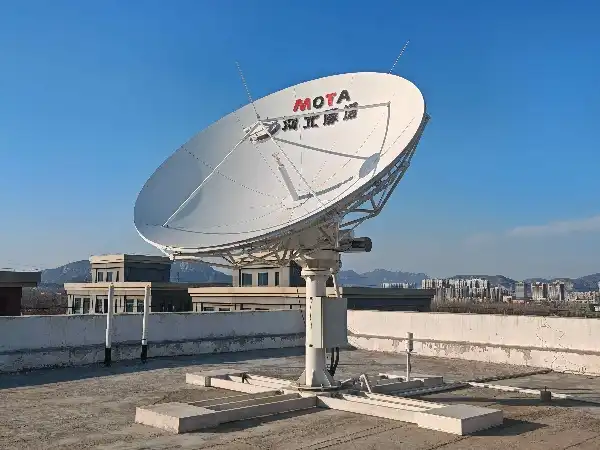
Understanding Low Noise Fixed Satellite Antennas
What "Noise Figure" Actually Means for Your Ground Station
The noise figure (NF) shows how much unwanted thermal noise the electronic parts of a low noise fixed satellite antenna add to a signal that is being received. The signal-to-noise ratio (SNR), which is the basis of safe data transfer, stays the same when the NF is low. ITU-R S.580 standards for earth station radiation patterns say that even small amounts of NF degradation add up over the link budget, increasing bit error rates and decreasing effective flow.
The NF number for professional fixed ground station antennas is between 0.5dB and 0.8dB. The MOTA low noise fixed satellite antenna has a measured noise figure of ≤0.8dB, which means it has a much higher reception sensitivity. This is especially important when working in areas with limited coverage or getting weak signals from transponders far away.
Core Technical Specifications That Separate Professional Models
Procurement engineers can avoid spending for features that aren't necessary by knowing which specs are important. Professional-grade parabolic reflector antennas are different from regular ones in the following ways:
- Noise Figure ≤0.8dB: Makes sure that the LNB downconverter stage doesn't lose too much signal, which protects the link margin in all kinds of weather.
- Transceiver Isolation ≥85dB: This keeps send energy from leaking into the receive chain, which is a very important factor for full-duplex VSAT ground stations.
- First Sidelobe Level ≤-14dB: Lowers the chance of interference from nearby satellites while still meeting FCC Part 25 and ITU coordination standards [2].
- Multi-Band Support (Ku/Ka/S/X/C/Qv): With manual band switching, operators can serve a wide range of network configurations from a single piece of hardware.
- Aperture Options: Reflector diameters of 2.4m, 3.3m, 4.5m, 5.4m, 6.2m, 7.3m, 9m, 11m, and 13m accommodate everything from small VSAT nodes to high-throughput teleport downlinks.
The reflector structure is made of aerospace-grade metal that has an RMS surface accuracy of less than 0.5mm, which according to study from the IEEE Antennas and Propagation Society is necessary to keep the peak gain at Ka-band frequencies.
Performance and Benefits of Low Noise Fixed Satellite Antennas
Why SNR Improvement Translates Directly to Operational Value
When it comes to steadiness, a low noise fixed satellite antenna is better than mobile and auto-tracking options. Even if the mechanical tracking seems to be correct, micro-vibrations and pointing jitter caused by mobile systems lower SNR. If you install a fixed parabolic antenna correctly, this variable goes away completely.
The MOTA system can send 1080p HD video even when there are 7 levels of wind. This is possible thanks to a two-axis self-stabilizing platform and a special pointing algorithm. It can work in temperatures ranging from -25°C to +55°C, so it can be used in monitoring stations in the arctic, oil field installations in the desert, and tropical maritime environments without having to be changed.
Operators of VSAT networks at remote mining sites and offshore platforms say that switching from older antennas with NF values above 1.2dB to systems with NF values below 0.8dB cuts down on rain fade outage events by a measurable amount. This directly improves SLA compliance and lowers the cost of leasing a satellite transponder by better utilizing link budgets.
Selecting the Right Low Noise Fixed Satellite Antenna for Your Business
A Practical B2B Procurement Checklist
If you pick the wrong low noise fixed satellite antenna, you'll have to pay more for repairs, less efficient transponders, and hardware replacements before they're due. Before making a deal with a seller, buying managers should make sure of the following:
- Verified noise figure data from physical testing, not only datasheet values. Ask independent RF labs or factory test benches for measurement records.
- MTBF documentation confirming long-term reliability under field conditions. Military manufacturing standards (like GJB 9001C) and aerospace-grade parts are good ways to tell if something will last.
- Batch consistency records showing that production units match the specifications of the prototype. This is an area where many high-volume ground station rollouts fail.
- Integrated system architecture: The MOTA antenna combines LNA, BUC/LNB, modem, and smart power management into a single plug-and-play unit, so there are no worries about connectivity issues between parts that were bought independently.
- Certifications: ISO9001, ISO14001, and ISO45001 management system certifications, along with domestic type approval for radio transmission equipment, show that the equipment meets the rules in the markets where it will be used.
With these factors, you can tell the difference between makers who can keep up with enterprise-scale demand and distributors who just sell common gear. MOTA has all of these certificates and can customize products for users who need special frequency coordination, interface protocols, or legal needs.
Installation, Maintenance, and Technical Support
Reducing Commissioning Time and Long-Term Maintenance Burden
Total cost of ownership, not unit purchase price, is one of the most forgotten things to think about when buying something. A ground station antenna that needs two people and eight hours to set up costs a lot more per site than one that only takes three minutes to connect with the satellite and make a link.
With its own pointing algorithm, the MOTA low noise fixed satellite antenna can set up a full link in just three minutes. This cuts down on the cost of commissioning labor for large network rollout projects by a large amount. Its plug-and-play integrated design means that one worker can set it up and run it for the first time, even if they don't have any RF knowledge on hand.
MOTA offers 7x24 remote technical support for unmanned sites to make sure they are reliable over the long term. This support includes installation help, fault diagnosis, and firmware updates. Products come with a full warranty that meets international standards, and spare parts are sourced through cooperative localized channels to make sure they can be replaced quickly in the field without causing long periods of downtime. It is suggested that the alignment be checked once a year to account for the mounting base's thermal settling and keep the antenna's boresight accuracy at its best for as long as it is working.
Procurement and Ordering Process
Lead Times, Bulk Ordering, and Customization Options
MOTA keeps enough standard orders in stock to fill them right away. Customized and large-scale system production happens every 45–90 days, and guaranteed batch delivery capacity is met. Framework agreements let operators lock in prices and delivery dates for large-scale network expansions at ground stations. This type of procurement works well for VSAT network operators who are in charge of managing rolling infrastructure upgrades.
Cross-border logistics uses professional shockproof and moisture-proof packaging, end-to-end tracking, help with customs clearance, and choices for foreign storage to keep the risk of shipping high-tech items to a minimum. Different organizational models can use buying budget cycles with flexible payment terms.
For operators who need frequency-specific configurations or customized interface protocols, MOTA's ODM/OEM engineering team handles hardware adaptation from scheme design to prototyping and mass production, making sure that all regulatory requirements for the target market are met. You can look at the full product list and standard documents at motasat.com.
Conclusion
A stable and cost-effective ground station network starts with a low noise fixed satellite antenna that is well-designed. Noise figure, transceiver isolation, sidelobe suppression, and G/T ratio are the key performance indicators that show how much link margin your network keeps when it's used in the real world. The MOTA low noise fixed satellite antenna has a measured noise figure of ≤0.8dB, transceiver isolation of ≥85dB, and a first sidelobe level of ≤-14dB. It is made in a factory that is ISO9001-certified and has nine years of production experience. Verifiable specs and batch consistency are the best ways for buying teams handling VSAT network growth or plans to replace old equipment to see how valuable a seller will be in the long run.
FAQ
1. What noise figure should I specify for a VSAT ground station antenna?
A system noise figure that keeps the overall G/T ratio competitive for the chosen satellite's EIRP is what most professional VSAT ground station designs aim for. A Ku or Ka-band LNB or combined LNA with NF ≤0.8dB is the standard for these types of uses. Lower NF values lower the lowest level of signal that can be received. This directly increases your link's protection against rain fade and other propagation problems.
2. How does surface accuracy affect Ka-band performance?
Deviations in the surface of the reflector cause phase mistakes that lower the antenna's gain and raise the sidelobe levels. Up to 40 GHz in the Ka band, an RMS surface error of more than 0.5 mm can lower peak gain by several dB. MOTA antennas use aerospace-grade reflectors that are precisely made and have an RMS error of less than 0.5 mm to keep the gain at the right level across all frequency bands.
3. What factors influence lead times for bulk antenna orders?
Standard catalog layouts can be shipped right away from stock. Production takes 45 to 90 days for customized aperture sizes, non-standard frequency combinations, or changed interaction protocols. For large network rollout projects, the most reliable way to go is to set up a framework agreement with scheduled batch deliveries.
4. Can these antennas operate reliably at unmanned remote sites?
The MOTA low noise fixed satellite antenna can work in temperatures from -25°C to +55°C, has industrial-grade parts, and can be supported remotely 24 hours a day, seven days a week. This makes it perfect for deployments where no one is present. Its integrated design cuts down on the number of links between parts that are likely to fail in multi-vendor assemblies.
Partner with MOTA for Your Next Ground Station Project
MOTA is a manufacturer of low noise fixed satellite antennas. They have nine years of proven production experience, quality methods that are ISO9001-certified, and their own RF technology. Our engineering team can make sure that the specifications you need are exactly what you need for your operation, whether you are building a new teleport downlink, replacing old ground station equipment, or expanding a VSAT network. You can email us at hebei_mota@163.com or go to motasat.com to get a technical consultation, an evaluation of a prototype, or a quote for a large order.

References
1. International Telecommunication Union. (2022). ITU-R S.580-6: Radiation diagrams for use as design objectives for antennas of earth stations operating with geostationary satellites. ITU-R Publications.
2. Federal Communications Commission. (2023). Part 25 — Satellite Communications, 47 CFR § 25.209: Antenna performance standards. FCC Electronic Code of Federal Regulations.
3. IEEE Antennas and Propagation Society. (2021). IEEE Transactions on Antennas and Propagation: Surface accuracy requirements for high-frequency reflector antennas. IEEE Xplore.
4. Euroconsult. (2023). World Satellite Business Week Report: VSAT and broadband satellite market trends. Euroconsult Research.
5. Satellite Industry Association. (2022). State of the Satellite Industry Report. SIA Annual Publication.
6. Elbert, B. R. (2008). The Satellite Communication Ground Segment and Earth Station Handbook (2nd ed.). Artech House.
Tell us your requirements – get a tailored quote and technical support within 24 hours.