- English
- French
- German
- Portuguese
- Spanish
- Russian
- Japanese
- Korean
- Arabic
- Greek
- German
- Turkish
- Italian
- Danish
- Romanian
- Indonesian
- Czech
- Afrikaans
- Swedish
- Polish
- Basque
- Catalan
- Esperanto
- Hindi
- Lao
- Albanian
- Amharic
- Armenian
- Azerbaijani
- Belarusian
- Bengali
- Bosnian
- Bulgarian
- Cebuano
- Chichewa
- Corsican
- Croatian
- Dutch
- Estonian
- Filipino
- Finnish
- Frisian
- Galician
- Georgian
- Gujarati
- Haitian
- Hausa
- Hawaiian
- Hebrew
- Hmong
- Hungarian
- Icelandic
- Igbo
- Javanese
- Kannada
- Kazakh
- Khmer
- Kurdish
- Kyrgyz
- Latin
- Latvian
- Lithuanian
- Luxembou..
- Macedonian
- Malagasy
- Malay
- Malayalam
- Maltese
- Maori
- Marathi
- Mongolian
- Burmese
- Nepali
- Norwegian
- Pashto
- Persian
- Punjabi
- Serbian
- Sesotho
- Sinhala
- Slovak
- Slovenian
- Somali
- Samoan
- Scots Gaelic
- Shona
- Sindhi
- Sundanese
- Swahili
- Tajik
- Tamil
- Telugu
- Thai
- Ukrainian
- Urdu
- Uzbek
- Vietnamese
- Welsh
- Xhosa
- Yiddish
- Yoruba
- Zulu
Why is pointing accuracy important for satellite antennas?
Pointing accuracy determines how precisely a ground-based antenna maintains alignment with an orbital target. Even a deviation of 0.2° can cause measurable gain loss, degraded link margins, and corrupted telemetry data — consequences that are unacceptable in scientific research or TT&C operations. A high-precision fixed satellite antenna addresses this directly. MOTA's system achieves alignment error ≤0.1°, supported by a three-axis self-stabilizing platform and a self-developed tracking algorithm. For institutions where signal fidelity is non-negotiable, this level of angular accuracy defines the difference between mission success and data loss.
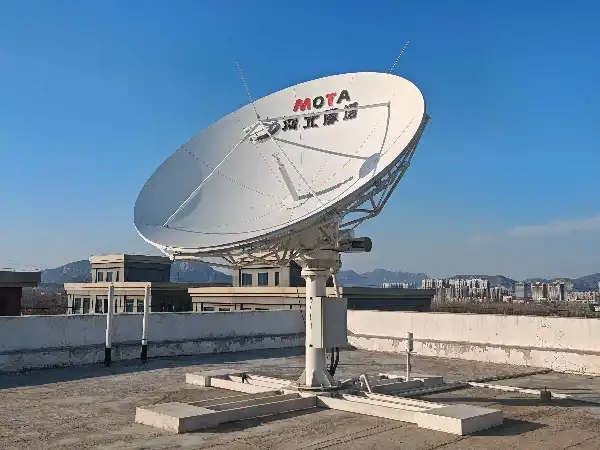
What Pointing Accuracy Actually Means in Satellite Communications
The Physics Behind Angular Deviation
Antennas with a parabolic mirror focus messages on a central point. Based on how the antenna radiates, the received power drops when the boresight moves away from the orbital position of the satellite. At Ka-band frequencies, where wavelengths are as small as 8 mm, phase mistakes caused by even a sub-degree misalignment make the G/T ratio much worse. The published ITU-R S.580-6 standards spell out the requirements for the sidelobe envelope. This is because off-axis energy directly messes up adjacent satellite slots.
Fixed vs. Mobile Antennas: Different Accuracy Demands
Mobile satellite stations can handle wider beam widths because they have better transmit power or more modern modulation to make up for it. Fixed ground stations have to follow tougher rules: they have to follow ITU coordination agreements, stay away from satellites that are nearby that could interfere with their signals, and keep link availability above 99.9% in mission-critical situations. Because of this, pointing precision is seen as a main requirement rather than a secondary one by procurement teams at research centers and TT&C facilities, making a high-precision fixed satellite antenna the preferred choice for such deployments.
Technical Foundations That Govern Pointing Performance
Environmental and Mechanical Factors
The four main things that cause pointing mistake in fixed systems are wind loads, thermal expansion, base movement, and servo backlash. At 7-level wind (61–74 km/h on the Beaufort scale), aerodynamic force on a large-aperture reflector can tilt the elevation axis by a few tenths of a degree if the structure holding it up isn't strong enough. Differential expansion, which happens because of thermal gradients across the reflector surface, changes the focal geometry. These are not just hypothetical worries; they are known ways that operational ground station engineering has seen things go wrong.
These problems can be fixed in modern antenna systems by using low-CTE materials, back-structures optimized by Finite Element Analysis, and closed-loop servo control with high-resolution encoders. The end result is a system that stays aligned not only when it is first put into service, but also for 15 years after that.
Why ≤0.1° Matters as a Specification Threshold
The number 0.1° is not made up on the spot. The 3dB beamwidth for a 9-meter aperture working at Ku-band is about 0.2° to 0.3°. By keeping the error to less than 0.1°, the antenna stays in the main beam's highest-gain region at all times. This makes sure that the link budget calculation used when designing the system still works when it's put into use. Noise figure of 0.8dB or less further protects the carrier-to-noise ratio, which directly affects the amount of data that can be sent and the bit error rate.
Comparing Fixed Satellite Antennas: Accuracy as a Decision Factor
What Separates High-Precision Systems from Standard Models
Not every stationary antenna is built with the same level of accuracy. Standard commercial dishes usually say that they can point accurately to within 0.5° or more, and they need to be adjusted by hand and re-calibrated every so often. High-precision systems have active correction devices that keep making up for changes in the surroundings.
Here are the main things that make antenna systems different that procurement engineers should look at:
- Pointing accuracy specification and verification method: Don't just believe what the seller says; get photogrammetry or laser-scanning reports that prove the reflector surface RMS accuracy. Surface RMS for Ka-band systems should be less than 0.2mm to keep gain from being lost due to phase shifts.
- Stabilization architecture: Three-axis active stabilization, which includes azimuth, elevation, and polarization, works better than two-axis systems in windy environments that change quickly, keeping the alignment straight without any help from a person.
- Anti-interference performance: Transceiver isolation ≥90dB and first sidelobe level ≤-18dB are measurable signs of a clean radiation pattern that lowers the risk of uplink interference to nearby satellites and safeguards delicate receive chains.
- Third-party certification and quality records: production methods that are GJB 9001C-certified, salt spray tests that are in line with ISO 9227, and recorded wind load analysis through FEA all provide proof of the structural and electrical performance.
These factors together tell us if an antenna system will work the way it's supposed to for the whole time it's supposed to be used. If procurement teams only look at aperture size and frequency band, they might choose systems that don't work well in real life.
MOTA's high-precision fixed satellite antenna has aperture options from 2.4m to 13m, can switch between Ku/Ka/S/X/C/Qv bands, and locks onto a satellite in just 2 minutes. This makes it one of the most useful systems for research institutions and TT&C ground stations that need performance that can be checked and repeated.
Procurement Insights: Acquiring the Right Antenna System
There's more to choosing a ground station antenna than just looking at data sheets. When antenna commissioning is tied to a satellite launch window, delivery dates, paperwork packages, and lifetime support agreements are all very important. A delivery that is late or doesn't have enough paperwork can hold up the whole mission program.
Manufacturers with a good reputation will give you full technical data packages that include RF performance reports, structural analysis documentation, factory acceptance test records, and inspection certificates from a third party. It is important for procurement teams to make clear requests for these things and make sure that any intellectual property, like secret tracking algorithms and signal processing software, is backed by registered patents and software copyrights, not just claims.
The structure for after-sales support should also be looked at closely. Technical support 24 hours a day, seven days a week, on-site setup help, and a well-documented spare parts supply chain all lower operating risk by a large amount over the course of a multi-year program timeline.
Future Trends: Where Satellite Antenna Pointing Technology Is Heading
AI-Driven Tracking and Predictive Maintenance
Machine learning algorithms are being added to servo control loops in the satellite ground station business. AI-powered tracking systems look at past pointing error trends and weather data to predict problems before they affect alignment. This is a big improvement over closed-loop control that only reacts to problems. IoT-enabled remote tracking tools let engineering teams see real-time information about the health of a high-precision fixed satellite antenna, which can lead to preventative maintenance being done before problems become outages.
Standardized Accuracy Benchmarks
A lot of business groups, like ITU and IEEE, are moving toward more detailed standards for pointing accuracy that make a difference between different aperture classes and static and dynamic performance. For business-to-business buyers, this standardization makes it easier to compare vendors and gives them a good reason to buy during expert review rounds. Working with companies who help create standards lets you see changes in compliance needs as they happen early on.
Conclusion
Accurate pointing is one of the most important performance factors for any fixed satellite ground station. It controls the validity of link budgets, following the rules, avoiding interference, and keeping data safe over time. The amount of angle error that can be accepted gets smaller as the opening size grows and the frequency bands move toward Ka and above. This standard cannot be changed by institutions that are spending in infrastructure for TT&C, remote sensing, or precise measurement. For professional use, a high-precision fixed satellite antenna that is accurate to within 0.1°, has active stability, low noise levels, and has been checked for structural soundness is the right standard.
FAQ
1. What causes pointing error in a fixed satellite antenna?
Some of the main reasons are structural deflection due to wind, thermal expansion of the reflector and mount, servo backlash in the drive mechanism, and foundation settlement over time. These problems can be fixed by high-precision systems that use low-CTE materials, closed-loop motor control, and active three-axis stability, as well as stronger back-structures.
2. How does noise figure relate to pointing accuracy?
They are different factors that together decide how well the system works. When the signal gets to the LNB, noise figure ≤0.8dB keeps the carrier-to-noise ratio, and pointing accuracy makes sure that the feed gets the strongest signal possible in the first place. For the link budget to stay in place, both must meet the requirements at the same time.
3. What aperture size is appropriate for Ka-band scientific applications?
For geostationary Ka-band links that need a lot of data throughput, research ground stations usually use apertures between 4.5m and 9m. This depends on the EIRP of the satellite and how much rain fade protection is needed. To cover this range, MOTA has openings that go from 2.4m to 13m.
4. Is third-party certification mandatory for research institute procurement?
Most commercial space programs and national research institutions need third-party inspection reports, GJB-compliant manufacturing records, and registered intellectual property evidence before they will award a contract. These are required for all purchases, they are not extras that can be chosen.
Partner with MOTA for Your Next Ground Station Project
With nine years of engineering experience and standards like ISO9001, ISO14001, and ISO45001, MOTA is a specialist in high-precision fixed satellite antenna manufacturing. Our systems are very reliable and accurate up to 13 meters away, with an aiming error of 0.1° and a noise level of 0.8dB. Get in touch with our engineering team to talk about unique configurations, expert documentation packages, and release times that work with the plan of your program. Email us at hebei_mota@163.com or go to motasat.com.

References
1. International Telecommunication Union. (2012). ITU-R S.580-6: Radiation diagrams for use as design objectives for antennas of earth stations operating with geostationary satellites. ITU-R.
2. Ruze, J. (1966). Antenna tolerance theory — A review. Proceedings of the IEEE, 54(4), 633–640.
3. Pratt, T., Bostian, C., & Allnutt, J. (2003). Satellite Communications (2nd ed.). Wiley.
4. Federal Communications Commission. (2021). Part 25 — Satellite communications: Technical and operational requirements for earth stations. FCC.
5. Bhattacharyya, A., & Garg, V. K. (2020). Machine learning applications in satellite tracking and ground station automation. IEEE Transactions on Aerospace and Electronic Systems, 56(3), 2145–2158.
6. IEEE Standards Association. (2017). IEEE 1513: Standard for qualification and testing of terrestrial photovoltaic concentrator modules — Referenced methodology applicable to antenna structural verification. IEEE.
Tell us your requirements – get a tailored quote and technical support within 24 hours.