- English
- French
- German
- Portuguese
- Spanish
- Russian
- Japanese
- Korean
- Arabic
- Greek
- German
- Turkish
- Italian
- Danish
- Romanian
- Indonesian
- Czech
- Afrikaans
- Swedish
- Polish
- Basque
- Catalan
- Esperanto
- Hindi
- Lao
- Albanian
- Amharic
- Armenian
- Azerbaijani
- Belarusian
- Bengali
- Bosnian
- Bulgarian
- Cebuano
- Chichewa
- Corsican
- Croatian
- Dutch
- Estonian
- Filipino
- Finnish
- Frisian
- Galician
- Georgian
- Gujarati
- Haitian
- Hausa
- Hawaiian
- Hebrew
- Hmong
- Hungarian
- Icelandic
- Igbo
- Javanese
- Kannada
- Kazakh
- Khmer
- Kurdish
- Kyrgyz
- Latin
- Latvian
- Lithuanian
- Luxembou..
- Macedonian
- Malagasy
- Malay
- Malayalam
- Maltese
- Maori
- Marathi
- Mongolian
- Burmese
- Nepali
- Norwegian
- Pashto
- Persian
- Punjabi
- Serbian
- Sesotho
- Sinhala
- Slovak
- Slovenian
- Somali
- Samoan
- Scots Gaelic
- Shona
- Sindhi
- Sundanese
- Swahili
- Tajik
- Tamil
- Telugu
- Thai
- Ukrainian
- Urdu
- Uzbek
- Vietnamese
- Welsh
- Xhosa
- Yiddish
- Yoruba
- Zulu
How to Choose a Marine Fixed Satellite Antenna for Your Vessel
To choose a marine fixed satellite antenna, consider your vessel's route, mounting space, and power supply. Choose the aperture, stabilisation, and frequency band you want. Check the noise figure, transmit/receive isolation, wind/wave rating, and salt spray protection against actual data. Check for compatibility with your modem and satellite service. Look at the whole cost, not just the price. I prepared this advice for fleet owners, distributors and shipbuilders looking for a vessel satellite antenna that remains online and resists corrosion. For a practical example, I utilise the MOTA Ku-band model.
Define Your Vessel's Connectivity Requirements
Great purchases are founded on a clear brief. Before you start comparing datasheets, write out how your vessel operates and what it needs to transmit.
What a Marine Fixed Satellite Antenna Does Aboard Your Vessel
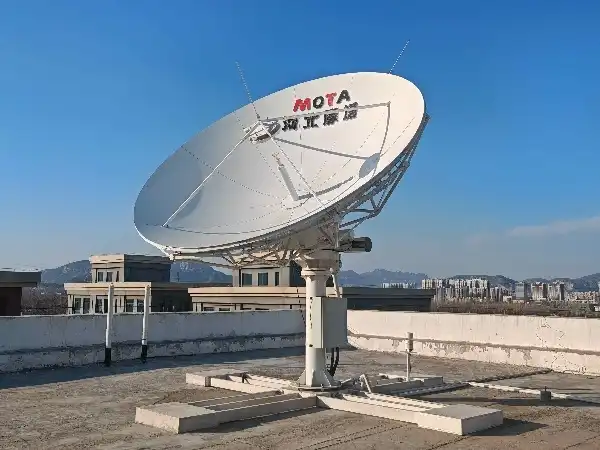
A marine fixed satellite antenna is a permanently placed dish on your boat. It attaches to a satellite so your personnel may access internet, voice calls, telemetry, CCTV, and emergency calling. But the modem is simply one link in the chain. Data flows from the user devices, to the onboard network, to the modem, to the antenna, to the satellite, to the ground station, and finally to its destination. Any weak connection will bring the outcome down.” Antenna gain, pointing precision, polarisation, weather and hull movement all affect what your crew really receives. That's why I want purchasers to describe the full system, not just the dish.
Map Your Route, Deck Space, and Power
Begin with the physical facts. Check the view to the satellite and measure the free deck space. Note your operating latitude, since a geostationary satellite appears lower in the sky the further you go away from the equator. Note your exposure to wind, tremor, and salt spray, and note the power available. The ocean is around 3.5 percent dissolved salt, and it attacks every outside metal part and seal all the time. Pass these details along to your supplier early, as they determine what aperture and mount will work with your deck.
Match Applications to Data Demand
Tell me what to write for the link. A connection has to meet multiple demands, such as crew calls, weather updates, CCTV, catch reports, fleet monitoring, and emergency calls. See how many individuals are connecting at once and when demand is highest. Fishing boats, transport ships, yachts, and offshore support vessels use the MOTA Ku-band antenna. A fishing team may want weather data and catch reports. Cargo Operator – Needs voyage documentation, crew calls. A boat owner wants streaming and surveillance. Before you make your purchase, verify that the modem, satellite provider, polarisation, and service package are all compatible.
Compare Frequency Bands and Antenna Designs
Now that you have documented your requirements, you have to decide on the band and the antenna design. These selections determine the coverage, size, and cost.
Ku-Band, Ka-Band, and C-Band Compared
Ku-band is often employed in mature marine services and provides a good compromise between dish size, coverage, and weather performance. Ka-band may provide better throughput if there is coverage; however, higher frequencies lose more signal in heavy rain. ITU-R Recommendation P.618 describes how engineers forecast that loss. C-band works great with rain, but you need a much bigger dish, which increases weight and deck load. Our antenna operates in Ku-band from 10.7-12.75GHz and comes in apertures of 1.2m, 1.0m, 0.9m and 0.8m so you can choose a size that will fit your deck.
Fixed, Stabilized, and Tracking Designs
“Fixed” means the way the antenna is mounted on the vessel, not whether it’s moving through water. A simple fixed dish has no motion adjustment and is thus suitable for docked vessels, platforms, and relatively steady workboats. Waves may tip a vessel over, and even a little tip can drag the beam off the satellite. Our marine fixed satellite antenna is mounted on a unique stabilising platform that adjusts for hull shaking and can resist level-8 wind and waves. It fits fishing grounds, anchorages and station-keeping tasks, since it aligns itself after anchoring.
Pick a Configuration That Fits Your Operating Pattern
Design for the way you work. For vessels on lengthy periods at anchor or on station, a stabilised fixed unit with automated alignment is low cost and simple. If you require a continuous connection during sailing at speed, then contact the seller to clarify the precise tracking behaviour before you purchase. Also compare single-band vs upgradable designs. Fleet standardisation is also a thing, as one model across several hulls makes spares and crew training easier. A good setup balances availability, power consumption, maintenance effort, and lifetime value. Tell us your operation pattern, and we'll tell you straight whether our device will fit.
Check Specifications and Sea Durability
Datasheet headlines are meaningless without context. It is how I interpret the statistics that matter at sea.
Read the RF Numbers: Isolation and Noise Figure
Two diagrams indicate the cleanliness of the signal route. The noise figure is a measure of how much noise the receiver contributes; therefore, the lower the better. Our antenna has a noise figure of ≤0.9dB, which is the same as around 67K of noise temperature. Transmit-receive isolation is a measure of the receiver’s ability to reject the transmitted signal. Our equipment lists> 88 dB, which signifies leakage below around one part in 630 million. “Radar, radios and other onboard equipment create electromagnetic interference on a vessel, so these figures help keep the link clean.” Also ask every provider for gain, G/T and beamwidth.
Judge Stabilization Against Wind and Waves
It only does any good if the dish stays under load aimed by a stabilising platform. Our purpose-built maritime platform withstands level-8 wind and waves. It automatically compensates for aiming problems due to pitch, roll and yaw. Ask each provider to explain their rating: What wind speed, what sea condition, and what test technique is behind the claim? Check wind loading also; a 1.2m dish collects considerably more wind than a 0.8m dish, and the mount has to handle that force. The greatest evidence is a sea trial, and hence many purchasers will conduct a trial of several weeks before placing their initial order.
Verify Salt Spray, Sealing, and IP68 Claims
Corrosion creates hidden problems that may not show up until after the warranty is up, so test the claims early. IP68 (IEC 60529): Dust-tight and protected against prolonged immersion under circumstances specified by the manufacturer. Our antenna is made of marine-grade stainless steel, with an anti-corrosion coating, IP68 protection, and a completely sealed construction to guard against moisture. Salt: Ask for salt spray test hours per ASTM B117, the standard neutral salt fog technique. Don’t only check the housing; check the seals, fasteners, and connections. Ask for these documents, including MOTA, from every provider on your list.
Plan Installation, Power, and Maintenance
A good antenna will still fail if the setup is bad. Before delivery, three areas need to be checked.
Mounting and Alignment on Deck
Check deck loading, mounting geometry, wind loads, cable routing, grounding, and satellite line of sight. Masts, radar arches, and rigging might obstruct the beam, so always scout the spot beforehand. After we ground our antenna, it takes 4 minutes to finish satellite alignment. In automatic mode, no crew work is required, while in manual mode skilled operators handle severe signal situations. Ask your provider for installation drawings and commissioning processes in plain English. Your team doesn’t work alone. We offer 7×24 remote installation and troubleshooting technical help.
Power Draw on 12V and 24V Systems
Our marine fixed satellite antenna runs on 12V or 24V DC, the voltage often found on vessel electrical systems. The working power is ≤10W and the standby power is ≤2W. The unit draws less than 1A on a 12V system at 10W. It requires a maximum of 240Wh in 24 hours or around 20Ah from a 12V battery bank. “About 48Wh for 24 hours standby. That load is tiny compared with refrigeration, lighting, and chart plotters; thus, generators and batteries have their reserve. Don't forget the modem and router in your power budget.
Maintenance, Spares, and Support
Many service calls are due to salt crystals and loose fittings, so plan for maintenance from day one. Regularly flush the outside with fresh water, check connections and seals, and carry a small parts kit. Speed of spare part delivery is also important, since downtime at sea might cost more than the equipment itself. We provide help with system installation, troubleshooting, and updates remotely on a 7×24 basis. We have adaptable plans, and each unit is fully warranted as per international standards. We also offer on-site technical assistance and timely replacement parts delivery via collaborating channels.
Compare Suppliers, Costs, and Common Mistakes
Once you’ve established the technical fit, compare the firm behind the device and the total cost of ownership.
Evaluate the Supplier Behind the Antenna
Check engineering capability, certifications, manufacturing capacity, paperwork, export history, and after-sales reach. MOTA is made by Hebei Mota Electronics, which has nine years of production expertise. has ISO9001, ISO14001, and ISO45001 certificates, GJB 9001C military quality management, and domestic type approval for radio transmission equipment. It is a national high-tech firm with independently developed antennas and tracking algorithms. “We have regular stock for regular orders, and customised or big systems take 45–90 days.” Our ODM/OEM service customises hardware design, interface protocols, functional modules, and certifications to target-market regulations.
Calculate Total Cost of Ownership
Compare detailed estimates. Don’t forget to separate hardware, accessories, installation, training, shipping, taxes, and satellite service from the antenna-only quotation. VSAT Package is another thing. Add maintenance, spare parts, downtime, and replacement over five or 10 years. Low power operation and a sealed stainless steel enclosure may save operating and maintenance expenses, and frequently the savings exceed a small differential in purchase price. We employ shockproof and moisture-proof packing for shipments, and we cooperate with sea freight, air freight, customs clearing, and foreign storage. Terms of payment are negotiable.
Avoid Common Selection Mistakes
The greatest error is purchasing based on price, size of the dish, or advertized speed alone. Others include bypassing the line-of-sight study, overlooking modem compatibility, underestimating deck loads, and accepting nebulous corrosion claims. U.S. customers should additionally verify FCC guidelines and the satellite operator's permission requirements before buying. Acceptance criteria should be included in the purchase order: alignment result, link test, delivery, warranty, training, spares, minimum order quantity, lead time. Then do a pilot installation or sea trial before you go all the way to a complete fleet or container load.
Conclusion
The first step in selecting a marine fixed satellite antenna is to consider your vessel’s route, deck space, power system, and uses, and then match the frequency band to the antenna design. Ku-band is a trade-off between dish size, coverage area, and rain performance. Stabilisation is whether the dish can maintain its pointing in turbulent water. Noise figure, isolation, wind and wave rating, IP68 sealing and validated salt spray statistics illustrate how a device will perform at sea. Daily performance depends on installation design, power drain on 12V or 24V systems, and maintenance assistance. Supplier credentials, itemised price, total cost of ownership, and a sea trial then establish the worth of the acquisition.
FAQ
1. What is the difference between a fixed and a stabilized antenna?
"Fixed" describes permanent mounting on the vessel. A stabilized unit adds a platform that corrects for hull motion. Our antenna includes one and withstands level-8 wind and waves.
2. Is Ku-band or Ka-band better for a vessel?
Ku-band balances dish size, coverage, and rain performance. Ka-band can offer higher throughput but loses more signal in heavy rain. Match the band to your satellite service.
3. What affects the price?
Aperture, stabilization, mounting parts, customization, order volume, and support all change the price. We offer 1.2m, 1.0m, 0.9m, and 0.8m dishes. Ask for an itemized quote.
4. What should I include in a quote request?
Share your vessel type, route, mounting location, power system, quantity, delivery date, and required services. Email hebei_mota@163.com.
Choose the Right Marine Fixed Satellite Antenna with MOTA
Choosing a marine fixed satellite antenna works best with a clear vessel brief. As a marine fixed satellite antenna manufacturer, MOTA reviews your route, power system, mounting space, and order size, then recommends a suitable aperture. Send your requirements to hebei_mota@163.com for product details. Our team responds 7×24, supports ODM/OEM projects, and keeps ready stock for regular orders.

References
1. ITU-R Recommendation P.618-13, Propagation Data and Prediction Methods Required for the Design of Earth-Space Telecommunication Systems, 2017.
2. IEC 60529, Degrees of Protection Provided by Enclosures (IP Code), 2013.
3. ASTM B117, Standard Practice for Operating Salt Spray (Fog) Apparatus, 2019.
4. IEC 60945, Maritime Navigation and Radiocommunication Equipment and Systems – General Requirements, 2002.
5. Pratt, T. and Allnutt, J., Satellite Communications (3rd Edition), Wiley, 2019.
6. Maral, G., Bousquet, M. and Sun, Z., Satellite Communications Systems (6th Edition), Wiley, 2020.
Tell us your requirements – get a tailored quote and technical support within 24 hours.