- English
- French
- German
- Portuguese
- Spanish
- Russian
- Japanese
- Korean
- Arabic
- Greek
- German
- Turkish
- Italian
- Danish
- Romanian
- Indonesian
- Czech
- Afrikaans
- Swedish
- Polish
- Basque
- Catalan
- Esperanto
- Hindi
- Lao
- Albanian
- Amharic
- Armenian
- Azerbaijani
- Belarusian
- Bengali
- Bosnian
- Bulgarian
- Cebuano
- Chichewa
- Corsican
- Croatian
- Dutch
- Estonian
- Filipino
- Finnish
- Frisian
- Galician
- Georgian
- Gujarati
- Haitian
- Hausa
- Hawaiian
- Hebrew
- Hmong
- Hungarian
- Icelandic
- Igbo
- Javanese
- Kannada
- Kazakh
- Khmer
- Kurdish
- Kyrgyz
- Latin
- Latvian
- Lithuanian
- Luxembou..
- Macedonian
- Malagasy
- Malay
- Malayalam
- Maltese
- Maori
- Marathi
- Mongolian
- Burmese
- Nepali
- Norwegian
- Pashto
- Persian
- Punjabi
- Serbian
- Sesotho
- Sinhala
- Slovak
- Slovenian
- Somali
- Samoan
- Scots Gaelic
- Shona
- Sindhi
- Sundanese
- Swahili
- Tajik
- Tamil
- Telugu
- Thai
- Ukrainian
- Urdu
- Uzbek
- Vietnamese
- Welsh
- Xhosa
- Yiddish
- Yoruba
- Zulu
What Factors Affect Indoor Fixed Satellite Antenna Performance?
Indoor fixed satellite antenna performance is determined by five factors: line of sight to the satellite, building materials including coated glass, antenna gain and aperture, quality of the Ku-band LNB, and careful alignment with clean cabling. The outcome also depends on weather and interference. It's not one datasheet number that determines reception; it's the full signal chain: satellite, antenna, LNB, coaxial cable, and receiver. This handbook is for homeowners, installers, hotel project purchasers, distributors, and OEM brands. Each section outlines the things to look out for, why it is important, and how MOTA builds its small Ku-band model around these things. Let me take you through them.
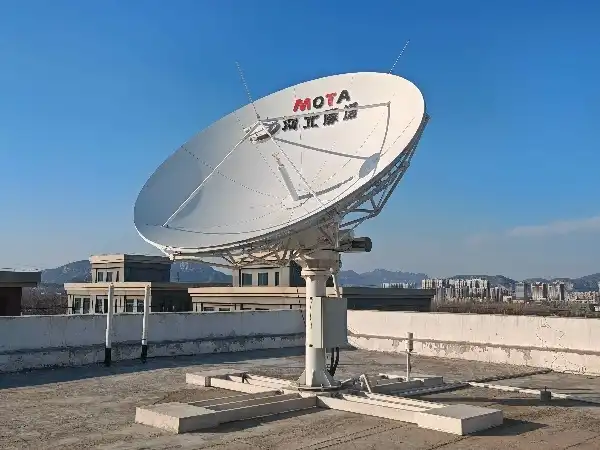
Location and Line of Sight: The First Performance Variables
Placement comes before any specification. A strong antenna in a poor spot still gives a weak link.
Window Placement and Satellite Direction
The optimal location for an interior satellite antenna is a window that faces the satellite. Geostationary satellites are around 35,786 km above the equator; therefore, in the continental US, the antenna has to be pointed south at an elevation that varies with latitude. First step, look up az and el for your target satellite. Then look outdoors for trees, neighbouring buildings, balconies that cross that angle. Even tiny obstructions may block a narrow beam in the Ku band. I would advise trying two or three areas for a couple of minutes each. Indoors there is no defined distance rule; the response varies with footprint, barriers and receiver sensitivity.
Building Materials and Coated Glass
Wood and drywall allow Ku-band signals to pass with little loss. Far more is blocked off by reinforced concrete, brick and metal frames. Low-emissivity (Low-E) glass is distinctive, since its thin metallic layer reflects heat. It also reflects some of the microwave signal. Metal film tinted windows do the same. Before I can recommend a place, I ask: Which glass is that in the window? Hotels and apartments should test one sample room for each window type, as buildings generally have a variety of glass kinds on each level. If glass loss exceeds link margin, it is frequently preferable to go to an uncoated window or open balcony door than to increase gain.
Interference and Weather Effects
The hardware is protected by being inside, but the signal route is not. Ku-band energy is absorbed by rain, wet snow, and thick cloud. Standard techniques for anticipating rain and cloud loss on Earth-space connections are given in ITU-R Recommendations P.618 and P.840. The C-band is less affected by severe rain than the Ku-band. Electronics local matter too. Switching power supply, LED drivers, and inadequately insulated connections may introduce noise into the IF between the LNB and receiver. Do not position the antenna cable close to adapters and routers. Read both metrics. A receiver may display a strong strength bar, yet quality may remain low. Testing for commercial projects in dry and wet environments.
Antenna Design, Frequency Coverage, and LNB Performance
After placement, the antenna and LNB set your signal margin.
Gain, Aperture, and Beamwidth
Gain is a measure of how effectively an antenna gathers and concentrates energy. If you double the aperture diameter at a given frequency, you get around 6 dB more gain, but the beam becomes narrower. A 0.6 m dish at 12 GHz has a half-power beamwidth of ~3 degrees, and a 1.2 m dish ~1.5 degrees, based on the typical 70 \lambda/D estimate in Roddy's Satellite Communications. Narrow beams provide higher gain, but less alignment tolerance, which is a factor inside where a bumped stand might move aim. Ask suppliers for the measured gain throughout the whole band, not a single peak figure. MOTA provides a variety of aperture choices, and our experts can match one to your satellite and location.
Ku-Band Coverage and Noise Figure
The Ku downlink band is 10.7 to 12.75 GHz, and the MOTA indoor fixed satellite antenna covers the whole spectrum. Equipment designed for a different band, like C-band, won’t work effectively for Ku-band services. The noise number is important since satellite signals travel more than 35,000 km and arrive faint, and free-space loss at 12 GHz is greater than 200 dB. The noise figure of the MOTA model is ≤1.2 dB, or about 92 K, or a lower noise temperature. Lower noise means the receiver can extract a clear signal out of the background hiss. But a low noise number can't solve a blocked route. It enhances a usable signal. It doesn't generate one.
Transceiver Isolation and System Compatibility
The MOTA antenna provides transceiver isolation of ≥80 dB. High isolation means that the broadcast route does not leak into the receive channel, preserving reception quality while in operation. The other side of the story is compatibility. The antenna, LNB, cable, and receiver must all be compatible with the same satellite service, polarisation, and frequency plan. I recommend trying real target transponders before you purchase. HD and 4K channels lock depending on modulation type, symbol rate, and receiver sensitivity. A built-in gain stage can compensate for cable or splitter loss, but it can’t save a signal that never made it. “Our integrated, plug-and-play unit connects directly to TVs, computers, and small monitoring cameras to reduce mismatch points.
Alignment, Installation, and Cable Quality
Good hardware still needs careful setup.
Alignment Steps That Protect Performance
Alignment translates datasheet performance into an actual outcome. Before handling the device, installers should check the satellite, band, polarisation, azimuth, elevation, and skew. Then they make modest horizontal and vertical motions while monitoring the signal quality on a receiver or metre. The quality and stability are more important than a high strength reading alone. The MOTA equipment takes 1.5 minutes to achieve satellite alignment and connection configuration and is suitable for desktop installation or wall mounting. Traceless mounting does not need any drilling, so a completed apartment or hotel room remains untouched. First, clean the mounting surface. Do not place the device where doors or cleaning carts might hit it.
Cable, Connector, and Power Quality
Cables lose signal, and the loss increases with length and frequency. Use well-shielded low-loss coax, keep runs short, and avoid abrupt bends. Crimp connections properly and get rid of splitters and worn adapters that you don’t require. A loose F-connector might produce dropouts that resemble an antenna failure. Power use is also a big concern. The MOTA antenna uses ≤4 W during operation and ≤0.8 W in standby, and it works quietly with minimal fan noise, making it ideal for bedrooms, businesses, and hotel rooms. It has an IP63 classification according to IEC 60529, meaning it is dust-tight and can withstand water spray, which is useful for cleaning splashes and ordinary dust.
Indoor Fixed Satellite Antenna Troubleshooting
When a channel fails, I proceed from the simplest reason to the toughest. First, check the receiver and LNB for power. Second, examine the satellite choice, transponder data, and polarisation. Thirdly, check the cable and the connections. 4. Check the alignment again. You may compare the signal strength with the signal quality. Strong strength and poor quality indicate interference or setup problems, while two low values indicate blockage or cable loss. The answer in many circumstances is to switch to an uncoated window, make the connection shorter, and ditch the splitters. If you have concrete walls, neighbouring buildings, or stringent uptime requirements that are beyond the capability of an indoor unit, then you want to go with an outdoor dish.
Comparing Indoor Fixed Satellite Antenna Solutions
Different sites call for different hardware, so honest comparisons save returns.
Indoor Antenna Versus Outdoor Dish
The indoor fixed unit is the winner for ease of installation, minimum visual impact, and code compliance. Renters, HOA residents, and completed hotels frequently can't drill or place hardware outdoors. An outdoor dish with a permanent mount and an unobstructed sky view generally has a better margin since a wider aperture fits and there is no glass or wall in the way. I urge consumers to choose based on site constraints, not habit. If you're driven by installation regulations or labour expense, choose indoor. Select outside when the signal route is weak, and the service must stand up to any conditions.
Flat-Panel Antennas and Signal Boosters
Indoor fixed satellite antennas are low-profile and have different gain, beamwidth, polarisation behaviour, and alignment tolerances than reflector designs. Compare them on measured specs, not on product images. In-line boosters and built-in gain stages are of little use unless the signal is already arriving at the receiver with acceptable quality. They compensate for loss due to cable or distribution, but add noise to the signal when the route is obstructed. The product must fit the application: small, stable units for apartments; higher-margin systems for weak-signal locations; vibration-resistant designs for RVs; documented, repeatable units for commercial projects. For the sake of fairness, ask for test reports for each applicant.
MOTA Indoor Fixed Satellite Antenna at a Glance
Here are the core specifications of our compact Ku-band model, built for home viewing, small offices, and indoor monitoring.
| Item | Specification |
|---|---|
| Frequency range | 10.7–12.75 GHz (Ku-band) |
| Noise figure | ≤1.2 dB |
| Transceiver isolation | ≥80 dB |
| Size | ≤20 cm × 20 cm × 5 cm |
| Weight | ≤1.2 kg |
| Installation | Desktop or wall-mounted, traceless mounting |
| Alignment time | 1.5 minutes |
| Power | ≤4 W working, ≤0.8 W standby |
| Protection | IP63, silent operation |
| Connection | Integrated, plug-and-play to TVs, computers, small cameras |
These figures match the factors above: low noise, high isolation, quick alignment, and a footprint that fits on a desk or wall.
B2B Procurement and Performance Verification
Volume buyers face one more question: will every unit perform the same way?
Supplier Evaluation Checklist
Here are two tests I recommend every B2B buyer do before accepting a supplier.
- Documents and quality system: Get the request frequency range, noise figure, isolation, dimensions, mounting technique, and test tolerances in writing, then check on a sample unit. MOTA is certified to ISO 9001, ISO 14001 and ISO 45001, GJB 9001C military quality management system and domestic type approval for radio transmission equipment. Also ask about batch uniformity and defect management.
- Terms of Supply and Support: Lead times, order quantities, warranty, and assistance hours are compared. MOTA has available stock for regular orders, 45-90 days for customised and large-scale systems, complete unit guarantee under international standards, and 24/7 remote technical assistance. You may arrange stock early and price each installed unit precisely with clear conditions.
- These checks safeguard your margin and cut the pricey returns.
OEM and ODM Customization for the U.S. Market
Operators and brand owners typically want their own label on the goods. OEM & ODM MOTA enables OEM and ODM projects, including logo, customised packaging, manual, hardware appearance, interface protocol, functional modules, etc. We adjust the product and its certification work to the regulations of the target nation. We oversee the process from the scheme design and prototype to mass manufacturing. For sales in the U.S., please identify your intended usage right away and check FCC standards so we can prepare the design accordingly. State the extent of customisation. If your price is based on market-protection clauses, ask for them in the quotation.
Verification Process Before a Large Order
Datasheets cannot address questions that field testing can. Define first of all the target satellite, provider, band, channels, building type, and weather. Then define quantifiable pass marks for signal strength, signal quality, carrier-to-noise ratio, bit error rate, channel lock time, and stability across transponders. Test the full chain — LNB, cable, connections, receiver, and mount — in multiple rooms and kinds of windows and document each result. This data distinguishes product restrictions from installation problems and informs decisions on model, quantity, and installer training. Most buyers allow 2-4 weeks for sample testing. MOTA offers 24/7 remote technical help for installation and troubleshooting.
Conclusion
There is no one parameter that determines the performance of an indoor fixed satellite antenna; it’s the full signal route. The signal that reaches the antenna depends on line of sight, window glass, wall materials, interference, and weather. The gain, aperture, and beamwidth regulate the margin and alignment tolerance, while the Ku-band coverage, noise figure, and transceiver isolation control how cleanly the receiver can make use of that signal. The result in the datasheet is protected by careful alignment, a short low-loss connection, and a sturdy mount. In the sheet, a predetermined sequence of troubleshooting isolates setup problems from site restrictions. Indoor devices fit where you can’t drill or put outside, while outdoor dishes fit bad signal lines. For bulk orders, paperwork, certificates, sample testing, and measurable pass marks are just as important as the specs.
FAQ
1. Can an indoor fixed satellite antenna work through a window?
Yes, when the glass and satellite direction allow it. Metal-coated Low-E or tinted glass can cause heavy loss, so test the window first, or move the antenna to an uncoated window or balcony door.
2. Does higher gain always improve reception?
No. Higher gain narrows the beam and reduces alignment tolerance. Choose gain based on the satellite, the location, and how stable the mount is, and check measured gain across the full band.
3. Can a booster fix a weak signal?
A booster offsets cable or splitter loss, but it cannot correct a blocked path or poor alignment. Fix obstruction and aiming first, then add gain only if needed.
4. How long does MOTA alignment take?
Our indoor unit finishes satellite alignment in 1.5 minutes. It then connects plug-and-play to a TV, computer, or small monitoring camera. A clean surface helps the traceless mount hold.
5. When should I choose an outdoor dish?
Choose outdoor when the site needs a stronger signal margin or higher uptime, or when concrete walls and nearby obstructions block the sky.
Discuss Your Indoor Fixed Satellite Antenna Requirement with MOTA
Looking for an indoor fixed satellite antenna supplier with a compact Ku-band model, OEM/ODM options, ready stock, and 24/7 response? Send your target satellite, country, order plan, and branding needs to MOTA at hebei_mota@163.com. Our team will review your project and recommend a suitable configuration.

References
1. ITU-R Recommendation P.618-13, Propagation Data and Prediction Methods Required for the Design of Earth-Space Telecommunication Systems, 2017.
2. ITU-R Recommendation P.840-8, Attenuation Due to Clouds and Fog, 2019.
3. Dennis Roddy, Satellite Communications (4th edition), McGraw-Hill, 2006.
4. Gérard Maral and Michel Bousquet, Satellite Communications Systems (5th edition), Wiley, 2009.
5. Constantine A. Balanis, Antenna Theory: Analysis and Design (4th edition), Wiley, 2016.
6. IEC 60529, Degrees of Protection Provided by Enclosures (IP Code), 2013.
Tell us your requirements – get a tailored quote and technical support within 24 hours.