- English
- French
- German
- Portuguese
- Spanish
- Russian
- Japanese
- Korean
- Arabic
- Greek
- German
- Turkish
- Italian
- Danish
- Romanian
- Indonesian
- Czech
- Afrikaans
- Swedish
- Polish
- Basque
- Catalan
- Esperanto
- Hindi
- Lao
- Albanian
- Amharic
- Armenian
- Azerbaijani
- Belarusian
- Bengali
- Bosnian
- Bulgarian
- Cebuano
- Chichewa
- Corsican
- Croatian
- Dutch
- Estonian
- Filipino
- Finnish
- Frisian
- Galician
- Georgian
- Gujarati
- Haitian
- Hausa
- Hawaiian
- Hebrew
- Hmong
- Hungarian
- Icelandic
- Igbo
- Javanese
- Kannada
- Kazakh
- Khmer
- Kurdish
- Kyrgyz
- Latin
- Latvian
- Lithuanian
- Luxembou..
- Macedonian
- Malagasy
- Malay
- Malayalam
- Maltese
- Maori
- Marathi
- Mongolian
- Burmese
- Nepali
- Norwegian
- Pashto
- Persian
- Punjabi
- Serbian
- Sesotho
- Sinhala
- Slovak
- Slovenian
- Somali
- Samoan
- Scots Gaelic
- Shona
- Sindhi
- Sundanese
- Swahili
- Tajik
- Tamil
- Telugu
- Thai
- Ukrainian
- Urdu
- Uzbek
- Vietnamese
- Welsh
- Xhosa
- Yiddish
- Yoruba
- Zulu
The Best Vehicle Satellite Antenna for Sale in 2026 - MOTA
The finest car satellite antenna for 2026 remains installed on difficult roads, takes less power, and connects to the satellite promptly after parking. The vehicle-mounted fixed satellite antenna from MOTA satisfies that criteria. Magnetic adsorption and bolts hold it in the Ku band from 10.7 to 12.75GHz. Its aperture is 0.45m. This 12V or 24V device uses 8W or less and aligns in 3 minutes after parking. For upfitters, fleet operators, and OEM purchasers, I prepared this guide. Hebei Mota Electronics Technology Co., Ltd. is a 2017 integrated production and trade firm. I explain how these antennas operate, how to pick, install, and purchase one below.
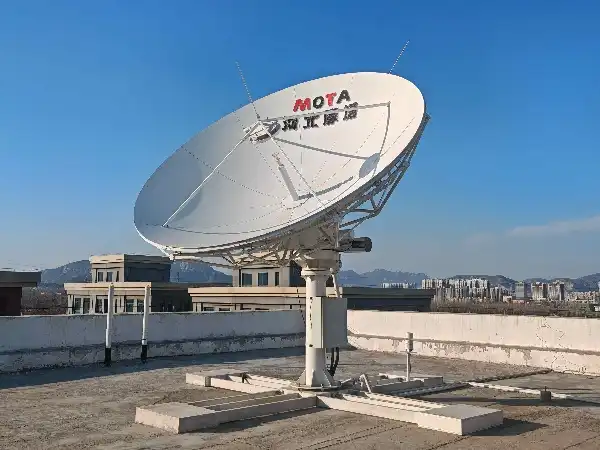
Understanding Vehicle-Mounted Fixed Satellite Antennas: How They Work and Why They Matter
What a Fixed Vehicle Satellite Antenna Does
A vehicle-mounted fixed satellite antenna is a satellite ground terminal built for a vehicle roof. Industry teams often call this design "comms-on-the-pause." The vehicle stops, the antenna points at a satellite, and the link goes live. It does not track while the wheels turn. That choice removes the gyro-stabilized platform that moving-link systems need, so the hardware stays simpler and costs less.
Main pieces include reflector, feed with low noise receiver, transmit chain, positioning unit and control board. Textbooks such as spacecraft Messages by Dennis Roddy outline the common principle: a powerful antenna concentrates a narrow beam on one spacecraft. You don’t need cell towers or fibre since the connectivity is over space.
Ku, Ka, and C Bands Compared
The most common in automobile projects are three frequency bands. C band employs lower frequencies as well as handles heavy rain effectively, but requires huge dishes that seldom fit on a car roof. The Ka band operates at higher frequencies and hence provides high data speeds, but suffers from significant signal attenuation due to rain, as Maral and Bousquet discuss in Satellite Communication Systems.
Ku band is between the two. It supports tiny dishes and is frequently used for broadcast and VSAT applications. That balance is the reason MOTA developed its antenna to span 10.7–12.75 GHz. The 0.45m aperture is a reasonable size for trucks, coaches, particular automobiles and RVs still keeping the receive path sensitive.
Where Fixed Antennas Prove Their Value
Fixed antennas fit jobs that happen at stops. Here are four scenarios where I see them used most.
• Crisis response: Command trucks provide video conferencing and situation data to headquarters while local networks are down.
• Energy or mining: Field crews relay survey and seismic information from places without fibre or cellphone service.
• Mobile TV: News teams upload live footage from event venues when cellular networks are overloaded.
• Mobile office along with research: Field personnel use cloud tools and calls via video without coming back to a permanent location.
In all cases the team parks, hooks up and works. A fixed connection is cheaper than a movable link and that’s why many cars choose for it.
How to Choose the Best Vehicle Satellite Antenna in 2026
Match the Antenna to the Vehicle and the Job
Start with the vehicle, not the datasheet. A truck needs a roof position that tolerates vibration and a power plan for 12V or 24V. An RV owner cares about a low draw, so the house battery lasts through the night. An integrator building a command or broadcast vehicle cares about rack space, audio and video links, and delivery dates. The antenna is often the last part installed, and it can delay a whole project when nobody checks it early.
Three questions shape every other choice for the vehicle-mounted fixed satellite antenna. Where does the antenna mount? How does the cable travel to the equipment? Which power source feeds it? I also ask what the end user does on arrival. The ideal answer is simple: park, press one button, and wait.
Selection Criteria Checklist
Here are four criteria I use when I review an antenna for a vehicle program.
• Power draw: MOTA's antenna uses 8W or less while working and 1.5W or less on standby, and it connects directly to 12V or 24V supply. At 12V, 8W equals about 0.67A. Standby over 24 hours totals 36Wh, roughly 3 percent of a 100Ah 12V battery's nominal 1,200Wh.
• Mounting method: The design pairs strong magnetic adsorption with bolt fixing. The magnet holds the base in place, and the bolts keep it there through bumps, sharp turns, and climbs. Ask every supplier for installed-vehicle test records on road types like yours.
• Weather protection: IP66 is defined by IEC 60529 as dust-tight and safeguarded against forceful water jets . MOTA’S device is also corrosion-resistant. IP66 is not a submersion classification, thus keep the antenna up above any stagnant water.
• Setup time: Alignment finishes within 3 minutes after parking, with a manual mode as backup. Time the process with a stopwatch during your trial installation.
These four checks catch most fit problems before a unit reaches the assembly line, and they reduce the risk of repair claims later.
Fixed vs. Mobile, Reflector vs. Phased Array, and Ownership Cost
The moving-link antennas maintain the beam pointed at the target as the vehicle moves. They require stabilising hardware, so they expense more and take up more roof area. If your crews operate at stops, a stationary unit will provide you the same stopping time service over less money.
Phased arrays steer the beam electronically and sit flat. Reflector designs, like MOTA's 0.45m antenna, keep the hardware simpler. Simpler hardware generally means fewer service items.
The cost of ownership is more than the purchase price. Low power consumption saves the car battery and shock-reinforced core parts decrease the likelihood of recurrent repairs. Add installation hours, requisite training and warranty conditions to your comparison.
Why MOTA Offers Strong Value
MOTA has been producing for 9 years. Our quality system has been certified ISO 9001, ISO 14001 and ISO 45001, and military quality assurance system GJB 9001C. We have obtained the domestic type certification for radio communication equipment, so we are a national high-tech firm and a military-civil combination enterprise.
We have developed our own communications via the vehicle-mounted fixed satellite antenna and precision tracking algorithms, and have several intellectual property rights. Our crew is available 24/7. Each unit is also covered by a comprehensive unit warranty to international standards. Flexible plans are available.
Installation, Alignment, and Maintenance: Ensuring Optimal Performance on the Road
Installing the Antenna Step by Step
A clean installation prevents most field complaints. Here is the sequence I recommend for procurement teams and engineers.
- Pick the roof position. Choose a flat, rigid area with a clear view of the southern sky, since geostationary satellites sit above the equator. Keep the antenna away from roof racks, air conditioners, and cargo that could block the beam.
- Fix the base. Set the base with magnetic adsorption first, then drive bolts through the reinforced points on your engineering drawing. Seal each bolt hole against water. Never rely on the magnet alone.
- Route cable and power. Follow existing cable paths, avoid sharp bends, and use outdoor-suitable connectors. Connect to the 12V or 24V supply through a fuse that your electrical engineer sizes.
- Test on site. Park on level ground, run automatic alignment, and record the time and signal result. Repeat after a short road drive to confirm the mounting holds.
Following these steps in order gives your assembly line a repeatable process and gives your engineers clear records for acceptance reviews.
How Alignment Works After You park
MOTA pairs a vehicle-dedicated alignment algorithm with GPS/GNSS positioning. The position data tells the antenna where to look, so it can find the satellite and build the link within 3 minutes of parking. The operator parks on reasonably level ground with open sky, powers up, and starts the one-button routine.
Manual alignment stays available as a backup. If an unusual site or a partial obstruction slows the automatic routine, a trained operator can finish the job by hand. I suggest handing drivers a one-page start guide. Most "it does not work" complaints come from a blocked sky view, not from the antenna.
Maintenance and Troubleshooting
Maintenance stays light, but I still schedule it. At routine vehicle service, check that bolts are tight, the magnetic seat is clean, connectors are dry, and seals are intact. Wipe mud and salt film off the housing.
When a link fails, work from the simple causes to the complex ones:
• Confirm the sky view is clear.
• Check the voltage at the antenna connector.
• Inspect the cable and connectors.
• Switch to manual alignment.
If the problem repeats or you see physical damage, escalate it. MOTA provides remote technical support around the clock for installation, troubleshooting, and system upgrades, so downtime stays short.
Top Vehicle-Mounted Fixed Satellite Antennas on the Market in 2026: MOTA's Product Line and Industry Comparisons
Benchmarks Buyers Should Use
Five benchmarks separate a strong vehicle antenna from an average one. Noise figure shows how cleanly the receiver handles weak signals, and lower is better. Transceiver isolation shows how well the transmit and receive paths stay apart, which matters near engines and onboard electronics. Mechanical design decides whether the unit survives vibration. Ingress protection decides how it handles long outdoor parking. Documentation and certification decide whether your customer accepts it.
Military-style standards such as MIL-STD-810H describe environmental and vibration testing methods for the vehicle-mounted fixed satellite antenna. Ask any supplier which tests it ran and request the records.
MOTA's 0.45m Ku-Band Vehicle Antenna
MOTA's vehicle-mounted fixed satellite antenna targets trucks, coaches, special vehicles, and RVs. It filters electromagnetic interference from engines and vehicle electronics through its noise figure and isolation values. Its core components carry shock reinforcement for long-term road use. The table lists the verified specifications.
| Parameter | Specification |
|---|---|
| Frequency band | Ku band, 10.7–12.75GHz |
| Aperture | 0.45m |
| Noise figure | ≤1.0dB |
| Transceiver isolation | ≥85dB |
| Power | ≤8W working, ≤1.5W standby |
| Supply | 12V/24V DC vehicle power |
| Protection | IP66, corrosion-resistant |
| Alignment | 3 minutes after stopping; automatic with manual backup |
| Mounting | Magnetic adsorption plus bolt |
How MOTA Compares with Other Options
Quotes for car antennas vary greatly, so compare the identical products across all of them. Does each unit have a noise figure as well as an isolation figure? Check whether it has a dual fastening mechanism, a power fluctuate for both 12V and 24V and an IP rating. Ask about supplier’s quality certificates and his capacity to change the design.
MOTA is a realistic middle ground. The antenna is specifically designed for automobiles, has explicit requirements and comes from the manufacturer with three system of management certificates and a military quality assurance system. If you’re a buyer trying to decide between a cheap unit and a premium moving-link system, a fixed design is a middle-ground solution for stop-based work.
Procurement Insights: Where and How to Buy Vehicle-Mounted Fixed Satellite Antennas in 2026
Where to Buy
You may purchase from a manufacturer, distributor or an online business-to-business platform. Buying straight from the manufacturer provides your engineers availability of the same people who produced the product. You require access to it when you need drawings, connection specs or test records. Distributors like minimal repeat orders. Online platforms let you compare suppliers, but you should examine the factory profile and credentials before you purchase.
Whatever channel you choose, confirm three points: the supplier makes the product, it holds the relevant approvals, and it will support the unit after delivery. MOTA's website, motasat.com, lists our product information and contact details.
Customization and Bulk Orders
Vehicle programs rarely fit a standard product exactly. MOTA offers professional ODM and OEM services, from scheme design and prototyping to mass production. We can adapt hardware appearance, interface protocols, functional modules, software interfaces, and certifications to each country's regulations and your needs.
Let me know what sort of vehicle you have, where you installed it, how you run the wires, and what power system you have. Our engineers will review what adjustments work, such as mounting base, brackets, cable length and connection type. First subjects of discussion may be trial numbers, branding and a chance list plans.
Pricing, Lead Time, Logistics, and After-Sales
Price depends on quantity, customization, and certification scope, so I do not quote fixed figures here. On timing, we keep ready stock for regular orders. Customized and large-scale systems take 45–90 days to produce.
We use international dedicated shipments, sea freight and air freight for shipment. We put precise electronics in sturdy, moisture-proof packaging and provide tracking, customs clearance and foreign storage.
For the US projects, let us know early. Our transmission by radio equipment approval is domestic therefore your importer should check local restrictions. We adjust the hardware and documentation to the regulations of the destination country. After delivery: remote assistance, complete unit warranty and replacement parts via cooperating channels.
Conclusion
A vehicle-mounted stationary satellite antenna provides cars with a Ku-band connectivity when at stops, without the added expense of a traveling-link system. The ideal option is the one that fits the vehicle, the electrical system and the task. Key tests include low power consumption on 12V or 24V, dual fixing toward vibration, IP66 safety, noise figure, isolation and 3 minute alignment with manual backup.
Careful installation and light maintenance keep the link dependable for the vehicle-mounted fixed satellite antenna. MOTA's 0.45m antenna meets these criteria and comes from a certified factory that supports ODM and OEM work, defined lead times, and ongoing technical support. Buyers who test installed units and confirm local radio requirements reduce repair and compliance risk.
FAQ
How does a fixed antenna differ from a mobile one in signal stability?
A fixed antenna holds a steady link while parked. A moving-link antenna keeps tracking while driving, which adds stabilization hardware and cost.
Can a truck-mounted antenna handle rain and dust?
MOTA's antenna carries an IP66 rating, which means dust-tight and protected against powerful water jets. It also resists corrosion.
Will it drain my vehicle battery?
Working power is 8W or less, and standby power is 1.5W or less. It connects directly to 12V or 24V supply.
What support does MOTA offer for installation?
We provide 24/7 remote technical support for installation, troubleshooting, and system upgrades. Cooperative channels can add on-site service.
Get Your 2026 Vehicle Antenna Quote from MOTA
MOTA is ready to quote your next vehicle program as a vehicle-mounted fixed satellite antenna supplier. Send your vehicle model, mounting position, power system, and trial quantity to hebei_mota@163.com, and our team replies around the clock. We support ODM and OEM work, ship regular orders from ready stock, and plan 45–90 days for customized builds. For details, please refer to the website: motasat.com.

References
1. ITU Radio Regulations, 2024
2. Satellite Communications, Dennis Roddy, McGraw-Hill, 2006
3. Satellite Communications Systems, Gérard Maral and Michel Bousquet, Wiley, 2020
4. IEC 60529: Degrees of Protection Provided by Enclosures (IP Code), 2013
5. MIL-STD-810H: Environmental Engineering Considerations and Laboratory Tests, U.S. Department of Defense, 2019
6. Code of Federal Regulations Title 47 Part 25: Satellite Communications, U.S. Federal Communications Commission, 2024
Tell us your requirements – get a tailored quote and technical support within 24 hours.