- English
- French
- German
- Portuguese
- Spanish
- Russian
- Japanese
- Korean
- Arabic
- Greek
- German
- Turkish
- Italian
- Danish
- Romanian
- Indonesian
- Czech
- Afrikaans
- Swedish
- Polish
- Basque
- Catalan
- Esperanto
- Hindi
- Lao
- Albanian
- Amharic
- Armenian
- Azerbaijani
- Belarusian
- Bengali
- Bosnian
- Bulgarian
- Cebuano
- Chichewa
- Corsican
- Croatian
- Dutch
- Estonian
- Filipino
- Finnish
- Frisian
- Galician
- Georgian
- Gujarati
- Haitian
- Hausa
- Hawaiian
- Hebrew
- Hmong
- Hungarian
- Icelandic
- Igbo
- Javanese
- Kannada
- Kazakh
- Khmer
- Kurdish
- Kyrgyz
- Latin
- Latvian
- Lithuanian
- Luxembou..
- Macedonian
- Malagasy
- Malay
- Malayalam
- Maltese
- Maori
- Marathi
- Mongolian
- Burmese
- Nepali
- Norwegian
- Pashto
- Persian
- Punjabi
- Serbian
- Sesotho
- Sinhala
- Slovak
- Slovenian
- Somali
- Samoan
- Scots Gaelic
- Shona
- Sindhi
- Sundanese
- Swahili
- Tajik
- Tamil
- Telugu
- Thai
- Ukrainian
- Urdu
- Uzbek
- Vietnamese
- Welsh
- Xhosa
- Yiddish
- Yoruba
- Zulu
What Affects the Performance of an Industrial Fixed Satellite Antenna?
The performance of an industrial fixed satellite antenna depends on five things: reflector gain and sidelobe control, pointing accuracy, site weather, interference from nearby equipment, and the quality of the RF chain behind the dish. When one of these slips, link margin shrinks and outages follow. I talk with communication managers at energy and mining sites often, and the pattern repeats: the spec sheet looks fine, yet the field result disappoints. This guide explains each factor in plain language, so you can judge a design before you buy and keep a remote station online around the clock.
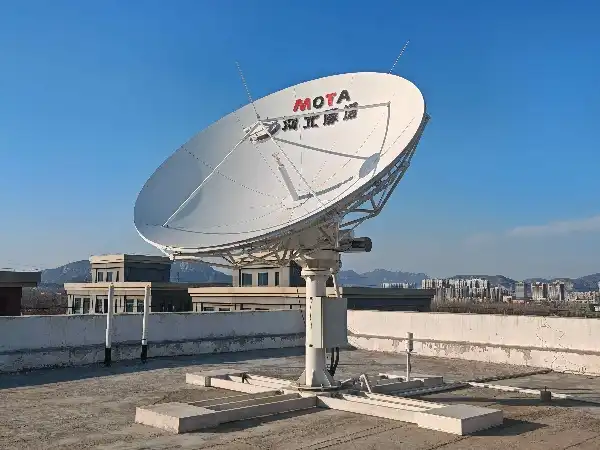
Understanding Industrial Fixed Satellite Antenna Performance
What an Industrial Fixed Satellite Antenna Does
An industrial fixed satellite antenna is a ground point that stays in one place and sends voice, video, and data to a satellite. Geostationary orbit, which is about 35,786 km above the equator, is home to many satellites used for business communications. This means that the dish only needs to be aimed once and then only slightly adjusted afterward.
Mobile systems give up that steadiness to be portable, so they have to re-point all the time. A fixed port sends steady SCADA data and camera feeds to a pipeline valve station, a mine office, or a substation that doesn't have fiber. Fixed placement also keeps the hardware from moving around all the time, which wears it down.
Core Components That Shape Signal Quality
Four parts affect output quality. The reflector gathers the information and focuses it. The feed horn is in the middle and picks up that energy. The LNB boosts the weak downlink with little extra noise, and the BUC boosts the power of the uplink. Balanis writes in Antenna Theory that the gain goes up with the dish diameter and frequency. Doubling the diameter adds about 6 dB. The MOTA terminal has a high-speed modem, an industrial-grade BUC/LNB module, and smart power management built in. Less work is done on-site to match parts, so there are fewer places where problems can hide.
Performance Metrics Buyers Should Read First
Before you read anything else, read five numbers. It can tell how well the terminal hears the satellite by its antenna gain and G/T. The first level of the sidelobe shows how much energy leaks off-axis. Lower values make it easier for satellites nearby to talk to each other. If the strong uplink drowns out the weak downlink, this is called transmit-receive isolation. Our unit has a first sidelobe of -16 dB or less and a separation of 88 dB or more. There was a downtime of five hours. Don't ask for adjectives; ask for work history from real sites. A three-month test station tells you more than any data sheet.
They tell you about the tools. What happens to it after it leaves the plant is talked about next.
Primary Factors Affecting the Performance of Industrial Fixed Satellite Antennas
Weather, Climate, and Site Conditions
A lot more than most people think, weather changes the strength of links. ITU-R P.618 says that Ku-band and Ka-band links fade more than C-band or S-band links because heavy rain soaks up and spreads out signals. The loss also increases with frequency. If there is snow or ice on the reflector, it weakens the signal.
Wind can change the pointing angle, and dust and salt air can damage the coatings and connectors. The MOTA terminal has a housing that doesn't rust and an IP65 rating for protection against dust and water jets. It can work in temperatures ranging from -30°C to +55°C. Please let us know if your site is outside of that range, and we will look into it.
Pointing Accuracy and Installation Quality
A narrow beam doesn't leave much room for error. For the industrial fixed satellite antenna, at Ku-band, a 1.2 m dish has a half-power beamwidth of about 1.5 degrees, which means that even a small tilt in the mount quickly loses gain. That tilt could be caused by cracks, a base that is shifting, or a bolt that is coming loose.
It takes about three minutes for our terminal's two-axis self-stabilizing base and industrial pointing program to lock on to the satellite. Under level-7 wind (Beaufort 7, about 50–61 km/h), it keeps a stable 1080p video return. Also, that speed saves time for field crews that don't know much about satellites because they don't have to look for the signal by hand.
Interference and Signal Integrity
A lot of radio noise comes from industrial places. The noise level is raised by variable-frequency drives, switching power supplies, radar, and nearby transmitters. Metal structures cause multipath reflections that change the signal. Three habits are good for you. Make sure the dish is not near any known noise sources and that it has a clear line of sight.
Ground yourself and use insulated wires. Pick hardware that has good isolation between send and receive. At least 88 dB of separation is provided by our design, and its pointing method blocks electromagnetic interference from factories. I also suggest an on-site EMC check during the design phase so that your automation engineers can set limits on interference before you buy.
Frequency Band and Hardware Selection
The choice of frequency strikes a mix between output, dish size, and weather resistance. Our terminal can manually switch between these bands:
- C-band and S-band: The lower bands are better at handling heavy rain than the higher ones. This makes them good for tropical, coastal, and storm-prone areas. The size of the dish has to be bigger for a lower frequency to get the same gain. When uptime is more important than raw data speed on remote telemetry links, choose them.
- Ku-band and X-band: Ku-band strikes a good mix between dish size and throughput. It is often used for video return and commercial VSAT networks. Before you design around the X-band, make sure you know how to get to it. It's mostly used by government and defence services. Both need a link budget that is based on actual rain data for your area, not a guess.
- Ka-band and Q-band: These higher bands have more space and can support high-throughput satellite services, but when it rains, they lose their strength the most. Use them when you need a lot of video or data and the weather is dry, but be sure to leave some room for error. Because we switch between models by hand, one model can handle more than one satellite service.
You'll need to stock fewer part numbers if you have a type that lets you switch bands by hand.
Comparison of Industrial Fixed Satellite Antenna Technologies and Market Solutions
Fixed Versus Mobile Satellite Antennas
Types of terminals: fixed and mobile; each type solves a different set of issues. To connect to a satellite while a car, boat, or trailer moves, a movable interface needs motors, gimbals, and cables, all of which wear out over time. That's because the designers limit the aperture size to keep the unit small, which also limits the gain.
A fixed terminal doesn't move, so its mount, reflector, and cable don't have to deal with as much stress. Its gain can also be adjusted to fit the link budget. I like the fixed design because it gives longer service gaps and makes it easier to find faults at stable sites like pump stations, remote plants, and ground-station watch posts.
Fixed Versus Steerable Antennas
A steerable antenna has motors that let it move between satellites or follow ones that aren't in a fixed orbit. That helps if your plans change a lot, but motors and control units cost more and need more maintenance. It points at one satellite and holds it there. The fixed approach is what our terminal does: you put it somewhere permanent, and its two-axis self-stabilizing platform and pointing algorithm take care of acquisition and wind movement. You don't have to rebuild the station every time you need to change bands. Instead, you do it by hand. This is a common way for buyers with one stable service per spot to keep costs low.
Market Overview of Leading Brands
This field is served by a number of well-known names. For the government and defence, L3Harris sells big ground antennas and satellite communication gear. Electronically steered flat-panel antennas are what Kymeta makes for mobile use. Comtech sells VSAT and earth station gear, and Gilat is known for its VSAT networks. Thales sells satellite communication systems to both government and civilian customers.
Each brand is good at what it does in its own area. Buyers who are focused on the site usually compare them to specialised suppliers based on how well they work with the site, how long the lead time is, and how well they offer local support. MOTA specialises in industrial fixed satellite antennas that have a modem, BUC/LNB, and ready stock for standard models, as well as ODM/OEM customisation.
Improving Performance Through Procurement and Installation
Evaluation Criteria for Remote Industrial Sites
Start with the site and then the rules. Check the frequency band and satellite service, as well as the power source and any backup plans you have in case the power goes out or the grid becomes shaky. Early on, check the connections because your automation engineers need to make sure that the terminal can connect to RTU, PLC, and SCADA equipment via Ethernet or serial lines.
MOTA lets you make changes to interface protocols and functional modules as an OEM or ODM, so let us know what you need when you're making your choice. Ask live sites for records of environmental tests, guarantee terms, and working history. After that, run a test station for three months before placing a large order.
Installation and Maintenance Steps
A good fix will keep the results you paid for safe. The following three steps are ones I will not skip:
- Site survey: Find the satellite's height and azimuth, and make sure there are no trees, towers, or buildings in the way. Note the amount of wind, high temperatures, salt or dust levels, and noise sources nearby. A one-day survey can often keep you from having to move at a high cost after the concrete foundation sets. Also, make sure you know where the power and grounding will come from.
- Mounting and alignment: A strong, level base is important, and all bolts must be tightened to the right level. If the mount isn't tight, the beam will move in the wind. Check the send and receive levels, peak the signal, and ground the dish and RF cables. Write down the final readings so that your operations team has a starting point that they can use when they need to troubleshoot later.
- Routine checks: Every three months, check the feed horn window for water. Once a year, look at the structure and foundation bolts. And finally, clean the reflector of any dust, salt, or snow. Record the signal levels once a month and keep the files. A slow drop in readings usually means there is a problem with the point or connector long before the power goes out.
These steps keep the link gap you set up and make it easy for support workers to figure out what's wrong.
Bulk Orders, Lead Times, and Supplier Checks
Plan your purchases around the launch of your site. We keep regular models in stock, and it takes 45 to 90 days to make custom or large-scale systems. We have stable capacity for batch delivery. For projects with more than one site, I recommend sending items in stages that match construction milestones. Checks with the supplier are just as important as the specs.
The company MOTA was established in 2017 and has ISO 9001, ISO 14001, and ISO 45001 certifications, as well as GJB 9001C quality management and local type approval for radio gear. Our industrial fixed satellite antenna can be adapted for different regional compliance requirements. For US sites, make sure you know early on what local licences and certifications you need. We will then change the tools, interfaces, and papers to fit the rules of the target country. Our guarantee is based on international standards, and we offer 7x24 remote help for setup and problem-solving.
Future Trends Shaping Industrial Fixed Satellite Antenna Performance
Higher Frequency Bands and Greater Throughput
High-throughput satellites are being launched all the time, and many of them use Ka-band. For remote sites, the cost per megabit can go down if there is more capacity per satellite. This is good for monitoring that uses a lot of data and video. The catch is that it's sensitive to rain, so a terminal needs to have enough space and a design that locks quickly after a fade.
A site can switch to a different service without getting a new antenna if it has hardware that works with more than one band. As the number of service choices grows, I think buyers will value this flexibility even more. So, ask any seller how band changes work in the field.
Materials, Durability, and Power Efficiency
Electronics and materials are getting better in quiet but useful ways. Better coatings and alloys that don't rust make housings last longer in chemical and coastal environments, and ASTM B117 salt spray testing lets buyers compare them in a standard way. At solar-powered stations, where every watt adds to the cost of the panels and batteries, power use is just as important. Our terminal has smart power management built in to help in places where the power supply isn't stable, and its main parts have been tested and found to work in an industrial setting. Ask each supplier for test records and information on how much power they use.
IoT Integration and Sustainable Lifecycle Management
As of now, satellite links can do more than just send voice calls. Integrators need open interfaces and units that work the same way on a lot of different small projects because they feed SCADA, industrial IoT sensors, and HD video into central platforms. Our ODM/OEM service changes the software interfaces, functional modules, and interface protocols so that makers of RTUs and SCADAs can name the device and put it together.
One common model across sites cuts down on the number of different extra parts and training time. Durable housing also cuts down on the amount of waste that comes from replacing things. Our ISO 14001 certification shows that our factory also thinks about the whole lifecycle.
Conclusion
The performance of an industrial fixed satellite antenna depends on its parts, the frequency band it works in, how it is installed, and its surroundings. How well the hardware works can be seen by the gain, the sidelobe level, and the transmit-receive isolation. In the field, it's tested by rain, wind, weather, dust, and salt. Electrical equipment close can also make it noisier. When the point is right and the mount is rigid, the link stays in place.
Fixed designs work best for long-term locations because they require less maintenance than movable or steerable units. The right band will rely on the amount of rain in the area and the service needs. A reliable remote station has clear specifications, pilot testing, planned maintenance, and checked supplier credentials. In the future, sites will be built with higher bands, better materials, and open interfaces.
FAQ
What is the difference between a fixed and a steerable antenna?
A stable antenna stays in one place in space and works well for permanent spots. A steerable antenna has motors that change satellites or follow moving ones, which makes it more expensive and harder to keep up. The MOTA terminal is an industrial fixed satellite antenna design that switches bands by hand.
How does the environment affect performance?
Most Ku-band and Ka-band frequencies get weaker when it rains. Pointing can be changed by wind, ice can block the reflector, and salt or dust can damage the coverings. Pick the correct band, add link margin, and pick a housing that is sealed and won't rust, like our IP65 design.
What drives the price beyond the unit cost?
The price includes the BUC/LNB and modem, as well as the power systems, installation, warranty, spare parts, and customer service. Over its lifetime, a terminal with fewer field parts and remote help available 24 hours a day, seven days a week, is likely to cost less to run.
Request an Industrial Fixed Satellite Antenna Quote from MOTA
MOTA is an ISO-certified company that makes industrial fixed satellite antennas. They have stock on hand, can make custom systems in 45 to 90 days, and can support both ODM and OEM. Send your site's conditions, frequency band, and interface needs to hebei_mota@163.com, and our team will get back to you with a pilot-station plan as soon as possible. You can look at more information about the product at motasat.com. Get your price right now.

References
1. ITU-R Recommendation P.618-14: Propagation Data and Prediction Methods Required for the Design of Earth-Space Telecommunication Systems, International Telecommunication Union, 2023
2. Satellite Communications, Dennis Roddy, McGraw-Hill, 2006
3. Antenna Theory: Analysis and Design, Constantine A. Balanis, Wiley, 2016
4. Satellite Communications Systems: Systems, Techniques and Technology, Gérard Maral and Michel Bousquet, Wiley, 2009
5. IEC 60529: Degrees of Protection Provided by Enclosures (IP Code), International Electrotechnical Commission, 2013
6. ASTM B117: Standard Practice for Operating Salt Spray (Fog) Apparatus, ASTM International, 2019
Tell us your requirements – get a tailored quote and technical support within 24 hours.