- English
- French
- German
- Portuguese
- Spanish
- Russian
- Japanese
- Korean
- Arabic
- Greek
- German
- Turkish
- Italian
- Danish
- Romanian
- Indonesian
- Czech
- Afrikaans
- Swedish
- Polish
- Basque
- Catalan
- Esperanto
- Hindi
- Lao
- Albanian
- Amharic
- Armenian
- Azerbaijani
- Belarusian
- Bengali
- Bosnian
- Bulgarian
- Cebuano
- Chichewa
- Corsican
- Croatian
- Dutch
- Estonian
- Filipino
- Finnish
- Frisian
- Galician
- Georgian
- Gujarati
- Haitian
- Hausa
- Hawaiian
- Hebrew
- Hmong
- Hungarian
- Icelandic
- Igbo
- Javanese
- Kannada
- Kazakh
- Khmer
- Kurdish
- Kyrgyz
- Latin
- Latvian
- Lithuanian
- Luxembou..
- Macedonian
- Malagasy
- Malay
- Malayalam
- Maltese
- Maori
- Marathi
- Mongolian
- Burmese
- Nepali
- Norwegian
- Pashto
- Persian
- Punjabi
- Serbian
- Sesotho
- Sinhala
- Slovak
- Slovenian
- Somali
- Samoan
- Scots Gaelic
- Shona
- Sindhi
- Sundanese
- Swahili
- Tajik
- Tamil
- Telugu
- Thai
- Ukrainian
- Urdu
- Uzbek
- Vietnamese
- Welsh
- Xhosa
- Yiddish
- Yoruba
- Zulu
Why Industrial-grade Satellite Antennas Are Essential for Mission-Critical Systems
When terrestrial networks fail or simply never existed, mission-critical operations depend on one thing: a satellite link that stays up. An industrial-grade fixed satellite antenna is not a luxury upgrade — it is the communications backbone for power grids, mining operations, oil fields, and emergency response centers that cannot tolerate downtime. Unlike consumer VSAT dishes, these systems are engineered for 24/7 continuous duty, extreme environmental exposure, and seamless integration with SCADA and PLC architectures. This post breaks down why that distinction matters and how to make the right procurement decision.
Understanding Industrial-Grade Fixed Satellite Antennas
Anything you would put on the roof of a house is very different from an antenna for a heavy-duty base station. The engineering thinking starts with making sure the signals are correct and moves out to making sure the structures will last.
What Sets These Systems Apart
This is how ITU-R S.580 and FCC 25.209 industrial satellite ground stations are built, and the RMS mistakes on the reflector surface are usually less than 0.5 mm to keep the gain efficiency high. There are different aperture sizes, from small 2.4 m dishes to big 13 m mirrors. Depending on the mission plan, the frequency coverage ranges from C to S to Q/V bands. The end result is a system that can reach G/T ratios and EIRP levels that regular hardware can't even come close to. It can also handle high-bandwidth data backhaul in places where terrestrial infrastructure isn't available or isn't stable.
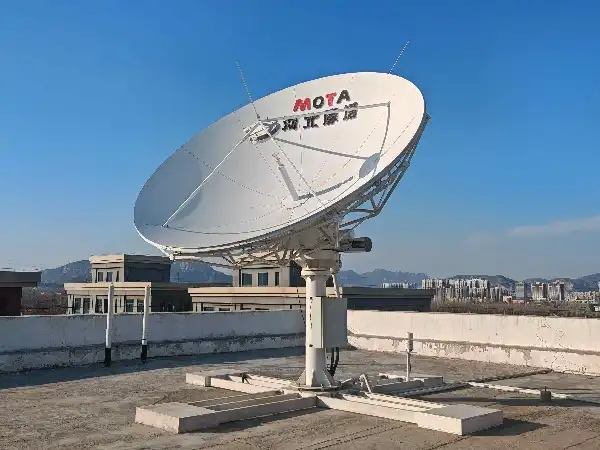
MOTA's fixed satellite communication system can manually switch between Ku/Ka/S/X/C/Qv bands, can align satellites in less than 3 minutes, and can keep 1080p video backhaul stable even when there is Level 7 wind load. With aperture sizes ranging from 2.4 m to 13 m, engineering teams can make sure that the link budget is just right for each site's throughput needs without buying too much hardware.
Why Reliability Matters — Critical Applications of Industrial Fixed Satellite Antennas
In the workplace, not being able to communicate is not an inconvenience. It's a safety event on an offshore platform, in a deep-pit mine, or at a substation that is far away. The International Energy Agency said in a report from 2022 that unplanned power outages in remote energy facilities cost operators an average of $260,000 per hour in lost production and response time. When hardware isn't given enough attention, the industrial-grade fixed satellite antenna in the middle of the VSAT link is the first thing that breaks.
Here are the three operating settings where this risk is most obvious:
- Remote energy and extractive industries: Offshore rigs and open-cut mines use a lot of electromagnetic noise from variable-speed drives, salty air, and mechanical shaking. All three are handled at the same time by a system that is rated IP65 and has radio separation of ≥88 dB. The MOTA antenna's high-strength, corrosion-resistant case and two-axis self-stabilizing base keep the antenna pointed correctly even when they are under constant mechanical stress. This makes sure that the data link to the SCADA head-end never drops.
- Utility substations and distributed grid monitoring: The IEC 61850 standard for rolling out a smart grid requires sub-second delay and reliable packet delivery across nodes that are spread out geographically [3]. When fiber isn't available, a fixed satellite terminal with built-in BUC/LNB units and smart power management acts as the main connection for coordinating safety relays and sending real-time data.
- Disaster response and sovereign communications hubs: FEMA's 2021 After-Action Reports on hurricane response found that failing communication infrastructure was the main thing that made it hard to coordinate relief efforts . Fixed satellite terminals can be set up in less than three minutes and work in temperatures ranging from -30 °C to +55 °C. This gives incident leaders a guaranteed way to communicate even if the grid or cells go down.
In all of these situations, the antenna has to work the first time, every time, even when there isn't a technician next to it. The plug-and-play design of the MOTA system, which includes a modem and power control built in, gets rid of single points of failure from the rollout list.
Selecting the Right Industrial Fixed Satellite Antenna for Your Needs
There are more factors to consider than just price per unit when buying high-reliability satellite stations. When figuring out the total cost of ownership, you have to think about how hard it is to set up, how often you have to do maintenance, and how much it costs for unplanned downtime over the system's operational life, which is usually 15 years or more for industrial-grade hardware.
Key Selection Criteria
Which satellite assets your terminal can access depend on the frequency band. Ku-band is still the most widely available VSAT frequency for business use around the world. Ka-band offers faster throughput at smaller apertures. X-band is only used for government and defense purposes. In warm areas, C-band is better at resisting rain fade. When your goal changes, you can keep your investment safe with a computer that supports manual multi-band switching, like the MOTA system does.
Compliance with structures is also very important. Buyers should check operational wind survival ratings, FEA structural analysis of the foundation design, and environmental certifications. MOTA has certifications for GJB 9001C, ISO 9001, ISO 14001, and ISO 45001, which proves its quality in design, production, and environmental management of the industrial-grade fixed satellite antenna.
In business settings, real-world link stability is determined by how well the link blocks disruptions. It has a first sidelobe level of -16 dB and a transceiver isolation of ≥88 dB, which is higher than the ITU coordination limits and protects neighboring transponder slots, which is something that satellite operators are increasingly requiring through licensing conditions.
Installation and Maintenance Best Practices for Industrial Fixed Satellite Antennas
Site Preparation and Commissioning
Long-term performance that you can count on starts long before the first bolt is torqued. A thorough site study should prove the electromagnetic environment, the antenna's look-angle arc, and the soil's ability to support weight. The foundation design should be checked against the wind load specs provided by the antenna maker. For example, the MOTA 13 m reflector is designed to work continuously in Level 7 wind, which means that the civil works must be designed and built accordingly.
Once it is set up, the feed horn window should be checked for moisture every three months, the base hardware should be re-torqued once a year, and the modem and tracking controller's software should be updated every year. This is the bare minimum for a system that works 24 hours a day, seven days a week. MOTA offers technical support 24 hours a day, seven days a week, as well as a cooperative localized on-site service network. This way, maintenance events don't have to involve flying a specialist to a remote site for each fix.
Trusting the Right Supplier — Navigating Industrial Fixed Satellite Antenna Vendors
With a decision cycle for procurement that lasts between 6 and 12 months and project values that can go over $1 million, qualifying suppliers is just as important as specifying products. Three things regularly separate sellers who do a good job from those who don't.
There is more to certification depth than just the ISO mark on a paper. Suppliers should have written quality management systems that include control over the design, tracking the production process, and testing for environmental stress. With a nine-year history of manufacturing industrial-grade fixed satellite antenna products, GJB 9001C military-standard certification, and multi-band IP-protected designs, MOTA can provide purchase documents that are ready for audit for both EPC contractors and public bidding processes.
Whether or not the antenna works with your current SCADA or PLC design depends on how customizable it is. MOTA provides full ODM/OEM engineering services, changing hardware interfaces, communication protocols, and software APIs to fit the needs of each project, from planning the scheme to making prototypes and then mass production. Most custom and large-scale systems have a lead time of 45 to 90 days, and they can be delivered in large quantities.
After launching, working continuity is protected by supply chain continuity. MOTA keeps standard configurations in stock and has cross-border logistics partnerships for international dedicated lines, sea freight, and air freight. They also offer full tracking and help with clearing customs. It's important to include things like the availability of spare parts and a clear window for when to fix problems in every bidding document.
Conclusion
Hardware that was made for ease of use rather than continuity cannot be used for mission-critical communications. When properly chosen, placed, and backed, an industrial-grade fixed satellite antenna gives SCADA systems, remote monitoring platforms, and emergency coordination centers the reliable data backhaul they need. The technical differences between industrial and consumer tools are not just words used in marketing; they are real numbers that tell you if your link will stay up during the most important operating conditions. The best way for an infrastructure project team to manage risk is to check these parameters before they are bought and work with a supplier who can write them down.
FAQ
1. What frequency bands does the MOTA industrial satellite antenna support?
The system works with the Ku, Ka, S, X, C, and Q/V bands and lets you switch between them manually. Because it can work with multiple bands, the terminal can be set up for different satellite assets or to meet new mission requirements without having to replace any hardware.
2. How does this antenna perform in environments with heavy electromagnetic interference?
We can say that the MOTA fixed satellite station has a first sidelobe level of -16 dB and transceiver separation of ≥88 dB. The two-axis self-stabilizing platform and dedicated tracking algorithm actively block industrial EMI. This makes it perfect for places like substations, mines, and factory halls where high-voltage equipment and variable-speed drives produce a lot of RF noise.
3. Can this system integrate with existing SCADA and PLC infrastructure?
Yes. MOTA lets OEMs and ODMs fully customize hardware interfaces and communication methods to work with current automation systems. The plug-and-play design with built-in BUC/LNB and modem modules makes commissioning easier and cuts down on the work that needs to be done to adapt protocols when adding new RF infrastructure to an existing control network.
4. What is the realistic maintenance requirement for a 24/7 duty cycle installation?
The normal maintenance plan includes checking the feed horn every three months, re-torquing the base hardware once a year, and updating the software from time to time. MOTA's 7x24 remote support and localized on-site service network take care of most faults without having to go to the site for each one.
Partner with MOTA for Your Next Mission-Critical Satellite Infrastructure Project
As an industrial-grade fixed satellite antenna provider, MOTA meets the standards your business needs with products that are IP65-rated, GJB 9001C certified, and backed by nine years of manufacturing experience. Our tech team is ready to set up the right option for you, whether you need a single site terminal or a distributed VSAT network for an EPC project. We can be reached at motasat.com or hebei_mota@163.com right now. You can keep your important links up and running by getting a custom quote from a reputable manufacturer of industrial-grade fixed satellite antennas.

References
1. International Telecommunication Union. (2022). ITU-R S.580-6: Radiation diagrams for use as design objectives for antennas of earth stations operating with geostationary satellites. ITU.
2. International Energy Agency. (2022). World Energy Investment 2022: Data and Findings. IEA.
3. International Electrotechnical Commission. (2020). IEC 61850: Communication networks and systems for power utility automation. IEC.
4. Federal Emergency Management Agency. (2021). 2021 Hurricane Season After-Action Report. FEMA.
5. Via Satellite. (2023). Industrial VSAT: Trends in Remote Energy and Mining Connectivity. Via Satellite Magazine.
6. Satellite Industry Association. (2023). State of the Satellite Industry Report 2023. SIA.
Tell us your requirements – get a tailored quote and technical support within 24 hours.