- English
- French
- German
- Portuguese
- Spanish
- Russian
- Japanese
- Korean
- Arabic
- Greek
- German
- Turkish
- Italian
- Danish
- Romanian
- Indonesian
- Czech
- Afrikaans
- Swedish
- Polish
- Basque
- Catalan
- Esperanto
- Hindi
- Lao
- Albanian
- Amharic
- Armenian
- Azerbaijani
- Belarusian
- Bengali
- Bosnian
- Bulgarian
- Cebuano
- Chichewa
- Corsican
- Croatian
- Dutch
- Estonian
- Filipino
- Finnish
- Frisian
- Galician
- Georgian
- Gujarati
- Haitian
- Hausa
- Hawaiian
- Hebrew
- Hmong
- Hungarian
- Icelandic
- Igbo
- Javanese
- Kannada
- Kazakh
- Khmer
- Kurdish
- Kyrgyz
- Latin
- Latvian
- Lithuanian
- Luxembou..
- Macedonian
- Malagasy
- Malay
- Malayalam
- Maltese
- Maori
- Marathi
- Mongolian
- Burmese
- Nepali
- Norwegian
- Pashto
- Persian
- Punjabi
- Serbian
- Sesotho
- Sinhala
- Slovak
- Slovenian
- Somali
- Samoan
- Scots Gaelic
- Shona
- Sindhi
- Sundanese
- Swahili
- Tajik
- Tamil
- Telugu
- Thai
- Ukrainian
- Urdu
- Uzbek
- Vietnamese
- Welsh
- Xhosa
- Yiddish
- Yoruba
- Zulu
What Is a Ka-band Fixed Satellite Antenna Used For?
A ka-band fixed satellite antenna is a high-frequency ground station terminal operating within the 17.7–21.2 GHz downlink and 27.5–31 GHz uplink spectrum. Unlike mobile terminals, it mounts permanently to deliver dedicated, high-capacity satellite links. As High Throughput Satellite (HTS) networks expand globally, these antennas serve as the backbone infrastructure for broadband access, 4K video backhaul, enterprise data relay, and government secure communications. They solve real-world pain points — spectrum congestion in legacy C and Ku bands, massive throughput requirements, and the need for smaller apertures without sacrificing gain or link reliability.
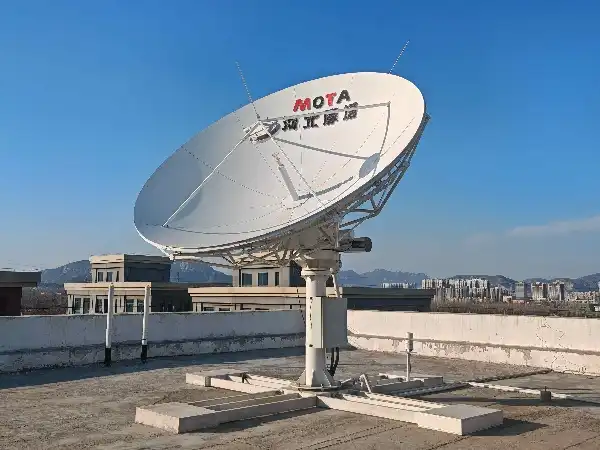
Understanding Ka-band Fixed Satellite Antennas
How the Ka-band Frequency Spectrum Works
The frequency range of the Ka-band is wider than that of the Ku-band (12–18 GHz) or the C-band (4–8 GHz). That higher frequency directly means more available bandwidth, which is very helpful when your network has to handle terabits of data every day. But shorter wavelengths (about 1 cm) also need more accurate surface measurements. Small changes in reflectors can have a big effect on gain. That's why, on high-quality installations, surface RMS error is usually kept below 0.3 mm.
Key Technical Parameters to Evaluate
When testing a Ka-band ground station antenna, these factors show how well it works in real life:
- Aperture size: MOTA's range goes from 2.4 m to 13 m and includes everything from high-capacity teleport hubs to remote corporate ports. More gain and better link margins come from apertures that are bigger.
- Transceiver isolation ≥88 dB: Keeps send and receive signals well apart, keeping the link's stability safe in areas with a lot of radio waves.
- First sidelobe level ≤-16 dB: This level keeps interference from neighboring satellites to a minimum, which is required by ITU-R S.580 rules [3].
- G/T (Gain-to-Noise Temperature): A measure of how well the system gets a useful signal, which has a direct effect on throughput in real-world propagation conditions.
Before committing to a rollout, CTOs and RF engineers can make more accurate link budgets when they know these specs.
Key Applications of Ka-band Fixed Satellite Antennas in B2B Industries
Ka-band fixed satellite antennas are used in places where link reliability, high throughput, and low latency are essential. As more HTS satellites are added in North America, the Middle East, and other places, their application reach is growing very quickly.
Enterprise Gateway Earth Stations and ISP Networks
Fixed Ka-band terminals are where all the user data comes together, and regional ISPs and phone companies depend on them. Every day, a single gateway antenna can handle terabits of throughput, giving bandwidth to tens of thousands of users further down the line. If satellite broadband providers want to increase their HTS bandwidth, this design cuts the cost per megabit immediately, which is what makes them money.
Remote Critical Infrastructure and IoT Backhaul
Offshore energy installations, oil and gas platforms, and mining operations often work in areas that terrestrial fiber can't reach. With a fixed antenna, you can get the fast backhaul you need for monitoring sensors in real time, integrating SCADA, and HD video surveillance. MOTA's antenna can keep sending 4K video even when there is 7-level wind. This is very important on offshore sites that are open to the weather, where the weather is always a factor in operations.
Government, Defense, and Emergency Response
For classified data applications, secure, dedicated links are better than Ku-band infrastructure. Rapid link establishment is mission-critical during disaster reaction activities. MOTA's system can fully align satellites in three minutes, which lets emergency response teams set up reliable 4K video feeds at any deployment site without having to send technical experts there.
Ka-band vs. Ku-band Fixed Satellite Antennas: Which One Suits Your Business?
Choosing between Ka-band and Ku-band isn't just a matter of taste when it comes to frequency; it also affects your total costs, the maximum amount of data you can send, and how hard it is to set up. Ka-band fixed satellite antennas have a much wider bandwidth and better spectral efficiency thanks to tighter frequency reuse, which makes them the best choice for HTS architectures. Ku-band, which has longer wavelengths, is better at resisting natural rain fade, but its capacity ceilings are much lower.
Most people who look at Ka-band systems worry about rain fade. Adaptive Coding and Modulation (ACM) and Uplink Power Control (UPC), which change signal settings on the fly during rain events, are the practical solutions. Systems that don't have ACM will lose performance when it rains a lot, but systems that do have it will keep providing service. Buyers who do business in tropical or seaside areas must make sure that the modem standard includes ACM support.
Total cost of ownership is lower for Ka-band antennas than for Ku-band antennas because they have smaller aperture sizes for the same gain. This means they are easier to install and cost less for civil works. For businesses that want to buy in bulk across multiple sites, this aperture efficiency adds up to big savings.
How to Choose and Procure the Best Ka-band Fixed Satellite Antenna
In this type of procurement, decisions are evaluated over a period of 3 to 9 months. During this time, the link budget is usually looked over, prototype integration testing is done, a small-scale pilot deployment happens, and then the full rollout happens. Any step that is rushed adds structural risk.
Here are the main factors that skilled network planners use to judge proposals:
- HTS platform compatibility: Make sure the BUC/LNB power ratings and feed geometry meet the needs of the satellite operator you want to work with. If two parts don't work together, the link budget will fail, no matter how good the radio is.
- Modem interoperability: The receiver must work well with iDirect, Hughes, Comtech, and other similar systems. With plug-and-play integration, there is no need for expensive custom engineering at each site.
- Regulatory certification: FCC and CE certification are required for deployments in the US and Europe. MOTA has the right safety certifications and can customize ODM/OEM products to fit the rules in each area.
- Environmental rating: IP65 protection and a temperature range of -25°C to +55°C are necessary for outdoor installations that will be used in a variety of climates. This is directly dealt with by MOTA's military-grade design standard.
These factors can help you cut down the list of potential suppliers and lower the risk of integration during pilot testing. Check the manufacturer's production capacity as well as their specs. For example, MOTA keeps standard setups in stock and has a 45–90 day production cycle for custom or large-scale system orders. They also have a customer response system that works 24 hours a day, seven days a week.
Installation, Troubleshooting, and Maintenance Essentials
Site Selection and Alignment Best Practices
Your long-term link speed cap depends on where you put your antenna. There must be a clear line of sight to the target orbital slot, very little local RF interference, and structural supports that can handle the antenna's wind survival load (MOTA systems are rated for winds well above 7-level working conditions). These are the minimum requirements. With MOTA's two-axis self-stabilizing platform and proprietary pointing algorithm, alignment time is cut down to 3 minutes, so one technician can finish site commissioning by themselves.
Ongoing Maintenance and Firmware Management
A carefully placed Ka-band fixed satellite antenna can work for 15 to 20 years [6] as long as the surface is properly treated to prevent corrosion and is checked for mechanical problems on a regular basis. The reflector surface should be inspected once a year, the VSWR of the feed chain should be checked, the tracking system should be calibrated, and the modem firmware should be updated. MOTA offers remote technical support 24 hours a day, seven days a week for system upgrades and troubleshooting. Localized on-site service is also available through cooperative channels around the world.
Conclusion
A Ka-band fixed satellite antenna is no longer a niche piece of infrastructure; it is now the most important thing for any satellite broadband provider looking to increase HTS capacity. The range of uses is wide, from business ISP ports to overseas backhaul and government secure networks. The performance gains over older bands are significant. It is clear what the important factors are for buying something: aperture choice, modem compatibility, ACM capability, and environmental scores. Companies that make these parameters fit their specific operations will get the most out of their satellite bandwidth investments.
FAQ
1. How does a Ka-band satellite antenna handle rain fade?
Adaptive Coding and Modulation (ACM) and Uplink Power Control (UPC) are both used in high-quality Ka-band fixed satellite antennas. These technologies change the signal code and send power on the fly when it rains, so the link doesn't drop completely but keeps working.
2. What aperture size do I need for my application?
MOTA has openings that range from 2.4 m to 13 m. For business remote sites and ISP edge nodes, smaller apertures (2.4–4.5 m) work best. For high-capacity teleport gateways, bigger apertures (7.3 m–13 m) work best. The right choice will depend on your link budget, the goal satellite EIRP, and the volume you need.
3. How long does installation take?
After being physically mounted, MOTA's system aligns all of the satellites perfectly in 3 minutes. Depending on the conditions of the site, the whole installation process, which includes the foundation, wiring, and commissioning, usually takes between one and three days.
4. What is the operational lifespan?
With professional installation, treatment against corrosion, and yearly mechanical maintenance, these systems should work well for 15 to 20 years.
5. Does it support both GEO and LEO satellites?
The default setting is for GEO function. For LEO compatibility, you need tracking motors that can go faster and the right feed systems. Contact MOTA directly to find out what configuration options are available for your target constellation.
Elevate Your HTS Network With MOTA Ka-band Fixed Satellite Antenna
MOTA offers tried-and-true Ka-band fixed satellite antenna options that are made to meet the needs of satellite broadband companies around the world. We've been making things for nine years, have ISO9001/14001/45001 certifications, and are in line with FCC and CE rules. We can help you with every step of the buying process, from helping you make a link budget to delivering in bulk. To get prices and details for your deployment, email our tech team at hebei_mota@163.com or visit motasat.com to request specifications and pricing for your deployment.

References
1. European Space Agency. (2023). High Throughput Satellites: Technology and Market Overview. ESA Publications.
2. ITU Radiocommunication Bureau. (2022). ITU-R S.580: Radiation Diagrams for Use as Design Objectives for Antennas of Earth Stations Operating with Geostationary Satellites. International Telecommunication Union.
3. Intelsat. (2023). Ka-band HTS Network Architecture and Ground Segment Requirements. Intelsat Technical Briefs.
4. NSR (Northern Sky Research). (2024). High Throughput Satellite Markets, 14th Edition. NSR Research Reports.
5. SIA (Satellite Industry Association). (2023). State of the Satellite Industry Report 2023. Satellite Industry Association.
6. IEEE Transactions on Antennas and Propagation. (2022). Longevity and Environmental Reliability of Fixed Satellite Ground Station Antennas. IEEE Xplore.
Tell us your requirements – get a tailored quote and technical support within 24 hours.