- English
- French
- German
- Portuguese
- Spanish
- Russian
- Japanese
- Korean
- Arabic
- Greek
- German
- Turkish
- Italian
- Danish
- Romanian
- Indonesian
- Czech
- Afrikaans
- Swedish
- Polish
- Basque
- Catalan
- Esperanto
- Hindi
- Lao
- Albanian
- Amharic
- Armenian
- Azerbaijani
- Belarusian
- Bengali
- Bosnian
- Bulgarian
- Cebuano
- Chichewa
- Corsican
- Croatian
- Dutch
- Estonian
- Filipino
- Finnish
- Frisian
- Galician
- Georgian
- Gujarati
- Haitian
- Hausa
- Hawaiian
- Hebrew
- Hmong
- Hungarian
- Icelandic
- Igbo
- Javanese
- Kannada
- Kazakh
- Khmer
- Kurdish
- Kyrgyz
- Latin
- Latvian
- Lithuanian
- Luxembou..
- Macedonian
- Malagasy
- Malay
- Malayalam
- Maltese
- Maori
- Marathi
- Mongolian
- Burmese
- Nepali
- Norwegian
- Pashto
- Persian
- Punjabi
- Serbian
- Sesotho
- Sinhala
- Slovak
- Slovenian
- Somali
- Samoan
- Scots Gaelic
- Shona
- Sindhi
- Sundanese
- Swahili
- Tajik
- Tamil
- Telugu
- Thai
- Ukrainian
- Urdu
- Uzbek
- Vietnamese
- Welsh
- Xhosa
- Yiddish
- Yoruba
- Zulu
What is a low-power industrial fixed satellite antenna?
A low-power industrial fixed satellite antenna is a permanently mounted satellite terminal that sends and receives data on very little electricity. Engineers install it at pipeline valves, substations, and weather stations, where grid power is missing and solar panels carry the load. Our model works in Ku-band and draws no more than 3W on standby and 12W in operation. That figure cuts power use by over 50% compared with conventional industrial terminals. In this article, I explain how the technology works, how it compares with high-power options, and how to install, certify, and select it.
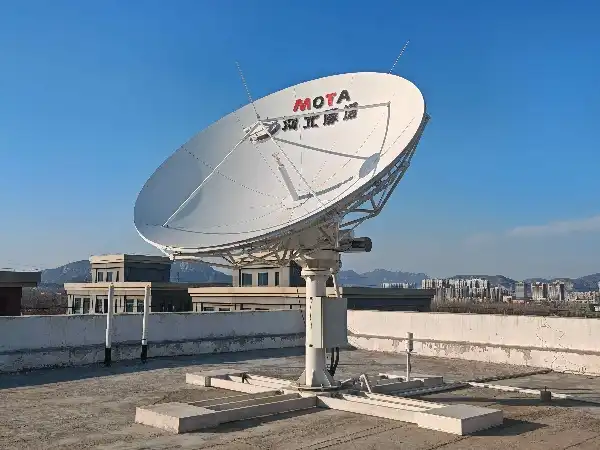
Understanding Low-Power Industrial Fixed Satellite Antennas
How a Low-Power Terminal Works
A fixed satellite terminal points its dish at one geostationary satellite and stays on that spot once aligned. The reflector gathers the downlink signal, the low-noise block converter (LNB) amplifies it, and the modem turns it into data for your monitoring equipment. The same chain sends your readings back up. The phrase "low power" describes electrical draw, not signal quality.
Our terminal integrates an industrial LNB module, a high-speed modem, and an energy-saving power module. Intelligent power management sleeps the unit when traffic drops and wakes it when data returns, so a modest solar array and battery bank can keep it online overnight.
Frequency Bands: L, Ku, and Ka
Satellite links use more than one band. From 1 to 2 GHz, IEEE Std 521 says that L-band is, and 12 to 18 GHz, Ku-band is. L-band works well in the rain, but it can't carry as much data. When it comes to throughput, Ku-band is better than C-band from a smaller dish, but heavy rain can weaken it. When it rains, Ka-band is more affected because it is higher up. Ku-band works well for our antenna and can send SCADA data and 1080p video from a pipeline station. Before you choose a dish size, I suggest that you match the band to the amount of rain in your area and the amount of data you need.
Where These Antennas Are Used
The main users are remote assets that don't have access to the power grid or cell service. The terminal sends information to the control center about pressure, flow rate, and leak detection on oil and gas pipelines that go through deserts or the tundra. It’s used as backup at mountain substations to help balance the load, find faults, and set up automatic switches when fiber is too expensive.
It's used by meteorological and hydrological stations to send information about the air, water levels, and rainfall. The link stays up even when bad weather damages ground towers. The link at each distant station is important, as shown in NIST Special Publication 800-82, which is about SCADA systems that connect sites that are in different places.
Comparing Low-Power and High-Power Industrial Fixed Satellite Antennas
Energy Use and Power System Cost
Power draw decides how big everything behind it is. Our low-power industrial fixed satellite antenna helps cut energy consumption for remote deployments. At its 12W operating limit, the terminal can only use 288 Wh per day if it sends all the time (12W x 24 hours). When set to 3W reserve, the daily amount drops to 72 Wh.
Sleep and wake cycles put the real amount of energy used somewhere between those two numbers. An industrial terminal that uses more than 50% of the power that our design does can be used instead of adding panels and batteries. The cost of the array, the battery bank, and the wiring at each remote site goes up when the terminals draw more power.
Performance Trade-Offs
A high-power connector has a bigger broadcast amplifier, which helps when there are a lot of uplinks or when it rains a lot. Most users would rather use a low-power device for monitoring, SCADA polling, and single-station video than send large files. Ku-band is more affected by rain than L-band, so opening is important since a bigger dish increases gain and link cushion. There are 13m, 11m, 9m, 7.3m, 6.2m, 5.4m, 4.5m, 3.3m, and 2.4m in our line. The unit can handle stable 1080p video and industrial data in 7-level wind, even though it has a low draw. It has a noise figure of ≒1.0dB and radio isolation of ≥85dB.
Durability and Total Cost of Ownership
The total price includes the terminal, solar and battery hardware, installation, site visits, and any spare parts that might be needed. Our antenna has an IP67 grade, which according to IEC 60529 means it is dust-proof and can withstand short-term soaking. From -30°C to +60°C, it works, and it can handle water, dust, rust, and impact. Every site visit that isn't made saves time and money on travel. We keep a lot of stock on hand for regular sales, and it takes 45 to 90 days to make special or large-scale systems. The hardware is covered by an international standard full-unit warranty, and there are different payment plans to choose from.
Installation and Maintenance Guide for Low-Power Industrial Fixed Satellite Antennas
Site Assessment and Mounting
). For the dish to work, it needs to be able to see straight down toward the south, away from any trees, buildings, or other obstacles. This is because geostationary satellites are in the southern sky over the United States. Wind will push on any size dish, so make sure the base is level and stable. A 2.4-meter dish and a 13-meter dish need very different mounts. Connect to the ground and protect against surges. Then, compare the size of your solar panel and battery to the 3W and 12W limits. This will make sure that the power system and plug are compatible.
Alignment and Commissioning Steps
Here is the sequence I suggest for each site, from the office to the final test:
- Confirm the service details first. Get the satellite longitude, polarization, and carrier settings from your capacity provider, then calculate azimuth and elevation from the exact site coordinates. Correct data before you leave the office prevents repeat trips to stations that sit hours from the nearest town. Print the values and keep them with the site record.
- Align the dish. Our terminal completes satellite alignment in 3 minutes, so a technician can finish peaking in one short visit. Watch the signal meter, lock onto the target satellite, and tighten the mount only after the reading stays steady. Record the final value and a photo for later comparison and audits.
- Test the whole link before you leave. Connect the terminal to your RTU or SCADA gateway, send test data, and confirm the sleep and wake cycle works as planned. Check that the power draw stays within the 3W standby and 12W operating limits on a meter, since solar sizing depends on those numbers.
These three steps address common commissioning mistakes and give your maintenance team a baseline for later checks.
Routine Maintenance and Troubleshooting
Plan to do a visual check every season and after big storms for your low-power industrial fixed satellite antenna. Check the dish surface, grounding, mount bolts, and cable glands for damage or debris. The current signal reading should be compared to the number you wrote down when the system was first set up. A drop means that something isn't lined up right, there is water in a connector, or there is an obstacle, like new tree growth.
Our team offers remote expert help 24 hours a day, seven days a week for system updates, installation, and troubleshooting. Because we work together, we can also set up on-site expert support and quick delivery of extra parts, which is important when your stations are far from cities.
Regulations, Certifications, and Compliance
Frequency Rules and Licensing in the United States
Title 47, Part 25 of the Code of Federal Regulations tells the Federal Communications Commission what to do with satellite earth stations in the United States. The ITU Radio Regulations decide how to divide up the international radio bands. Each country then follows these rules. Getting a license depends on how the network is set up.
Some companies have a network license that covers all of their terminals, but other projects need permission that is special to the spot. You should ask your satellite capacity provider early on which route works because it changes the schedule for the project. Our team helps with coordination and documentation, and we make sure that hardware and certifications follow the rules of each market we're going after.
Supplier Certifications and Quality Systems
Credentials for suppliers show how a plant runs its business. MOTA has been making things for nine years and is certified in ISO9001 (quality management), ISO14001 (environmental management), and ISO45001 (health and safety at work). We are also authorized to use radio transmission equipment in the United States.
Our goods are based on satellite communication antennas, high-precision tracking algorithms, and satellite-terrestrial combined communication technology that we created ourselves. These are protected by several intellectual property rights. Ask each supplier for copies of their certificates and test reports, and then compare them to the requirements for your project. When getting the IP67 rating, ask what test method was used to make the report.
OEM Versus Branded Products and Risk Control
Sometimes, a branded product has set technology and a fixed list of people who can approve it. You can change the design to fit your project if you have an OEM or ODM deal. We make sure that the hardware design, interface protocols, useful modules, software interfaces, and certifications are all in line with the rules and needs of each country.
We also take care of the whole process, from designing the plan for our low-power industrial fixed satellite antenna to mass production. No matter what you do, before you sign, ask for a written list of approvals, a warranty statement, and a test report. When going through customs, these papers lower the risk and show that your team is following the rules during audits.
How to Choose the Best Low-Power Industrial Fixed Satellite Antenna
Match the Specifications to Your Site
The numbers that tell you if the terminal works with your power system are: standby ≤3W, operating ≤12W, and ability to adapt to changes in voltage. Next, check the environment: it should be able to work in temperatures between -30°C and +60°C, have IP67 protection, and not rust or break easily. Then check the radio's performance. In order to reduce interference and receive sensitivity, a noise figure of ≤1.0dB and transceiver separation of ≥85dB are needed. In the end, choose the angle. All nine of our sizes, from 2.4m to 13m, let you find the right balance between link margin and mounting cost at each station.
A Practical Selection Checklist
Use this checklist when you compare quotations from several vendors:
- Power and solar budget. Multiply the 12W operating and 3W standby limits by your duty cycle to estimate daily energy, then size the panel and battery with margin for winter sun. Our auto sleep and wake function lowers the average draw, and voltage fluctuation adaptation helps the terminal keep running when the supply sags.
- Environment and link margin. Check your coldest and hottest site temperatures against the -30℃ to +60℃ range, and confirm IP67 protection covers dust, water, corrosion, and impact at your location. Pick the aperture, from motasat.com to 13m, that gives enough link margin for local rain and wind. Ask your supplier for a link budget calculation for each site.
- Integration and service. Confirm how the terminal connects to your RTU, sensors, and SCADA gateway, and run that test at a pilot site. Ask about spare parts delivery time to your region, remote troubleshooting hours, and the warranty period, since these decide how quickly a failed unit returns to service. Write the answers into the contract.
Answering these three points before purchase keeps the power system, the site conditions, and the service plan aligned.
From Pilot Site to Rolling Deployment
For pipeline and utility projects, the usual order is to start with a pilot site, then have an operating review, sign an annual supply agreement, and finally start rolling out along the route. We support this road by having stock ready for regular orders, making custom and large-scale systems in 45–90 days, and making sure there is a steady capacity for mass shipping.
Cross-border transportation is what our team does. They work with foreign dedicated lines, air freight, and sea freight. Precision equipment is shipped in packaging that is resistant to shock and moisture. It can also be tracked from start to finish and stored overseas. We also have reasonable prices and easy payment options for long-term business relationships.
Conclusion
A low-power industrial fixed satellite antenna lets monitoring sites far away have a steady satellite link without having to build a big solar and battery system. This article demonstrated that conventional industrial terminals use more than half as much energy as Ku-band terminals, which use only 3W when not in use and 12W when they are. Sleep and wake control further reduced energy use by more than 50%.
The low-power design works better for monitoring, SCADA, and video than high-power units, and the choice of aperture saves the link margin. IP67 protection and a wide temperature range make it good for sites where no one is around, and 3-minute alignment speeds up installation. FCC and ITU rules, supplier certifications, and OEM paperwork all make compliance less risky. A good buy fits your power budget, surroundings, integration needs, and service support, and it's best to make the purchase after a pilot.
FAQ
How much power does the terminal draw?
The draw when it's not in use is 12W and when it is, it's 3W. These limits would use 72 Wh and 288 Wh per day if they were run all the time, so you can use these numbers to figure out the size of your solar panels and batteries.
Does it work in cold, wet, or dusty locations?
Yes. The terminal is rated IP67 and can work in temperatures from -30°F to +60°F. It is protected from water, dust, corrosion, and impact.
Can it work with my existing RTU and sensors?
All the parts of the unit are built in so it can be used right away. Since every site is different, I think you should test your layout and process on a small group of people. When needed, our ODM/OEM team can change software and communication standards.
What is the lead time for large orders?
We keep a lot of stock on hand for regular orders. It takes 45 to 90 days to make customized and large systems.
How fast can a crew align it?
It only takes three minutes to align the satellites, so regular operations staff can do the deployment without any special RF training.
Contact MOTA for a Low-Power Industrial Fixed Satellite Antenna Quote
With ISO9001, ISO14001, and ISO45001 certifications, as well as ODM/OEM customization, MOTA is a low-power industrial fixed satellite antenna manufacturer. Send a list of your sites, your power budget, and where you want the goods delivered to hebei_mota@163.com. Our team will get back to you with a setup and quote. We offer competitive prices and easy payment options, and our 7x24 response system helps us process orders quickly. For more information on this product, go to motasat.com.

References
1. IEEE Std 521-2019, IEEE Standard Letter Designations for Radar-Frequency Bands, 2019
2. IEC 60529, Degrees of Protection Provided by Enclosures (IP Code), 2013
3. NIST Special Publication 800-82 Revision 3, Guide to Operational Technology (OT) Security, 2023
4. ITU Radio Regulations, Edition of 2020
5. Electronic Code of Federal Regulations, Title 47, Part 25: Satellite Communications, 2024
6. Satellite Communications Systems: Systems, Techniques and Technology (6th edition), Wiley, 2020
Tell us your requirements – get a tailored quote and technical support within 24 hours.