- English
- French
- German
- Portuguese
- Spanish
- Russian
- Japanese
- Korean
- Arabic
- Greek
- German
- Turkish
- Italian
- Danish
- Romanian
- Indonesian
- Czech
- Afrikaans
- Swedish
- Polish
- Basque
- Catalan
- Esperanto
- Hindi
- Lao
- Albanian
- Amharic
- Armenian
- Azerbaijani
- Belarusian
- Bengali
- Bosnian
- Bulgarian
- Cebuano
- Chichewa
- Corsican
- Croatian
- Dutch
- Estonian
- Filipino
- Finnish
- Frisian
- Galician
- Georgian
- Gujarati
- Haitian
- Hausa
- Hawaiian
- Hebrew
- Hmong
- Hungarian
- Icelandic
- Igbo
- Javanese
- Kannada
- Kazakh
- Khmer
- Kurdish
- Kyrgyz
- Latin
- Latvian
- Lithuanian
- Luxembou..
- Macedonian
- Malagasy
- Malay
- Malayalam
- Maltese
- Maori
- Marathi
- Mongolian
- Burmese
- Nepali
- Norwegian
- Pashto
- Persian
- Punjabi
- Serbian
- Sesotho
- Sinhala
- Slovak
- Slovenian
- Somali
- Samoan
- Scots Gaelic
- Shona
- Sindhi
- Sundanese
- Swahili
- Tajik
- Tamil
- Telugu
- Thai
- Ukrainian
- Urdu
- Uzbek
- Vietnamese
- Welsh
- Xhosa
- Yiddish
- Yoruba
- Zulu
What is the difference between pointing accuracy and tracking accuracy?
Pointing accuracy describes how closely an antenna's main beam aims at a target satellite at a given moment. Tracking accuracy describes how well the antenna holds that aim as the satellite drifts or conditions change over time. In a high-precision fixed satellite antenna, pointing accuracy sets the starting alignment, and tracking accuracy keeps the link steady afterward. Both appear in degrees, yet they answer different questions: did the antenna aim correctly, and can it stay aimed? I wrote this guide to help research teams, TT&C engineers, and procurement managers specify both numbers clearly.
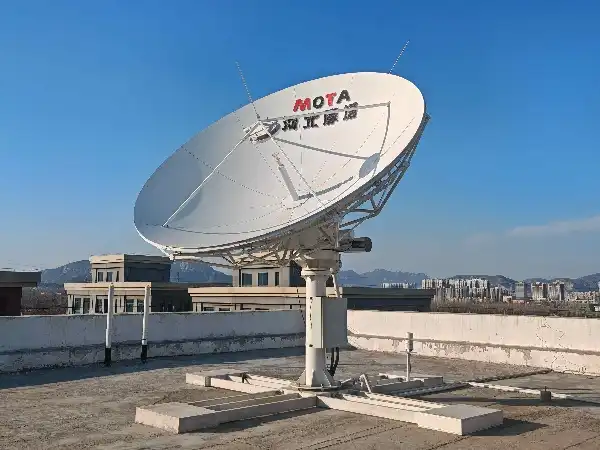
Understanding Pointing Accuracy and Tracking Accuracy
What Pointing Accuracy Measures
The antenna's boresight is how far away from the middle of its main beam and the real direction of the satellite it can point. People who work as engineers also call it a "pointing mistake." For both direction and elevation, most providers give it in degrees.
Beamwidth shows that it's important. A 70º/D dish working at 12 GHz usually has a half-power beamwidth of about 0.7°. This means that a 0.1° change costs about 0.2 dB. Beams get smaller as apertures get bigger, which means that the same offset costs more data. So, you need to choose the opening and pointing specs at the same time.
What Tracking Accuracy Measures
It measures how far off the beam is from the satellite as the antenna moves with the target. Suppliers will often give it to you as an RMS number over a test time.
You might not think a geostationary satellite is moving, but it is. People who work for the FCC have to keep it within 0.05° of the longitude they were given. Because the satellites are in tilted orbits, the sky looks like a figure eight. Weather, wind, and mount movement can also lead to mistakes. It's a picture how accurate your pointing is. Third, tracking accuracy shows how well the antenna keeps the link steady.
Three Differences at a Glance
Putting the two measures next to each other makes it easy to tell them apart. This is the most important difference to keep in mind when writing a proposal.
- Time range: It's only possible to point accurately once, usually right after setting up or moving to a new spot. It tells you how far the beam goes away from the satellite over a certain amount of time, like a day or a satellite pass. Write down how much time you need.
- Main spots where mistakes happen: The base, the encoder, the footing, the leveling, and the quality of the calibration are the main things that can go wrong with pointing. The speed of the control loop, wind load, heat movement, and sensor noise are some of the things that can go wrong with tracking. Figure out what's wrong faster if you know which source is the most important.
- Verification method: This is how teams make sure they are pointing correctly: they compare the angle they were given to the signal peak of a known satellite beacon. To be sure they are tracking right, they keep track of the signal level or angle shift over time and figure out the ROE. A good test report has both numbers for the same antenna.
That's why you can't just give an antenna a single number to show how well it works. Suppliers who only give quotes for exact amounts aren't telling you the whole story.
Technical Principles Behind Pointing and Tracking Accuracy
Mechanical Foundations of Pointing Accuracy
The first things that make aiming accurate are hardware like a level base, a stiff mount, low-backlash drives, and accurate angle sensors. The shape of the surface of the reflector is also important because flaws on the surface can change the beam. Then, tuning gets rid of the tiny differences that happen all the time between what was told to move and what actually happened.
Our high-precision fixed satellite antenna has an error in satellite alignment of ≤0.1°. It takes about 2 minutes to set up a link using a high-precision pointing program that we made ourselves. The structure and base must be stable so that the figure is safe for a long time after it is set up.
Signal Processing and Feedback Behind Tracking Accuracy
It's important to get feedback for tracking. The receiver is moved and the signal strength is checked as it goes. In order to find the angle error, monopulse tracking compares information from a number of feed parts. In order to figure out where they should point, tracking apps use circle data.
Each method has its own pros and cons. Keeping track of steps is simple, but it takes more time. The feed hardware needs to be more complicated for monopulse to work. Sensors like inclinometers and gyroscopes can figure out how the platform moves, and a control loop makes it happen. When that loop goes faster and smoother, there is less of a tracking error.
How the Two Systems Work Together
When you point, the starting point is set, and it stays there when you follow. This link will lose power if the first point is off by half a beamwidth. Wind gusts and thermal movement will slowly pull the beam off its peak if it points well but doesn't track well.
Our three-axis high-precision self-stabilizing platform fixes mistakes in alignment itself, so the flow of data never stops. Transceiver separation of ≥90 dB and a first sidelobe level of ≤-18 dB make it possible to block interference. If the antenna keeps its link, it cuts down on stray signals.
Comparing High-Precision Pointing and Tracking Accuracy: What Procurement Managers Should Know
Where Each Metric Matters by Sector
Each measure is important to different people in different ways. Researchers and TT&C sites that get data from satellites need to point very precisely because narrow beams don't leave much link cushion. It is important to keep an eye on both streaming and direct-to-home links so that messages stay clear for a long time.
Offshore oil rigs, mining camps, and other industry sites that are far away must be able to handle both wind and weather stress. When people work in defense and security, they set very strict limits on meddling. For the same kinds of needs, our high-precision fixed satellite antenna is used for precise measurements, high-end monitoring, and scientific research.
High-Precision Fixed Antennas Versus Lower-Precision and Mobile Systems
For starters, a small dish with a wide beam can handle pointing that is rougher. These antennas need sensors and wheels that can work quickly so they can keep up with the platform as it moves. The way they go wrong also changes all the time.
When it comes to fixed systems, they have to deal with narrow beams on big holes that don't let them change much. Our high-precision fixed satellite antenna line has nine holes that are between 2.4 m and 13 m in length. When the base doesn't move, engineers can work on building, calibrating, and making sure the machine is stable. The Ku/Ka/S/X/C/Qv bands can also be switched between by hand by study teams that need to do different things.
Cost, Return, and Downtime Considerations
More strict rules cost more when you buy something. The real question is how much it costs to lose a link. During a launch or test window, it's not always possible to run a missed contact at the same time. Link margin is lost if you don't point correctly. This could mean you need a bigger dish or more transmit power. Bad tracking leads to dropouts and multiple fix trips.
The building won't bend if it rains or snows, and IP66 will protect it. When people buy something, I tell them to think about all of its costs, such as the price, the time it takes to buy and set up, the cost of repairs, and the risk to test plans.
Installation, Maintenance, and Accuracy Preservation Methods
A Stepwise Approach to Precise Alignment
A carefully thought-out order keeps the point straight:
- Look around the spot to make sure the ground is stable and that you can see the satellite arc well.
- Make sure the base is level and put it down before you put the mirror on it.
- Figure out the satellite's longitude and the site's coordinates to get a general idea of the direction, height, and polarization.
- Fine-tune against a marker or carrier while keeping an eye on a spectrum analyzer or modem signal.
- To begin, write down the end orientations and signal levels.
Our built-in pointing and plug-and-play design makes this process go faster. Setting up a link can be done by one person in twenty minutes.
Calibration, Sensor Checks, and Weather Mitigation
Over time, it will become less accurate if no one checks it. Fix a time to calibrate the sensors against a known marker, and compare their readings to the standard that was set during setup. Look for rust or looseness on the feed, drives, wires, and bolts.
The wind moves the mirror. On the Beaufort scale, level 7 wind is between 50 and 61 km/h. Our high-precision fixed satellite antenna can still send and receive 4K video and data even when the wind is that strong. It is possible for rain and snow to weaken the Ku and Ka bands. As an extra safety step, teams that work in places with a lot of snow often use reflector heaters. The antenna works from -30°C to +55°C and is protected against water, dust, and rust with an IP66 rating.
Retrofit or Replace?
It might be accurate again after getting new encoders, a re-calibrated mount, an updated tracking driver, or making the antenna more stable. It takes less time and costs less to do these things than to replace everything.
They have limits. A cracked base, a worn-out motor, or a bent reflector can't be fixed with software. There is less space between the surfaces when going from the C-band to the Ka-band, so it makes more sense to do a new installation. When we work on special projects, we change how hardware is made, how it talks to other hardware, and how it talks to software. This includes coming up with a plan, making a prototype, and making a lot of them.
Choosing the Right Antenna: Accuracy Metrics and Supplier Guidance for B2B Buyers
Reading Accuracy Specifications Correctly
When you compare specs, it's only fair that the test conditions are the same. Find out if the number is a peak or RMS value, what axs it covers, what the temperature and wind limits are, and whether it applies to the whole system or just a part of it. Ask for different lines to make sure you can accurately point and track.
A scientific white paper, a test result from a third party, and records of the calibration are all things you should ask for. It's also a good idea to check the noise figure, transceiver isolation, and sidelobe levels against the ITU-R S.580-6 and FCC 25.209 envelopes.
Why MOTA Fits Research and Measurement Projects
Since 2009, Hebei Mota Electronics Technology Co., Ltd. (MOTA) has been making things and is certified in ISO9001, ISO14001, and ISO45001 management systems. There are a lot of intellectual property rights that protect our high-precision tracking systems and high-precision fixed satellite antenna.
The antenna has an LNB/BUC with high accuracy, a modem with high speed, and a signal processing module built in. To make core parts, they follow the GJB 9001C production standards for military-grade parts. We can also make interfaces, functional modules, and certifications that are in line with the rules in each country through ODM/OEM customization.
Ordering, Lead Times, and Support
That's why we keep enough in stock to fill customer orders. It can take 45 to 90 days to deliver a lot of customized, large-scale systems. A lot of research projects tie delivery to test or launch windows. That's why I think you should include your milestone dates when you ask for a price.
Precision equipment is shipped in boxes that can handle being dropped and getting wet. It can also be held outside of the United States and tracked from beginning to end. Our after-sales team is here to help with setup, bugs, and changes 24 hours a day, seven days a week. The full-unit guarantee is based on international norms, and there are different ways to pay.
Conclusion
Accuracy can be measured in two ways: by how well it tracks and how well it points. How well the beam is aimed at the satellite at all times is called its "pointing accuracy." What matters is how well the antenna stays aimed even when the satellite moves, the wind blows, and the temperature changes. To make a point, you need accuracy and mechanical stiffness. You need devices, feedback loops, and different tracking ways to keep track of something.
Both metrics are important for monitoring, research, broadcasting, and industries that are far away. Large-aperture fixed systems don't let for much error. The accuracy stays the same over time with proper installation, regular calibration, and protection from the weather. People who want to buy something should ask for different, well-defined numbers with test records for each one. Using the same test conditions, you can get a good idea of what a high-precision fixed satellite antenna is like by comparing its alignment error, noise figure, isolation, and sidelobe level.
FAQ
Can I improve pointing accuracy after installation?
Most of the time, yes. If you lose accuracy, you can get it back by recalibrating the mount, re-peaking the antenna on a satellite beacon, replacing worn encoders, and making sure the foundation is solid. If the mistake is caused by a gearbox that is worn out or a reflector that is bent, the hardware needs to be fixed or changed. Our team is here to help with tech problems and tuning questions 24 hours a day, 7 days a week.
How does weather affect tracking accuracy?
Weather changes and wind can make the mount and reflector move a little, which can make the beam lose its peak. It's not as strong for the Ku and Ka bands when it rains. Moving is stopped by a stable base, and gadgets with a high ingress rating are safe. As long as the wind speed is less than 7 miles per hour, our antenna can still send data.
How do fixed and mobile antennas differ in accuracy?
A fixed antenna only points in one direction, so even if there are small changes, the narrow beam stays in the same place. A cell phone antenna has to keep adjusting because the platform is moving. Fixed systems can handle bigger gaps and more accurate points because of this, while mobile systems give up some accuracy to be able to move around. Choose the type that works best for your site and your goals.
Specify Pointing and Tracking Accuracy with MOTA's High-Precision Fixed Satellite Antenna
MOTA is a high-precision fixed satellite antenna maker with nine years of production experience and ISO9001, ISO14001, and ISO45001 certifications in addition to ODM/OEM modification. Send your needs for band, aperture, aiming accuracy, and tracking accuracy to hebei_mota@163.com. Our team will get back to you with a quote and a delivery plan. You can find out more about their products and get help seven days a week at motasat.com.

References
1. Antenna Theory and Design (Stutzman and Thiele), 2012
2. Antenna Theory: Analysis and Design (Balanis), 2016
3. Satellite Communications Systems (Maral and Bousquet), 2020
4. Satellite Communications (Pratt, Bostian, and Allnutt), 2019
5. ITU-R Recommendation S.580-6: Radiation Diagrams for Use as Design Objectives for Antennas of Earth Stations Operating with Geostationary Satellites, 2004
6. Large Antennas of the Deep Space Network (Imbriale), 2003
Tell us your requirements – get a tailored quote and technical support within 24 hours.